
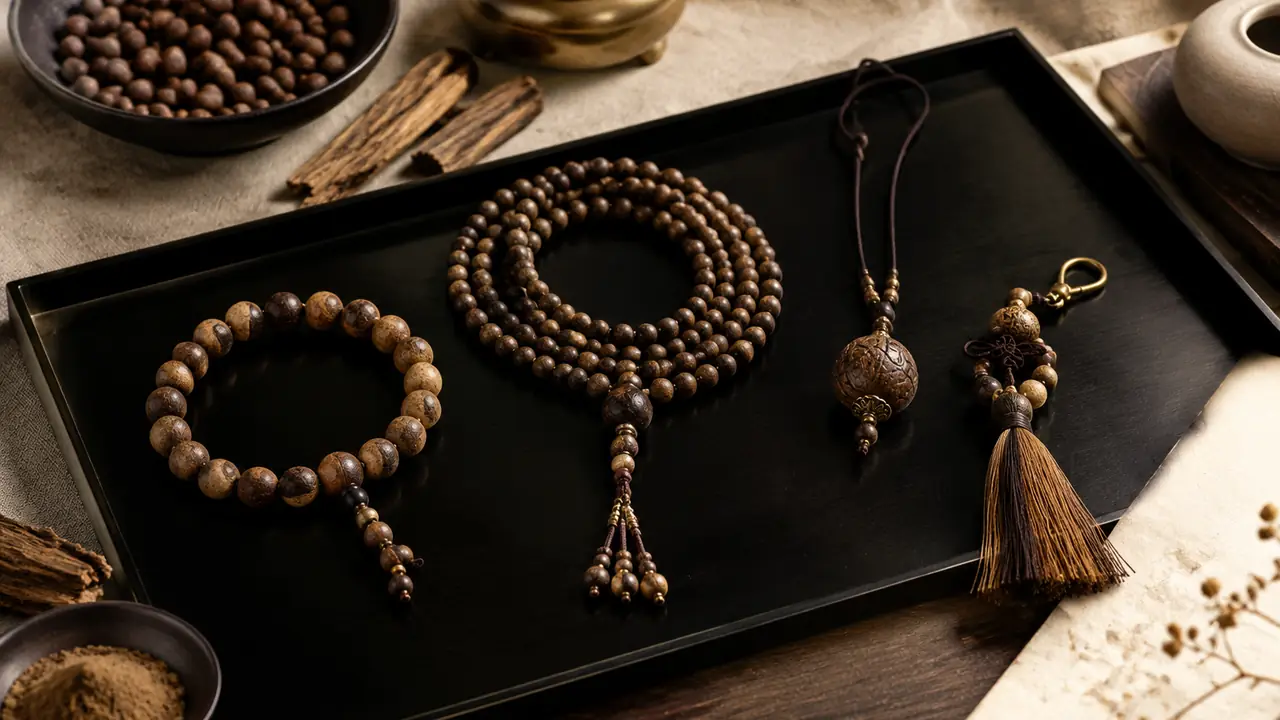
Sticks, pills and what separates them
An incense stick is a thin rod of aromatic powder bound with a plant binder, burned from the tip. Two types are common: bamboo-core sticks, where the powder coats a thin bamboo stick, and coreless sticks, where the stick is formed from the dough alone. A pill, sometimes called a blended incense pill, is a small pellet made from the same kind of dough as incense beads, shaped for burning on charcoal, a heating element or a burner. A longer comparison is in incense sticks vs incense pills.
The binder is the connecting thread. Nanmu bark powder holds sticks together as well as beads, and Yongchun in Fujian, whose Dapu town received the title of China's incense capital in 2014, is the center of bamboo-core stick making. The history of that cluster is in Yongchun incense heritage.
Format comparison
| Format | How it burns | Gift box fit |
|---|---|---|
| Bamboo-core stick | Lit at the tip, burns down the stick, smoke from wood and bamboo | Long, flat boxes; widely understood format |
| Coreless stick | Lit at the tip, scent mostly from the aromatic powder itself | Premium boxes, cleaner scent, higher cost |
| Blended incense pill | Heated or burned in a burner, small and compact | Tins, jars, small boxes; can be cellared |
| Mixed set | Sticks plus pills plus holder | Premium gift boxes and sleeves |
Pills have one advantage in a gift range: they can be aged in a sealed jar, so the scent matures after production, and a brand can sell the pill as a product that improves with careful keeping. Say it softly: the scent develops, which many users find pleasing, and no fixed time should be promised.
Holders, burners and tools
A box of sticks without a holder is an incomplete gift. The usual accessories are a stick holder or incense plate, a small burner for pills, tongs and a spoon for handling ash and pellets. Materials include ceramic, brass, wood and stone. Holders need to be sized to the stick and stable on a table; burners need a safe, heat-resistant base. Accessories raise cost and weight, and they are breakable, so packing and freight need extra care. The accessories are covered in incense goods and tools.
Fire safety is part of the product. State on the box that incense should be burned on a stable, heat-resistant holder, away from curtains, paper and children, and never left unattended. This is a safety line, not a health claim, and it should be on every pack.
Box formats and fill
- Slim sleeve box. Sticks lie flat in a paper tray; common for single-scent sets.
- Tube or cylinder. Easy to display and ship; suits a single scent.
- Tin or jar. For pills; seals well and protects from humidity.
- Rigid gift box with insert. Holds sticks, a small jar of pills and a holder; the premium format.
Fill is set by count or by weight, and it should be stated on the pack. Sticks are counted in bundles; pills are counted or weighed. Agree the fill on the sample sheet, since a box that looks full at assembly can settle in transit and appear half empty.
Storage and shipping
Sticks and pills are dry, light goods that absorb moisture from the air. Damp sticks burn poorly and can mold, and the scent flattens in a humid environment. Pack in sealed inner bags, add a desiccant and use lined cartons for sea freight. Keep away from heat and direct sun. Pills benefit from a sealed jar. For logistics, small lots go by courier in 3-7 days, air takes 5-10 days, and sea freight reaches the US west coast in 15-25 days and Europe in 30-45. Note that HS code 3307.41 is used for agarbatti and other odoriferous preparations, but the final code is confirmed with the customs broker.
Building a range around the box
Most programs do not start with a mixed gift set. They begin with one stick format in one scent family, add a pill jar once the stick sells, and bring in a holder or burner as a third step. This order keeps the first minimum low and lets the brand learn how its customers use the product before it commits to accessories, which are breakable and harder to ship.
- Pick one scent family, usually sandalwood or a sandalwood-agarwood blend, and one stick type.
- Choose the box format and fill count; approve a sample box before print.
- Add a pill jar in the same scent, so the family reads as a set.
- Add a holder or burner from a ceramic or metal partner; test stability and heat safety.
- Add a rigid gift box that combines the above for seasonal programs.
Pairing a burning line with wearable beads is natural for brands that sell scent as a lifestyle: the same sandalwood can appear as a bracelet, a stick and a pill, and customers who buy one are likely to try another. If you plan that crossover, keep the scent description identical across the formats, and make sure the safety and care wording on each pack is specific to that format. A bead pack says keep dry and away from heat; a stick pack says burn on a heat-resistant holder under supervision.
Finally, remember that the two product types are regulated and declared differently in some markets. Burning incense may be subject to rules on smoke, fragrance allergen labeling and product safety that wearable beads are not; confirm the requirements for your target market before print, and ask the desk for the ingredient list and test reports you will need.
Scent and ingredient declaration
For burning products, the ingredient declaration matters more than for beads, because the smoke is part of the experience. The standard specification relies on aromatic wood powders, herbs and nanmu bark binder, with no synthetic fragrance oil and no industrial glue in the standard version, confirmed in writing. Bamboo-core sticks contain bamboo, which should be listed. For agarwood components, CITES documents travel with the lot. Avoid any health wording about smoke, and describe scent in sensory terms only.
Ordering
Gift boxes of sticks and pills typically start at around 200-500 boxes per design, as a reference range confirmed in writing per program, with standard sample times of 5-10 working days for stock items and longer for custom blends. Printed boxes extend the window because of artwork approval and print time, so settle those first. Specify the format, count, scent, accessories and quantity in the quote form, and read the full ranges on MOQ and lead time. Box options are on packaging and gift boxes.