
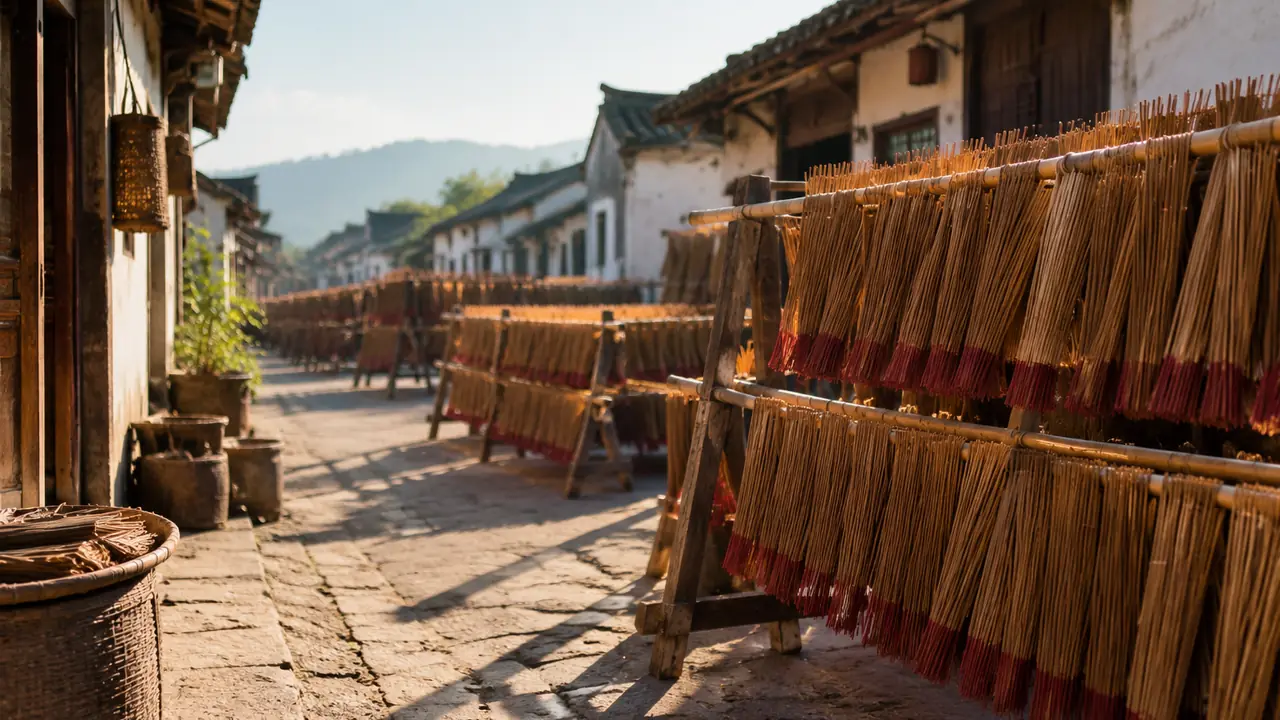
Why clusters matter for incense beads
An incense bead is the product of several small crafts: a fragrant raw material, a milling step, a binder, hand rolling, careful drying and finishing. In China those crafts are not spread evenly. They gather in a handful of towns where suppliers, tools, skilled hands and local know-how sit within a short drive of each other. Ouvare is a sourcing desk, not a single plant, so the useful question for a buyer is which cluster is the right place to look for a given line. The desk coordinates partner workshops in the Fujian and Guangdong incense clusters and uses the regions below as a map when shortlisting.
All figures on this page are published by local authorities or the press and are quoted as reported, with the source named. They describe the clusters, not any individual partner workshop.
Yongchun, Fujian: the incense town
Yongchun county in Quanzhou is the best-known incense-making base in China. Dapu town received the title of national incense capital in 2014 and is counted among the country's four major incense-making bases. According to People's Daily Overseas Edition (January 2024) and Fujian Daily and People's Daily Fujian reports (2025), the county has close to 300 incense companies, and the incense chain was reported at above RMB 14 billion in output value in 2024. Yongchun bamboo-core incense received national geographical indication protection in 2006, and Fujian incense-making techniques, known as Yongchun incense, were added to the national intangible cultural heritage list in 2021.
For bead buyers, Yongchun matters for powder milling, blending know-how, incense sticks and pills, and the habit of aging incense in jars. One honest caveat from the same reports: many raw materials are imported, for example from Vietnam and Malaysia, so the town is strongest in processing and craft rather than in growing.
Xianyou Bangtou, Fujian: the bead trade
Bangtou town in Xianyou county, Putian, is the core base for wooden prayer beads and bracelets. Official figures reported by Sina Finance (November 2019) put the share of small-leaf rosewood, yellow rosewood, bodhi and similar bead bracelets made here at more than 80% of the national total, with more than 1,400 craft enterprises and over 50,000 people employed, at roughly RMB 3 billion a year in output at that time. This is a claim of the local authorities, so read the share as indicative.
What Bangtou gives an incense bead program is the discipline of a bead trade: consistent diameters, drilling, stringing, findings, silver and copper spacers, and packing for retail. These skills matter most for the silver sets and the 108-bead strands, where hole size and count have to match every time.
Dianbai, Guangdong, and Hainan: agarwood and bodhi
Dianbai in Maoming is known as the hometown of agarwood. Reports from Yangcheng Evening News and Southern Plus in late 2024 describe an industry chain reported at roughly RMB 4-7 billion depending on scope, with about 7,000 enterprises including cooperatives and individual operators. In September 2024 Dianbai obtained its first export licence for agarwood raw material. Hainan has a large cultivated agarwood area, reported at more than 149,000 mu, and Wenchang in Hainan is the main source of star-moon bodhi seeds, reported at more than 80% of the national output.
These regions supply the Aquilaria material behind the agarwood bracelet and goose pear lines. Agarwood is listed under CITES Appendix II, so export paperwork follows every lot; see compliance and certifications.
Cluster overview
| Cluster | Speciality | Typical lines drawing on it |
|---|---|---|
| Yongchun, Fujian | Incense making, powder blending, sticks and pills | Incense stick and pill gift boxes, custom blended incense, standard bead formulas |
| Xianyou Bangtou, Fujian | Wooden bead bracelets, stringing, findings | Silver sets, 108-bead strands, loose beads, bracelet finishing |
| Dianbai, Guangdong | Cultivated agarwood, chips and powder | Agarwood bracelets, goose pear beads |
| Hainan and Wenchang | Agarwood plantations, bodhi seed beads | Agarwood powder supply, bodhi accent beads and charms |
How the desk uses the map
A single order often crosses clusters: agarwood powder from Guangdong, binder and blending in Fujian, stringing and findings in Putian, packing near the shipping point. The desk shortlists partner workshops against the checklist on how workshops are screened, runs the steps described in the production process, and confirms the route in writing. Workshops are not named on this site; names, certificates and the exact route are shared with buyers per project. For ranges and timing, read MOQ and lead time, then describe your program through the quote form.