
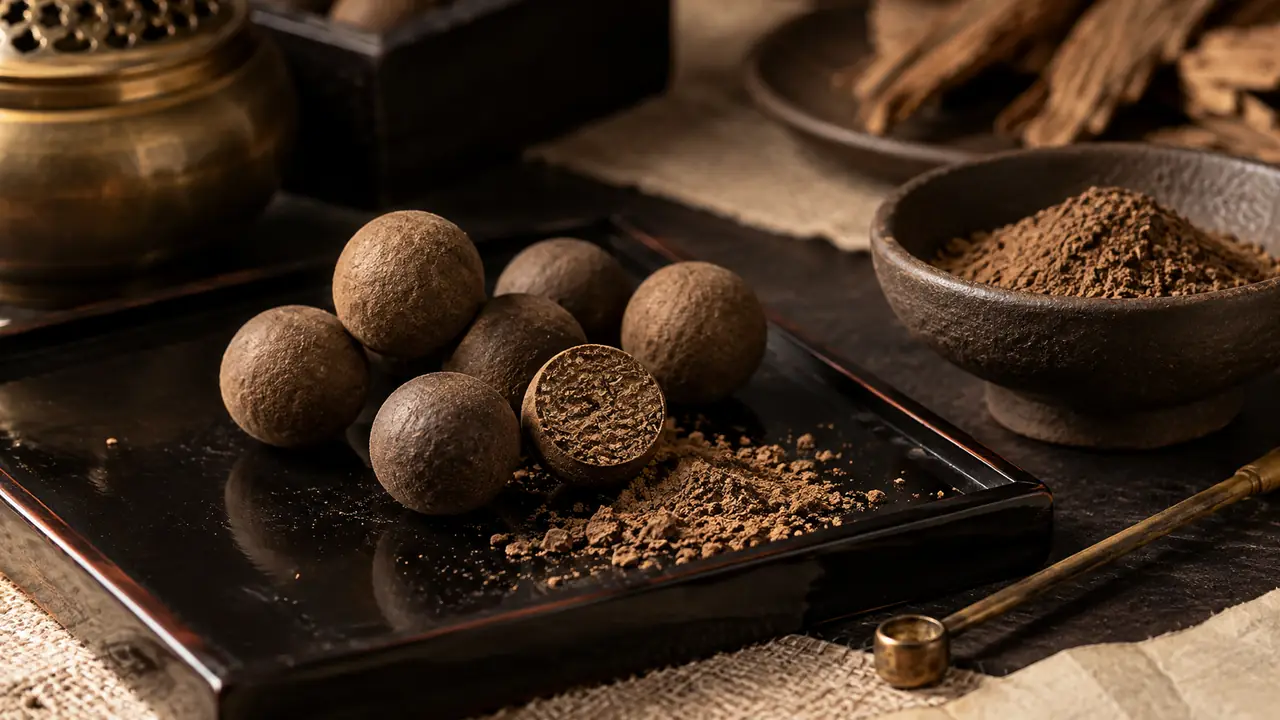
Definition
A blended incense bead is a bead made from a compound incense: a mixture of two or more aromatic powders, bound with a plant binder and a little honey, rolled by hand, pierced, dried and aged. In Chinese the craft is called hexiang, literally combining incense, and the product hexiang zhu. The word blended matters. A bead made only from one wood is a single-material bead; a hexiang bead is built like a perfume, with a main body, supporting notes and a fixative. It is worn, not burned, so the scent comes from body warmth, friction and the slow movement of volatile compounds through the bead.
The hexiang tradition
Compound incense has a long written history in China. Formula collections from the Song and Ming periods, such as the Chen Shi Xiang Pu and the Xiang Sheng, list formulas that combine woods, resins, herbs and sometimes fruit, with quantities in liang and qian. Most of these were meant for burning, but the logic of balancing ingredients carried over to pressed and rolled forms, including pills and beads. Today the technique is kept alive by workshops in the Fujian and Guangdong incense clusters and by heritage practitioners. The historical texts are covered on ancient incense formulas.
The structure of a formula
A well-built formula has roles rather than a random list. Reading a sheet is easier once the roles are clear.
- Base. The main wood powder that sets the character: sandalwood for a creamy, milky tone, agarwood for a dark, resinous one. See the sandalwood guide and the agarwood guide.
- Binder. Nanmu bark powder, about 25% of the powder in a standard bead, which turns powder into a workable dough.
- Plasticizer. A small amount of honey and water to keep the dough smooth and reduce cracking.
- Accents. Small shares of botanicals, flowers or fruit that shape the top note.
- Fixative character. Resinous ingredients slow the release of scent and give the bead its staying power.
Formats
Hexiang can be shaped in several ways. Round beads suit bracelets and necklaces; tablets, pressed in a mold and sometimes engraved, suit pendants and hangings; pills suit burning or sachets; and loose beads suit buyers who finish pieces themselves. The same formula can often be supplied in more than one shape, though drying time and weight change with format. See loose beads for DIY and custom blended incense.
How to read a formula sheet
The formula shown on this page is a generic example, not a fixed recipe. Percentages are by weight of the dry mix. A sheet like it normally lists the ingredient, its share, its origin or grade, and any declaration attached to it. The table explains what to look at in each line.
| Line | What it tells you | What to ask |
|---|---|---|
| Base wood share | Scent character and cost direction | Which species, which origin per lot |
| Agarwood share | Depth and staying power | CITES documents per lot, powder grade |
| Nanmu binder | Structure and hardness | Share of total powder, supplier consistency |
| Honey and water | Plasticity during rolling | Honey grade, any dietary or vegan limit |
| Accents | Top note and color | Botanical names, any allergen concern |
| Total | Should add up to the whole mix | Is the basis dry weight or wet |
Two sheets with similar percentages can smell different because of grade, origin and aging. That is why a retained sample accompanies every approved formula.
Common misunderstandings
Three points come up often when buyers first meet hexiang beads. First, color is not a sign of quality: a pale bead is not weaker than a dark one, because color follows the powders and the finish. Second, a strong smell out of the pouch is not the goal; a good bead is quiet at arm's length and opens against the skin. Third, a smooth, glossy surface should raise a question, since a lacquer or glue coat can hide the scent; a matte, slightly grainy surface is normal for a botanical bead. How to check for added glue is explained on the nanmu binder page.
From sheet to bead
Once a sheet is approved, the bead goes through seven steps: material preparation, shade-drying and milling, blending, resting for about 24 hours, rolling and piercing, shade-drying for five to ten days, and polishing and aging. The detail is on how incense beads are made. The standard specification excludes synthetic fragrance oil and industrial glue and is confirmed in writing for each order.
Ordering notes
Stock blends start from about 50-200 bracelets per design; custom blends from about 500 pieces with sample rounds. These are typical reference ranges confirmed in writing. Start with the quote form.