
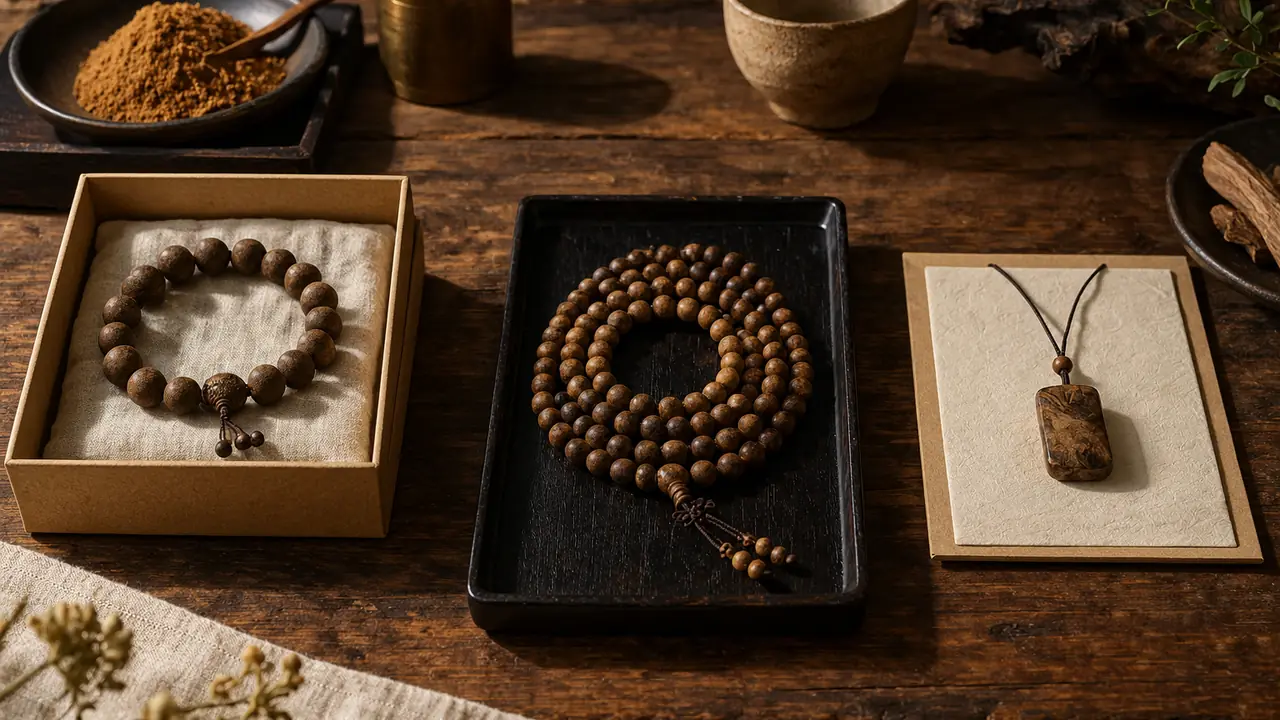
How to read these examples
The four programs below are illustrative program structures, not client testimonials. They are composites of the kinds of briefs the desk sees, written to show how a buyer might choose a line, a quantity and a packaging route. No client is named, no sales results are reported and no percentages are used, because the point is the structure of the work and not a claim about outcomes. Quantities are given only where they illustrate the reference ranges on MOQ and lead time, and they are always confirmed in writing for a real program.
Program 1: a fragrance brand launching two bracelet scents
Situation. A small lifestyle fragrance brand sells candles and room sprays and wants a wearable product with no synthetic fragrance oil in the standard spec. It has no experience of sourcing hand-made goods in China and needs a story to match its existing range.
Approach. The desk proposed two stock-based designs, a sandalwood bracelet and a goose pear bracelet, so that the brand could offer a simple scent and a story-led scent. Both were set at 8 mm with a neutral cord, and the brand added a printed pouch and a card. The first order sat at the stock end of the range, with a few pieces per design for samples. The sandalwood design is described on the sandalwood bracelet page, the other on goose pear beads.
What was checked. Sandalwood origin for the lot, CITES papers for the agarwood in the pear formula, bead diameter and weight against the formula sheet, scent against the retained sample, and desiccant in every pouch.
Outcome. The brand launched with two scents under one design family and used the retained sample as the reference for later reorders. The structure left room to add an agarwood tier in a later season.
Program 2: a corporate buyer ordering gift sets with engraved tablets
Situation. A corporate gifting buyer needed around 800 gift sets for a year-end program, each with an incense tablet carrying the company mark and a short message, and a presentable box.
Approach. The desk treated it as private label: an intaglio mould for the tablet, a kraft box with a fitted insert and a printed sleeve, and a foil pouch with desiccant inside the box. A proof of the mould and the box was approved first, then a physical sample. Because the buyer had a fixed delivery date, the desk worked back from that date and flagged the drying and packaging steps as the likely pressure points. Options for the tablet are on the incense tablet pendant page, and the OEM page lists the limits.
What was checked. Sharpness of the engraved mark, thickness and edge cracks, fit in the insert, box print against the proof, and a count by carton.
Outcome. The set arrived complete and consistent, and the buyer kept the approved sample and mould for a second run.
Program 3: a yoga studio group stocking 108 strands
Situation. A small group of yoga studios wanted 108-bead meditation strands for retail, in a few colors, with low quantity per studio and one shipment to a central address.
Approach. The desk recommended the 108 strand in 6 and 8 mm, with a guru bead and a simple tassel, and grouped three color designs into one order. Packaging was a cloth bag inside a sealed pouch, so that the strands traveled dry and still looked presentable on a shelf. Details of the product are on the 108 meditation beads page, and this audience is covered in solutions for yoga studios.
What was checked. Bead count per strand, guru bead fit, hole centering, cord strength by hand test, and a humidity check before sealing.
Outcome. The studios received uniform strands in one consignment, and the group used the same designs for later reorders without a new sample round.
Program 4: a jewelry brand buying loose beads by weight
Situation. A jewelry brand designs its own pieces and wanted incense beads as a component, not a finished bracelet. It needed predictable bead diameter and hole size to match its silver findings.
Approach. The desk sourced loose beads by kilogram in two diameters, with the hole size agreed against the brand's fittings and sample beads sent for a trial fit before the main lot. The metal parts remained the brand's responsibility, with a declaration for the market. More on this route is on loose incense beads and silver sets.
What was checked. Diameter spread, hole diameter, weight per hundred beads, surface cracks and a sample trial fit on the brand's findings.
Outcome. The brand integrated the beads into its jewelry line and kept the measured values as incoming inspection criteria for later lots.
What the programs have in common
| Program | Line | Packaging | Main check |
|---|---|---|---|
| Brand launch | Sandalwood and goose pear bracelets | Pouch and card | Origin, CITES, scent against retained sample |
| Corporate gifts | Engraved tablet in a gift box | Kraft box with insert | Mark sharpness, fit, print against proof |
| Studio strands | 108-bead strands | Cloth bag in a pouch | Count, guru bead, cord strength |
| Jewelry components | Loose beads by weight | Sealed bags | Diameter, hole size, trial fit |
In every case the formula sheet came first, a sample was approved in writing, a retained sample was kept and the batch was checked against it. That sequence is described on the sourcing process page.
Planning your own program
Write down the channel, the line, the quantity per design, the packaging and the date you need the goods. The desk will tell you which category of the reference ranges your brief belongs to and what is likely to take the longest. Send the brief through the quote form.