
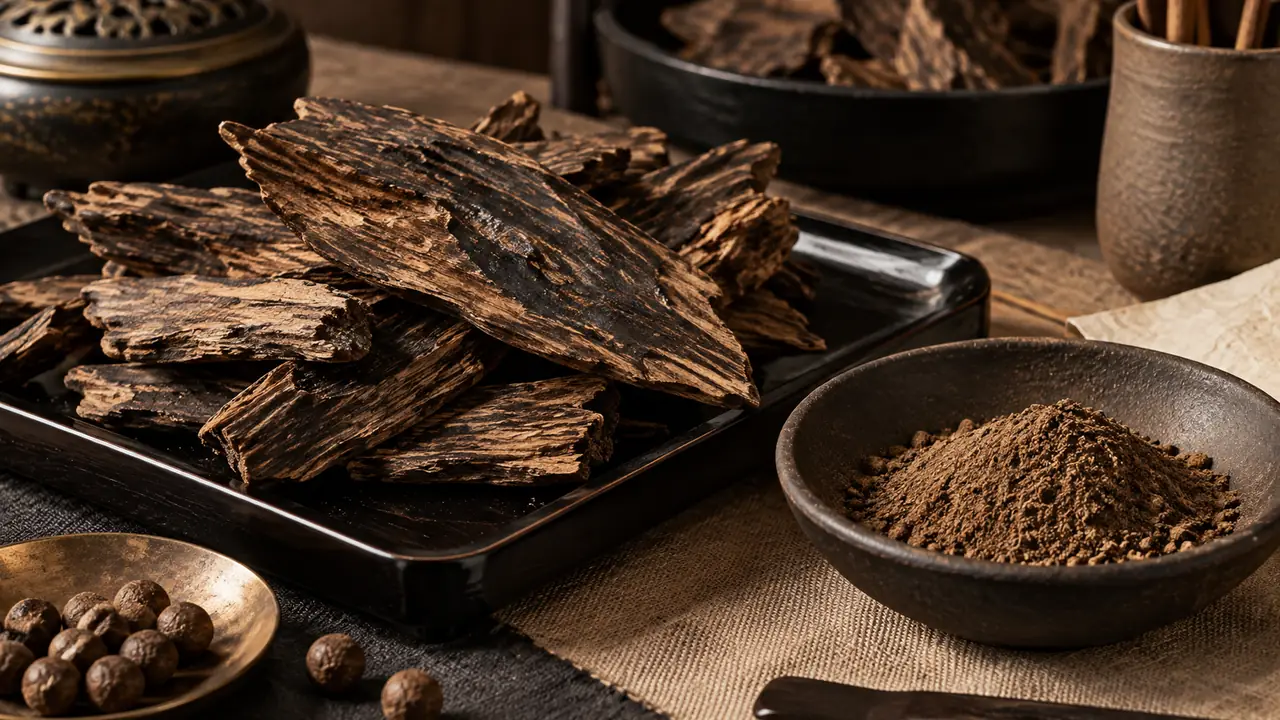
What agarwood is
Agarwood, called chenxiang in Chinese and oud in Arabic, is the resin-saturated heartwood of trees in the genus Aquilaria, a group of tropical evergreens in the family Thymelaeaceae. Healthy Aquilaria wood is pale and almost odorless. The scented material forms only when the tree responds to injury or infection by producing dark, aromatic resin, which gradually fills the surrounding wood. That resinous wood is what is carved, distilled or ground. For incense beads it is milled to powder and blended, usually with sandalwood, as in a classic blended bead.
How resin forms
Resin formation is a defense reaction, not a fixed property of the species. In wild trees it follows injury, insect attack or fungal infection and can take many years. In plantations growers induce it by wounding the trunk, drilling or applying inoculants, then wait several years for the resin to build up before harvest. Resin content therefore varies tree by tree and even within a single trunk, which is why agarwood is graded by what is actually in the wood, not by the age of the plantation. This variability is also why scent between lots can differ, and why a retained sample matters for repeat orders.
Cultivated versus wild
Wild agarwood has been heavily harvested and the genus is protected. The material in the standard bead range comes from cultivated plantations or from legally sourced wood supported by paperwork. Cultivated agarwood often has a lighter resin load and a softer, sweeter scent than old wild wood, which suits blended beads where the powder is combined with other notes. Higher-resin plantation grades are available and change both scent depth and cost. The desk does not describe cultivated wood as wild, and origin and type are stated per lot.
Supply regions
| Region | Role | Notes |
|---|---|---|
| Dianbai, Maoming (Guangdong) | Cultivated Aquilaria sinensis, processing hub | Known as the home of Chinese agarwood; industry value reported at roughly RMB 4-7 billion depending on scope; first agarwood raw material export permit issued in September 2024 |
| Hainan | Large planting area, state-supported | Planting area reported above 149,000 mu |
| Vietnam | Source of imported wood and chips | Used for some grades; documents per lot |
The Chinese industry figures come from regional reports and official bulletins; they differ by source and are quoted here as reported. More on regional context is on the industry clusters page.
Grades described in words
There is no single global grading scale for agarwood. Buyers and suppliers describe grade by the resin content seen in the wood, by color, density, how the material sinks or floats in water, and by scent when heated. For powder, the useful terms are: light resin (pale to tan, soft scent), medium resin (brown with visible dark streaks, rounder scent) and high resin (dark brown to nearly black, deep, sweet-resinous scent). Be cautious of any supplier who quotes a number grade without describing the material, since the scale is internal to each trader. The desk asks partner workshops for a physical reference sample and records it with the lot.
CITES Appendix II and export documents
All species of Aquilaria are listed in CITES Appendix II, meaning international trade is allowed only with permits that show the material was legally obtained and its harvest is not harmful to wild populations. For each agarwood lot, documentation is supplied per lot: the exporting country's CITES export permit where required, an ingredient declaration and an inspection record. Importers should check that their own country's import rules and any re-export requirements are satisfied before the order is confirmed. See compliance and certifications and the post on CITES and agarwood export documents. Finished beads and powder follow the rules for their product form; the documents depend on the lot and destination and are confirmed in writing.
How to read powder quality
- Color. Evenly brown to dark brown; a pale, chalky powder with no dark flecks suggests low resin.
- Texture. Fine, silky and well sieved; coarse fibers mean poor milling.
- Cold scent. A faint, sweet, woody smell; sharp chemical or perfumed smells are a warning sign.
- Warm scent. A small amount warmed on a heated surface should smell deep and sweet-resinous without a burnt note.
- Dryness and cleanliness. No mold spots, damp clumps or sand.
Ordering notes
Agarwood and goose pear bracelets typically start from 50-200 pieces per design, with documents arranged per lot, confirmed in writing for each program. Lead times follow the product line; see MOQ and lead time and the quote form.