
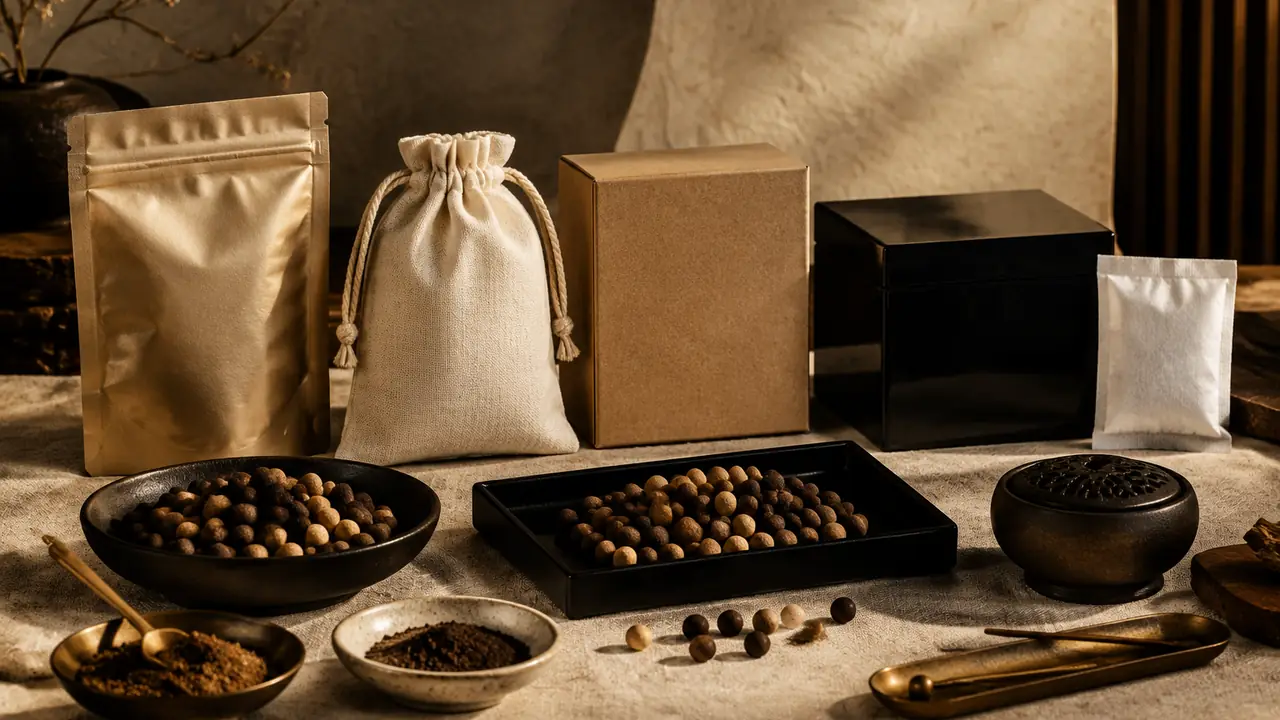
Why packaging matters for incense beads
An incense bead is made from powdered wood, a plant binder and a little honey. It is dried slowly in the shade over five to ten days and then aged in sealed jars. That same material takes up moisture again if it is left in humid air, which can soften the surface, dull the scent or, in the worst case, bring mold spots. It also loses scent faster if it is stored hot or in strong sun. Good packaging therefore has a technical job before it has a marketing job: keep the bead dry, keep it cool and keep it from rubbing against hard objects.
The desk specifies packaging in the same step as the formula, because the two decisions affect each other. A heavier gift box needs a different carton than a pouch, and a bead that is still settling after aging should not be sealed with a wet insert. Packaging is checked at the end of the line alongside the beads, as described in testing and inspection.
Format options
| Format | Best for | Humidity protection | Notes |
|---|---|---|---|
| Foil pouch with desiccant | Standard inner pack, e-commerce, bulk | High when sealed | Default for every program; label can be printed or applied |
| Cloth bag | Retail, gifting, yoga and temple shops | Low alone; use inside a pouch for shipping | Cotton or linen blend, drawstring, optional print |
| Kraft box | Natural, understated retail look | Low alone; pouch inside | Easy to print; sleeve or sticker for branding |
| Lacquer-style box | Premium gift sets, corporate gifting | Medium with a fitted lid | Higher cost and longer lead time |
| Sealed jar | Loose beads, aged lots | High | Useful for retail display and for refreshing older beads |
Foil pouch with a desiccant sachet is the standard because it is the most economical dependable moisture barrier. Cloth bags and boxes are presentation layers, and the desk recommends that a pouch sits inside them for the shipping journey.
Inserts and fit
An insert holds the bracelet in a fixed place so the beads do not rub or crack during handling. Common choices are a paperboard card with slots, an EVA foam cut-out or a fabric-wrapped tray. For a bracelet and sachet pairing, a two-pocket insert keeps the scented sachet from marking the beads. The bracelet and sachet set is the typical case. For incense sticks or pills in a box, the insert may also hold a holder or small burner, which is covered by the incense gift box line.
Box dimensions are set from the packed bracelet, not the other way round. A bracelet on elastic is flexible, but the beads have a fixed outer diameter, so the insert must allow for the bead size and the number of beads. The desk asks for the bead size and count before quoting a box.
Humidity protection in transit
- Seal first. Beads are packed into the pouch with desiccant only after they have been checked for dryness, so moisture is not sealed in.
- Keep the pouch intact. Pouches are checked for seal quality; torn or under-sealed pouches are replaced.
- Dry cartons. Cartons are stored off the floor and away from damp walls during packing and holding.
- Avoid heat. Parcels are not left in direct sun or in hot vehicles; this matters most for sea freight and summer shipping.
- Add a spare desiccant sachet inside the shipping carton for long sea routes when requested.
Transit routes and times are on the logistics and shipping page.
Carton specifications
Because incense beads are light, cartons are limited more by volume than by weight. Typical shipping cartons are five-layer corrugated board, taped on all seams, with a packing list inside. Carton size is chosen so that the contents do not move, and boxes are laid flat so that corners are not crushed. Each carton is marked with the program code, the contents, the quantity and the carton number. Exact carton dimensions, gross weights and the number of units per carton are set per program and listed on the packing list. For retail boxes, an outer master carton holds a fixed count so that your warehouse can receive by carton, not by piece.
Labelling
A label should say what the product is and how to look after it. For incense beads the useful items are:
- Product name and design name.
- Materials, listed as on the formula sheet, for example sandalwood powder, nanmu bark powder, honey.
- Bead size and count.
- Care text: keep dry, avoid heat and perfume, store sealed when not worn.
- Batch code, so that lots can be traced to the inspection record.
- Your brand, address and any market-specific marks that you supply.
Labels should stay factual. The desk does not print health or treatment claims, as explained under OEM and private label. Market-specific requirements such as language, importer details and metal declarations for silver fittings are your responsibility to confirm for the destination; the desk provides the material information needed for that purpose.
Ordering notes
Packaging adds a design and sample step, so branded programs run longer than stock bracelets in a plain pouch. As a reference, boxed and branded programs typically start from about 300-1,000 pieces per design, and packaging samples are approved in writing before the batch. Lacquer-style boxes need the longest lead time. These are typical reference ranges and are confirmed in writing for each program. Send your format and quantity through the quote form.