
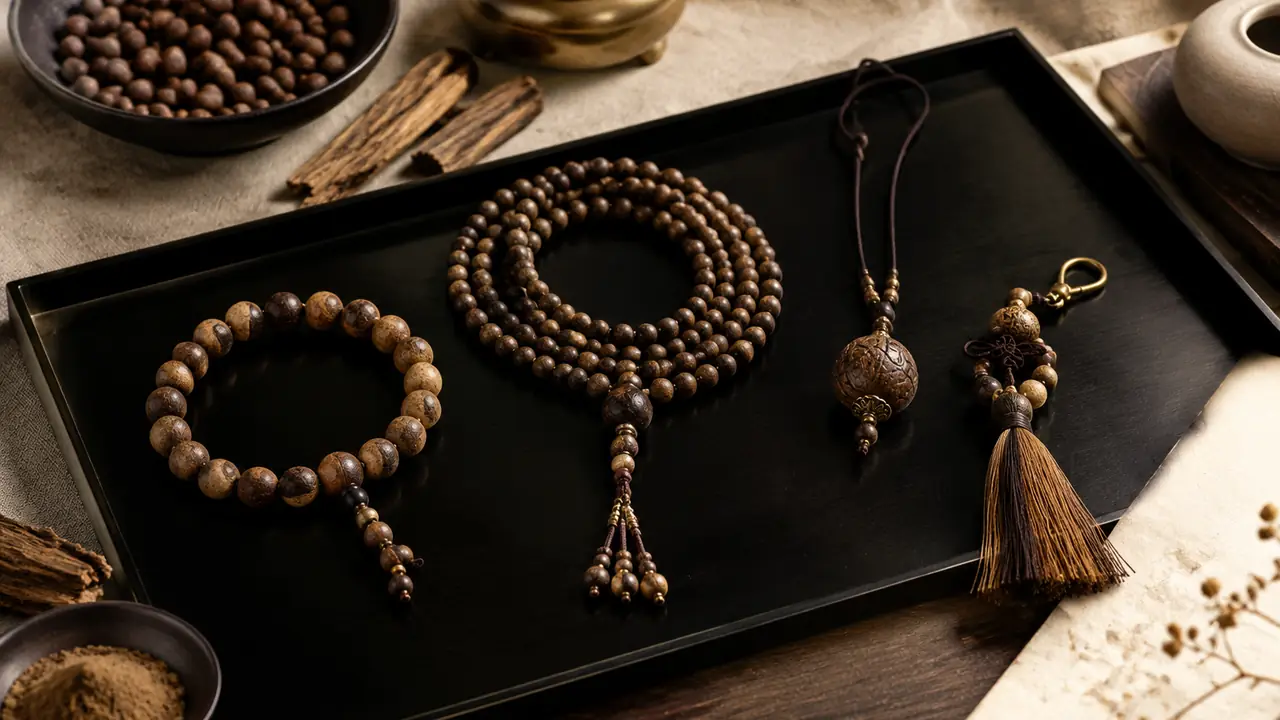
What an agarwood bead contains
An agarwood incense bead is rolled from ground resin-bearing Aquilaria wood, bound with nanmu bark powder and honey, and aged like any other bead. The standard line uses agarwood powder with sandalwood as a supporting material, because pure agarwood powder is oily and dry-binds poorly; sandalwood softens the blend and helps the bead hold its shape. The scent is resinous, deep and slightly sweet, and it stays on the wrist longer than a sandalwood bead of the same size.
Agarwood is used here as a powder, not as carved wood. That is a deliberate choice: a powder bead lets a workshop use off-cuts and lower-density lots that are unsuitable for carving, and it allows a consistent formula from lot to lot. The wider material story is in the agarwood guide.
Powder grades: what you can actually specify
There is no single global grading standard for agarwood powder. Estimates of market size vary widely by scope, and so do grade names, which is why a buyer should specify by observable facts rather than by label.
| What to specify | How to check it | Why it matters |
|---|---|---|
| Species and genus | Aquilaria spp., stated on the lot sheet | Drives the CITES paperwork |
| Origin | Cultivated Guangdong or Hainan material, or Vietnamese material | Affects scent, supply and documents |
| Resin level | Dark, oily fragments visible; scent on gentle warming | Sets strength and cost |
| Fineness | Sieve size agreed on the sample | Surface smoothness of the bead |
| Share in the formula | Percentage on the formula sheet | Decides scent presence per bead |
A higher agarwood share means a deeper bead and a higher cost; a lower share means a lighter one. Both are legitimate products when the share is written down. For more on powder levels see agarwood powder grades.
Cultivated material and documents
The Aquilaria genus is listed in CITES Appendix II, so export of agarwood material needs a CITES permit, with documents issued per lot. Dianbai in Guangdong, reported to have received its first agarwood raw-material export permit in September 2024, and Hainan are the main sources of cultivated wood in the partner network; Vietnamese material is another common source. The desk asks the workshop for the lot documents before dispatch and confirms in writing what travels with the shipment. Buyers importing into the EU or US should check their own rules too, because CITES requirements apply at both ends. The full picture is in CITES and agarwood export documents.
Plan the lead time around the paperwork. Document preparation can add days to a program that otherwise ships in the standard 15-25 working day range for stock items, and it is the most common cause of delays on first orders.
Options for a range
- Agarwood with sandalwood. The standard line; balanced and easier to wear. Good first agarwood SKU.
- Higher agarwood share. Deeper and more resinous; a premium variant with a higher cost and sample round.
- Agarwood with a botanical accent. A small share of herb or flower for a distinct signature; treated as a custom formula.
- Accent beads. A few 12-20 mm agarwood beads in a sandalwood bracelet, to carry the story without raising the whole cost.
Sizes follow the same grid as other lines: 8 mm is typically 18-22 beads, 10 mm typically 17-19, and an 8 mm bead typically weighs about 0.3-0.5 g. Because agarwood beads are darker and heavier in feel, many programs choose 8 or 10 mm and stay out of the smallest sizes.
Scent expectations
Agarwood beads can seem muted when new. The resin needs warmth to open, so a cold bead in a pouch smells little and a bead worn for ten minutes smells much more. Many users describe the scent as deep, woody and slightly sweet, and it changes through the first months of wear. Retail copy should describe this change as normal aging. Avoid any claim about the body; the product is a scent object and a ritual accessory, nothing more. A quick comparison with sandalwood is in agarwood vs sandalwood beads.
Appearance, handling and cost drivers
Agarwood beads are usually darker than sandalwood beads, ranging from warm brown to near black, and the tone varies a little from bead to bead because the powder is a natural material. Do not ask for perfect uniformity; ask instead for a color range agreed on the approved sample, and keep a reference strand. A bead that is much lighter than the reference may carry a lower agarwood share or more binder, which is worth querying.
Cost follows the same logic as scent. The main drivers are the agarwood share in the formula, the grade of the powder, the bead size, the amount of handwork in rolling and drying, the findings and the packaging. Paperwork adds a smaller but real cost per lot. When you compare two quotes, compare the formula sheets first, because two bracelets can look identical and differ widely in agarwood content. The detailed breakdown of price drivers is in what drives incense bead prices.
For storage, agarwood beads follow the usual rules: sealed pouch, desiccant, away from heat and direct sun. Because the resin is richer, a bead left in a hot car or a sunny window can sweat on the surface and darken unevenly, so shipping cartons should be kept out of hot storage. Retailers should rotate testers regularly, since an open tester loses its character within weeks.
Compliance checklist for an agarwood program
- Confirm species, origin and the CITES documents the lot will carry.
- Ask the workshop for the formula sheet with the agarwood share in percent.
- Check that there is no synthetic fragrance oil and no industrial glue, confirmed in writing.
- If silver or plated findings are used, request a material declaration and metal test reports for the target market.
- Agree on packaging: sealed pouch, desiccant, care card.
Ordering
Stock bracelets are typically ordered at around 50-200 pieces per design, with custom formulas from around 500 pieces and sample rounds of 15-25 days; these are reference ranges, confirmed in writing for each program. Send the brief through the quote form with your target market so the desk can check the document route up front, and read the ranges on MOQ and lead time.