
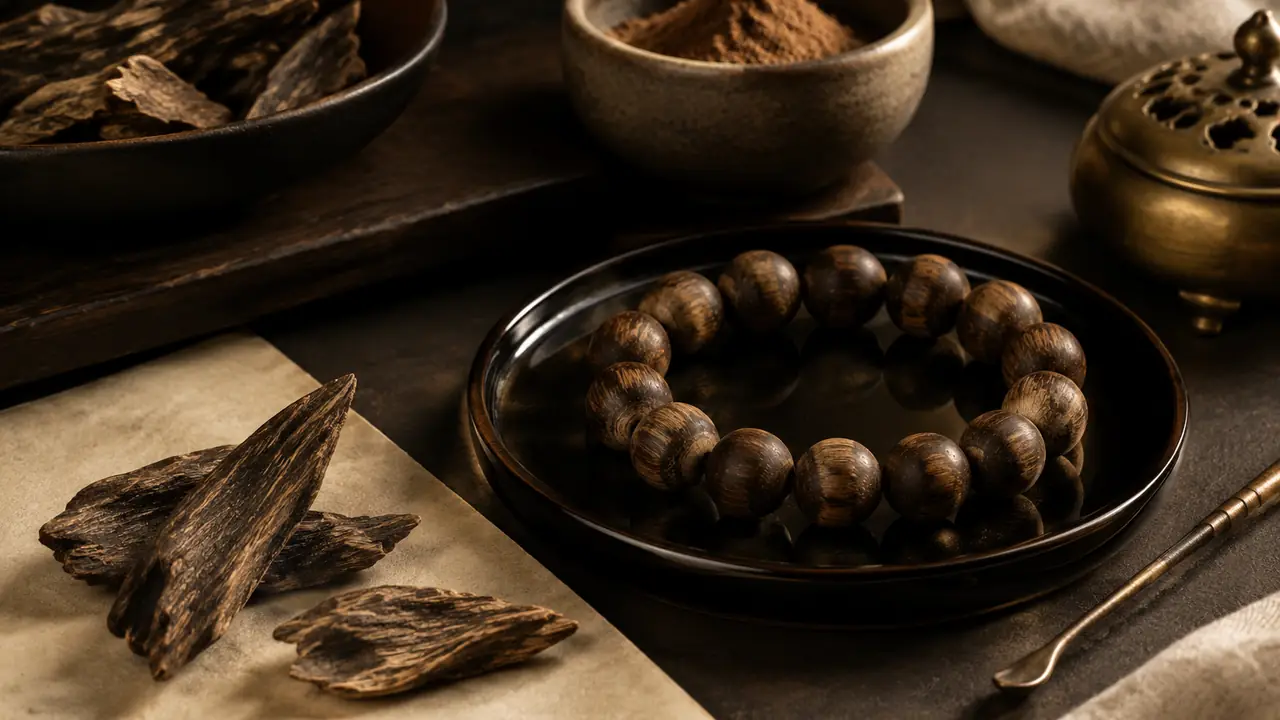
What the bracelet is made of
Agarwood is the resin-impregnated heartwood of trees in the genus Aquilaria. In this bracelet the standard formula uses agarwood powder as the main material at about 55% of the dry mix, with a share of sandalwood to soften the top note, nanmu bark powder as the natural binder and honey for plasticity. No synthetic fragrance oil and no industrial glue are used in the standard specification, confirmed in writing for each order.
| Component | Share by weight | Role |
|---|---|---|
| Agarwood powder | 55% | Resinous depth and long scent |
| Sandalwood powder | 10% | Softens and rounds the opening |
| Nanmu binder | 25% | Holds the bead together |
| Honey | 10% | Plasticity while rolling |
Figures are the standard version and move with the grade of the agarwood; the sheet is confirmed per program.
Origin and CITES documents
All species of Aquilaria are listed in CITES Appendix II, so cross-border shipments need permits and the paperwork must match the lot. The standard supply is cultivated agarwood from the Dianbai district of Guangdong and from Hainan, where plantation planting is well developed, with Vietnamese material used for some scent profiles. The desk compiles the documents per lot together with an ingredient declaration, and importers should confirm the rules of their own country in advance. Market estimates for agarwood vary widely by scope; WiseGuy Reports, for example, puts the agarwood market at about USD 1.3 billion in 2025. Details on the process are in CITES agarwood export documents.
How resin grade changes scent and cost
Agarwood powder is not one material. Lower-resin wood gives a light, dry, faintly sweet wood scent; mid-resin material gives a fuller balsamic character; high-resin material gives a dense, honeyed, slightly cool depth that carries for hours. Each step upward changes the scent and the cost, and the price effect compounds because resin content also limits how much usable powder a plantation yields. The desk therefore does not quote agarwood as a single item. It shortlists two or three grades, sends comparison samples, and writes the chosen grade into the formula sheet so that later lots match.
Scent, color and wear
Compared with sandalwood, agarwood smells deeper, darker and more complex, with sweet wood, a touch of spice and a dry resin base. It lasts longer on the wrist and changes through the day, which is why it is often placed as the premium tier. The beads are dark brown, sometimes nearly black, with a matte surface that polishes to a quiet sheen. You can read the two materials side by side in agarwood vs sandalwood beads.
Sizes and options
| Bead size | Typical beads per bracelet | Note |
|---|---|---|
| 6 mm | About 28-32 | Stack-friendly, lighter feel |
| 8 mm | 18-22 | Standard, about 7-9 g |
| 10 mm | 17-19 | Premium presentation |
| 12 mm | About 14-16 | Bold men's size |
- Grade. Standard, mid-resin or high-resin, as sampled.
- Findings. Knotted silk, elastic, or silver spacers as in the silver set.
- Packaging. Foil pouch with desiccant; lacquer-style boxes for retail.
- Add-ons. A pear-steamed variant is available as goose pear beads.
Care and storage
Think of the bracelet as a fragrance object. Keep it dry, away from perfume and heat, and sealed in a pouch when not worn. Take it off before washing, swimming or exercise, because water and sweat can dull the surface and loosen the cord. Wear it against bare skin on occasion so warmth can release the scent, and avoid leaving it in a hot car or on a sunny windowsill, where resin can soften and the surface may crack. Properly stored, the aroma lasts for years. For retail, a small care card and a resealable foil pouch with desiccant protect the product and give the customer a clear way to keep it.
Who it suits
Agarwood bracelets suit premium fragrance ranges, boutique gift programs and importers who already handle controlled-species paperwork. They are less suited to buyers who need the lowest entry cost or the simplest documents; for those, the sandalwood bracelet is the easier start. A common pattern is to launch with sandalwood and add one agarwood design as a top tier once the paperwork route is set up.
Inspection and ordering
Lots are checked for diameter, weight, hole centering, cracks, mold spots, dryness and scent against a retained sample, and the CITES paperwork is matched to the lot before shipment. Stock bracelets typically start from 50-200 pieces per design, private-label packaging from about 300-1,000 pieces and a custom grade or formula from about 500 pieces with sample rounds. Agarwood programs often need extra lead time for documents; the typical range is on MOQ and lead time, and all figures are confirmed in writing. Send your request through the quote form.