
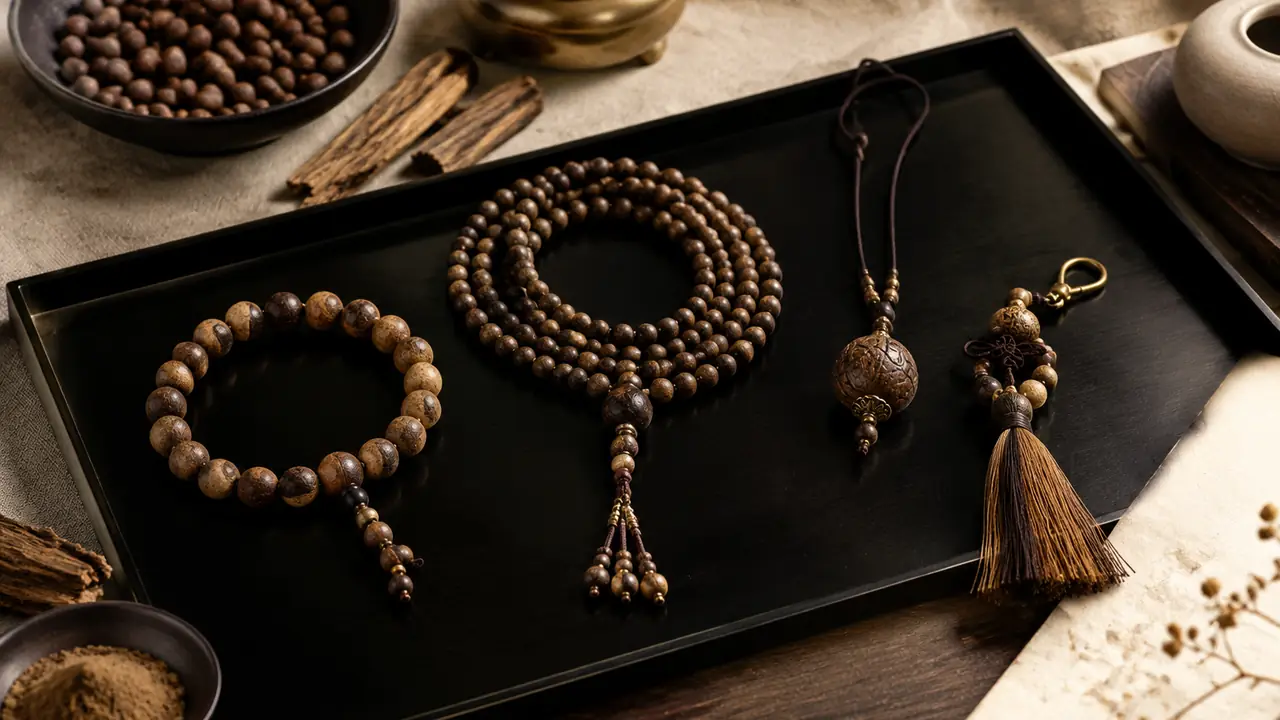
What goes in a set
The standard set has three parts: an incense bead bracelet, a fabric sachet and a box with an insert or card. The bracelet follows the usual specification: 8 mm typically 18-22 beads, botanical powders, nanmu bark binder and honey, with no synthetic fragrance oil and no industrial glue, confirmed in writing. The sachet is a small cloth bag holding incense powder or small botanical chips, tied with a cord or ribbon. Together they give the recipient something to wear and something to keep in a drawer, bag or wardrobe.
The sachet is the useful add-on. In traditional use, scented sachets were carried or tucked among clothes; the insect-related use is traditionally associated with sachets only, and a modern brand should describe it as a scent sachet for drawers and bags without any claim about insects. Because it carries fragrance material on its own, its fill is declared like the beads.
Set tiers
| Tier | Contents | Typical use |
|---|---|---|
| Essential | 8 mm bracelet, one sachet, kraft box or pouch | Promotions, bulk corporate gifts |
| Standard | Bracelet, sachet, printed card, rigid box with insert | Seasonal retail sets |
| Premium | Agarwood or goose pear bracelet, two sachets, tray box and sleeve | Executive and client gifts |
Moving up the tiers changes cost mostly through the box and the bracelet formula, not through the sachet. For many programs the best value is a standard set with a premium look on the box rather than a premium formula.
Sachet fill and cloth
The sachet fill is made from the same family of materials as the beads: sandalwood chips or powder, possibly agarwood powder, herbs and dried flowers. A sachet in a set should match the bracelet's scent direction, so the two do not clash. Fill weight is set per piece and written on the order. The cloth can be cotton, linen or silk, with a drawstring or ribbon, and a woven or printed pattern.
The cloth must be breathable but fine enough that powder does not leak; an inner liner of thin fabric solves this for powder fills. The sachet should be sealed in its own small bag until the set is opened, because exposed sachets lose their scent quickly. Dyes and prints should be checked for color fastness against sweat and humidity.
Box and card
- Box type. Kraft for natural positioning, rigid for gifting, tray with sleeve for premium sets.
- Insert. Paper or cloth cut-out that holds the bracelet and sachet in place; avoid foam that smells.
- Card. A short note on the scent, ingredients and care. Keep it factual and avoid health claims.
- Outer carton. Sized for freight, with a desiccant sachet and, for sea freight, a lined carton.
Printed boxes require artwork approval and a print window that often sets the overall lead time. See packaging and gift boxes for the format options.
Planning a seasonal calendar
Seasonal sets are bought against a fixed date, and the delay sits in the steps in the middle. A realistic sequence for a branded set runs as follows.
- Brief and sample: choose the bracelet, sachet fill, box and card; typical sample time is 15-25 days when printing and a custom element are involved.
- Approval: sign off the sample and artwork in writing, and lock the quantity.
- Production: typically 25-40 days for regular volumes, including bracelets, sachets and boxes in parallel.
- Pack and inspect: assemble sets, check counts and contents, and seal.
- Ship: courier for small lots in 3-7 days, air 5-10 days, sea freight to the US west coast 15-25 days and to Europe 30-45 days.
The approvals are where seasonal programs usually slip. Settling the box artwork and card text in the first week, and not after the bracelets are made, can save weeks. These timelines are typical reference ranges and are confirmed in writing for each program; see MOQ and lead time.
Corporate programs
Corporate buyers often want a custom card, a logo on the box and a small run split across several addresses. Branded or boxed items typically start at around 300-1,000 sets per design, which suits company-wide gifting rather than small teams. For smaller runs, a stock bracelet and sachet in a kraft box with a custom card can sit nearer the stock MOQ range of about 50-200. Additional notes, including card wording and delivery logistics, are in incense beads as corporate gifts and on the corporate gifting page.
Personalization options
Gift buyers often ask for a personal touch without a full custom program. Several options sit within a normal run and add little to the lead time.
- Card text. A printed message or company greeting, changed per recipient group if the print run allows.
- Cord and tassel color. A color match to the brand, with a dye fastness check.
- Charm or tag. A small metal or paper tag with a name or logo on the bracelet.
- Box sleeve. A printed paper sleeve over a plain box, which keeps the box stock and changes only the artwork.
Engraved or pressed marks on a tablet inside the set are possible too, as described in incense tablet pendants, but they need a mold and belong to the longer calendar. Each option should be written into the order with its specification, so that nothing is added by assumption.
One last planning point is the unboxing. Recipients open a gift set once, and the first impression includes scent. A set sealed too tightly arrives with almost no smell, and a set with exposed sachets arrives with a flat one. Ask the workshop to seal the bracelet and sachet in separate bags and to put a light, dry scent card or a loose sachet in the outer layer only if the brand wants a stronger opening, accepting that it will fade.
Checks before the set leaves
Open a random sample of finished sets from each lot. Check the bracelet count and size against the approved sample, the sachet fill weight and seal, the box print and the card text. Check that the sets are sealed against humidity and that desiccant is present in the outer carton. Weigh a few sets and compare with the sample sheet; a set that is lighter than expected may be missing a part. Keep one sealed reference set from the approved sample.
Send your brief through the quote form, naming the target date, quantity and delivery addresses, so the desk can check the calendar before sampling starts.