
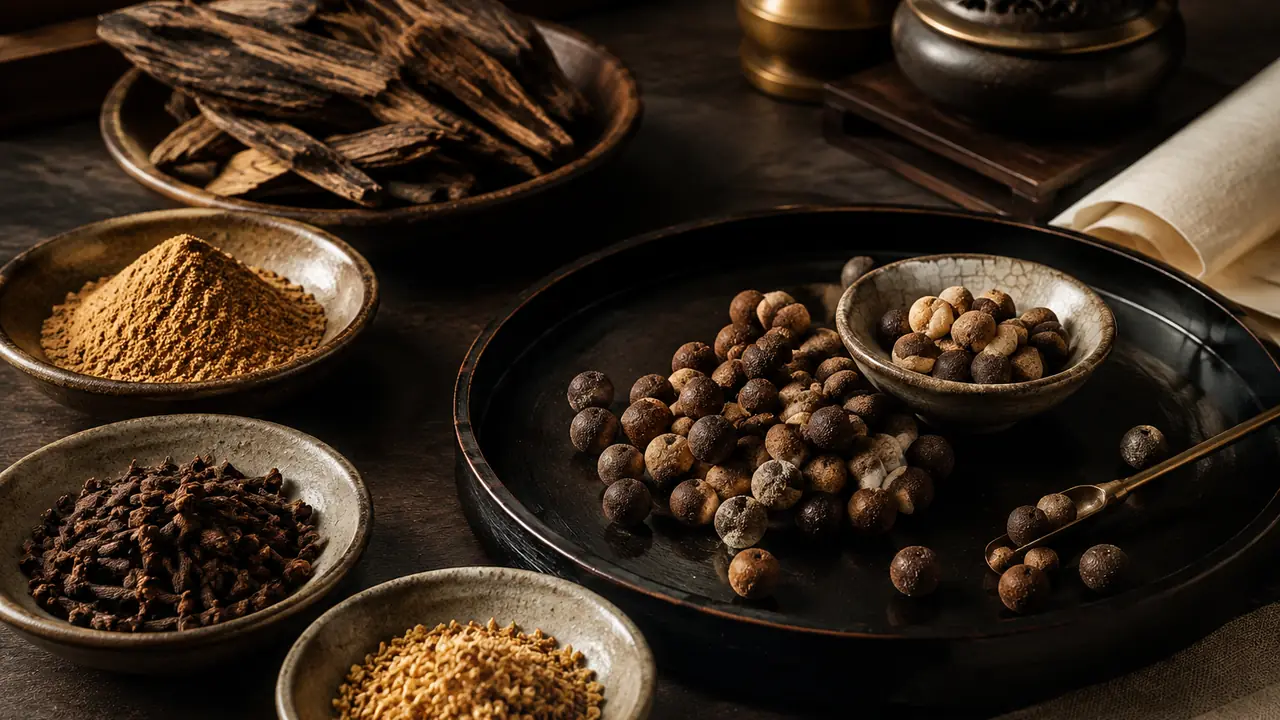
Why the distinction exists
Wild agarwood comes from Aquilaria trees growing in natural forest, where resin forms after injury or infection and trees are felled to find it. Decades of demand pushed several species to scarcity, which is the reason the whole genus is listed in CITES Appendix II. Cultivated agarwood comes from trees grown in plantations, often in the same regions but on managed land, where resin formation is encouraged by inoculation or controlled wounding and the trees are harvested after several years.
For a brand, the distinction is not just a story line. It changes what can be documented, how steady the supply is, how a lot is priced and how the product can be described honestly to customers.
Supply and security of reorders
Wild supply is thin, irregular and hard to verify. A workshop can offer a small quantity of a distinctive lot, but a repeat order six months later may not be matched. Plantation supply is larger and more predictable. In China, planting has been promoted in Hainan, where cultivation is described in public sources as a key forestry project, and in Guangdong around Dianbai in Maoming, known as the home of agarwood and with a first agarwood raw-material export licence reported in September 2024. For incense beads, where powder is used in volume, plantation material is what makes a repeatable program possible.
Comparison at a glance
| Point | Wild-sourced | Cultivated (plantation) |
|---|---|---|
| Availability | Scarce, irregular, small lots | Wider, more predictable |
| Documents | Heavier; origin harder to prove; CITES permit still required | CITES permit per lot; plantation origin can be documented |
| Scent | Often described as complex and variable | Varies with age, species and method; can be consistent within a plantation |
| Reorder matching | Difficult | Easier with an approved reference sample |
| Ethics narrative | Needs strong proof; many claims cannot be verified | Easier to support with documents |
| Cost profile | Higher and less predictable | Wider range, from entry to premium |
Scent: what can honestly be said
Wild lots are often described by collectors as more complex, with layers that cultivated wood does not always show. That is a perception, not a rule. Plantation resin depends on tree age, species, the method used to induce resin and how long the resin has matured. Younger plantation wood with a short resin period tends to give a lighter, sometimes sharper scent; well-matured plantation wood can be rich and deep. Because beads are blended with sandalwood and aged for weeks, much of the difference narrows at the bead stage, and a skilled blend can make plantation powder read as rich and balanced.
The practical test is a blind smell of two approved reference samples on the wrist after an hour, not a label on a box. If you plan a collector-tier line, ask the desk to arrange a few comparison samples at different resin levels so your team can decide what the customer will notice.
Impact on bead formulation and cost planning
Because supply type changes how consistent the powder is, it also changes how a formula should be written. With plantation powder, a workshop can fix the agarwood share at a stated percentage and expect reorders to land close to the approved sample. With a small wild-sourced lot, the same formula may need adjusting for each batch, and the desk will usually recommend a limited-edition format rather than a permanent SKU. A small run of numbered strands, sold as a seasonal collector piece, fits that supply honestly; a catalogue item that must be in stock all year does not.
Cost planning follows the same logic. Plantation lines allow a ladder of tiers, for instance an entry strand with a lower agarwood share and a premium strand with an agarwood-led formula, each priced from a workshop sheet. Wild-sourced premium lots are priced per lot and are rarely repeatable. The desk does not publish prices on this site; it asks for the target tier and quantity and returns a comparable sheet.
Finally, remember that bead size changes the powder demand sharply. A 12 mm bead holds several times more powder than a 6 mm bead, so a premium material is often best shown in smaller beads, or as an accent among sandalwood beads, to keep the strand at a sensible price.
Ethics and honest claims
Some brands want a sustainability story. Keep the story to what can be shown.
- Do say that the agarwood powder in this line comes from plantation-grown Aquilaria, if the lot documents support it.
- Do say that each lot ships with CITES documentation under Appendix II, because that is a matter of record.
- Do not say that a lot is wild, ancient or rare unless a document supports the claim. These words attract scrutiny and sell nothing that a sample cannot.
- Do not claim a certification the supplier cannot show. The desk confirms documents in writing per lot and does not invent labels.
How a sourcing desk handles it
When a program calls for agarwood, the desk asks partner workshops for the stated origin, species and form of the powder, and which export route they use. It then checks that the paperwork names the goods consistently across invoice, packing list and permit. Where a buyer requests plantation-only material, that is written into the specification, and the lot documents are reviewed before shipment. Quantities and timing are confirmed in writing for each program, as in the typical reference ranges on MOQ and lead time.
For most gift, fragrance and jewelry programs, plantation agarwood in a documented blend is the practical choice: steady, traceable and consistent from one reorder to the next. A wild-sourced premium tier is possible only in small quantity and with a clear paper trail, and the buyer should expect longer lead time. The related legal framework is covered in CITES and agarwood export documents, and the grade language in agarwood powder grades.
Questions to put on the specification
- Cultivated, wild or mixed, and the supporting document for each statement.
- Species and region of origin, as stated by the supplier and confirmed in writing.
- Form of the material: chips, wood, or finished powder, and the share of agarwood in the bead formula.
- CITES permit route and the party responsible for it.
- Reference sample and retained sample for scent comparison at each reorder.
Send these points through the quote form and the desk will return comparable offers from shortlisted workshops. Material profile pages are the agarwood guide and the agarwood bracelet.