
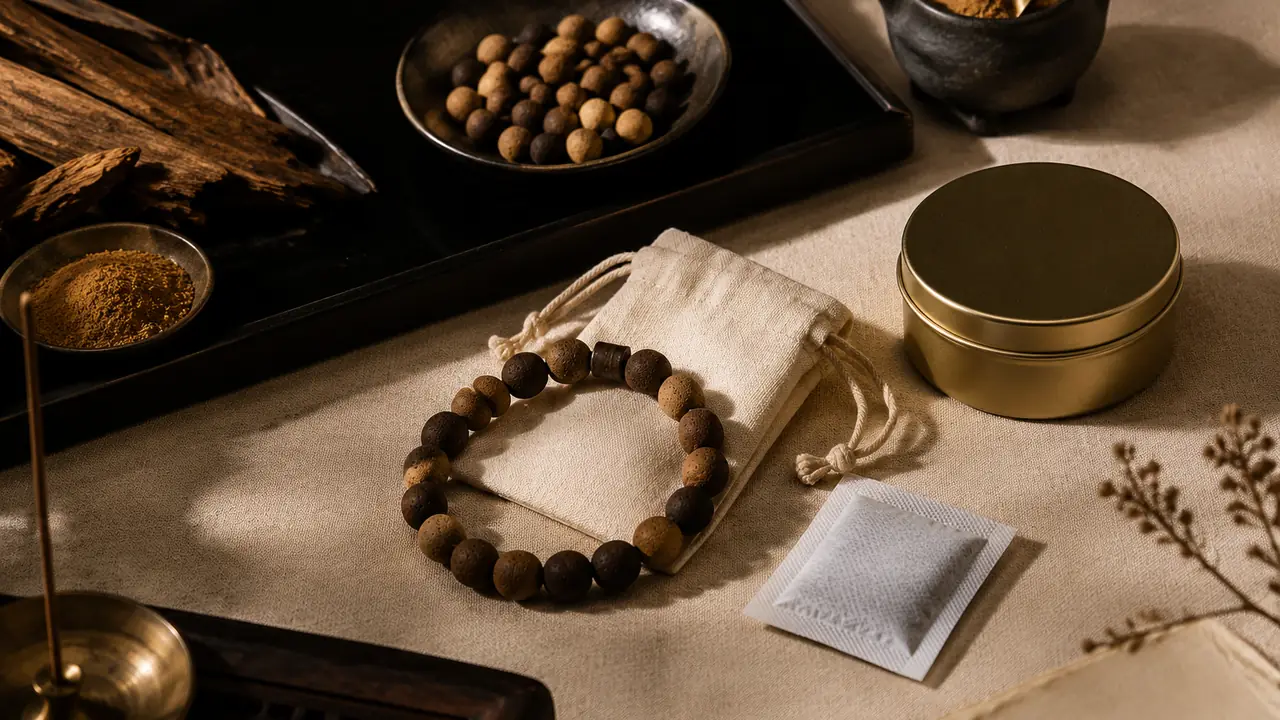
The three enemies of a bead
Incense beads are made from plant powder, nanmu bark binder and a little honey, dried slowly in the shade and aged. That makes them stable but not inert. They take up moisture from damp air, they lose volatile scent when warm and they can darken or crack under strong light. Every storage rule comes back to these three.
| Factor | What it does | Practical response |
|---|---|---|
| Humidity | Beads absorb moisture; surface turns tacky; mold can appear in closed damp spaces | Foil pouch or jar with desiccant; avoid bathrooms and basements |
| Heat | Speeds scent loss; dry heat can cause fine cracks | Normal room temperature; away from radiators, windows and cars |
| Light | Strong sun can fade color and dry the surface | Opaque or dark containers; drawers and cabinets |
Workshop practice for drying and resting is around 25 C and 60% relative humidity, which gives a useful picture of the comfortable range: a moderate room, neither steamy nor parched. The sections below turn that into habits.
Containers that work
The best container is the one that stays closed. Three options cover most cases.
- Foil pouch with zip seal. Light, cheap, blocks air and light, and travels well. Add a small desiccant sachet for humid markets.
- Glass or ceramic jar with a tight lid. Good for retail display storage and for loose beads. A jar also allows the aging effect: beads kept together in a closed jar blend their scent.
- Tin or wooden box with a lining. Suits gift programs. A wooden box breathes, so keep it in a dry room or add a pouch inside.
Avoid thin plastic bags that hold moisture against the surface, and avoid open dishes except for a short display. Do not store incense beads together with strongly scented items such as spices, perfume or other incense; beads take on neighboring odors over time. Packaging choices for a program are listed on the packaging and gift boxes page.
Retail and warehouse routine
- Receive cartons and check for damp, odor or crushed boxes before opening. Record any problem the same day.
- Keep sealed stock in sealed cartons on shelves, off the floor and away from exterior walls and windows.
- Label each lot with date and line so older stock sells first.
- Open one pouch at a time; reseal partly used packs with the desiccant inside.
- Replace display testers every few weeks; do not return a worn tester to stock.
A small hygrometer in the stockroom costs little and tells you when the room has drifted out of range. Readings that stay high for weeks, particularly in coastal summer, are the moment to add desiccant or move stock to a drier room. Mold prevention is covered in its own note, preventing mold on incense beads in humid climates.
Storage by product format
| Format | Best storage | Watch for |
|---|---|---|
| Bracelet | Individual foil pouch or small box | Elastic cord ages faster in heat |
| 108-bead strand | Cloth pouch inside a sealed bag | Tassel dust and fiber shedding |
| Tablet pendant | Flat, in a lined box | Relief edges rubbing against each other |
| Car or bag charm | Foil pouch until sold | Cord and tassel kinks |
| Loose beads | Sealed jar or bag, sorted by size and lot | Mixed lots in one container |
| Stick or pill boxes | Closed box in a dry cabinet | Sticks absorb moisture and soften |
Signs that storage has gone wrong
Check stock on a schedule, monthly in humid seasons and quarterly otherwise. Open one sample pouch from each lot and look, smell and feel. Healthy beads are dry, matte and evenly colored, with the scent you approved. Warning signs are a tacky surface, white or green spots, a sour or musty smell, fine cracks along the bead, or a pouch with condensation on the inside. A tacky or spotted lot should be separated from other stock at once, photographed and reported to the desk, so the cause - packing, transit or storage - can be traced before the problem repeats. Beads with light surface dust are usually fine and only need a dry soft cloth. Keep a short log with the lot code, date checked and result; it takes a minute and turns a vague complaint into a clear record that the workshop can act on.
Storage in transit
Beads are light cargo, so most damage in transit is climatic rather than physical. A carton that sits in a hot container or a damp port yard can arrive tacky or with a musty note. Foil pouches with desiccant inside a sealed inner carton reduce this risk, and a final outer carton should not be left on open dock floors. For sea shipments to the US west coast or to Europe, ask the workshop to confirm packaging in writing and keep a retained sample from the same lot for comparison. Routing and typical transit ranges are on logistics and shipping, and the buyer-side view is in shipping incense products overseas.
Customer-facing storage lines
Your customer is the final storekeeper, so give them three plain lines: keep sealed when not worn, keep away from heat and sun, keep dry. If you can fit a fourth, say that a day in a closed jar helps a quiet bracelet recover. Do not claim a fixed number of years; say that scent lasts for years with proper storage. Avoid any wording about health benefits, since incense jewelry is sold as a sensory and traditional product, not as a health product.
Include a small desiccant sachet in each pack only if you also mark it as not for eating, as the usual packaging rule requires. Some brands add a travel pouch to the gift box: a small foil pouch the customer can zip the bracelet into while traveling. It costs little, raises perceived value and quietly protects the scent.
Ordering with storage in mind
When sending a brief, state the destination climate, the planned shelf time and the sales channel. A program that ships to a humid coastal market and sits in a warehouse for three months needs different packing from a boutique restocking weekly. Ask the workshop to confirm pouch type, desiccant and carton sealing in writing, and request a lot reference bead. Use the quote form for this; typical reference timelines are on MOQ and lead time, with final terms confirmed in writing for each program.