
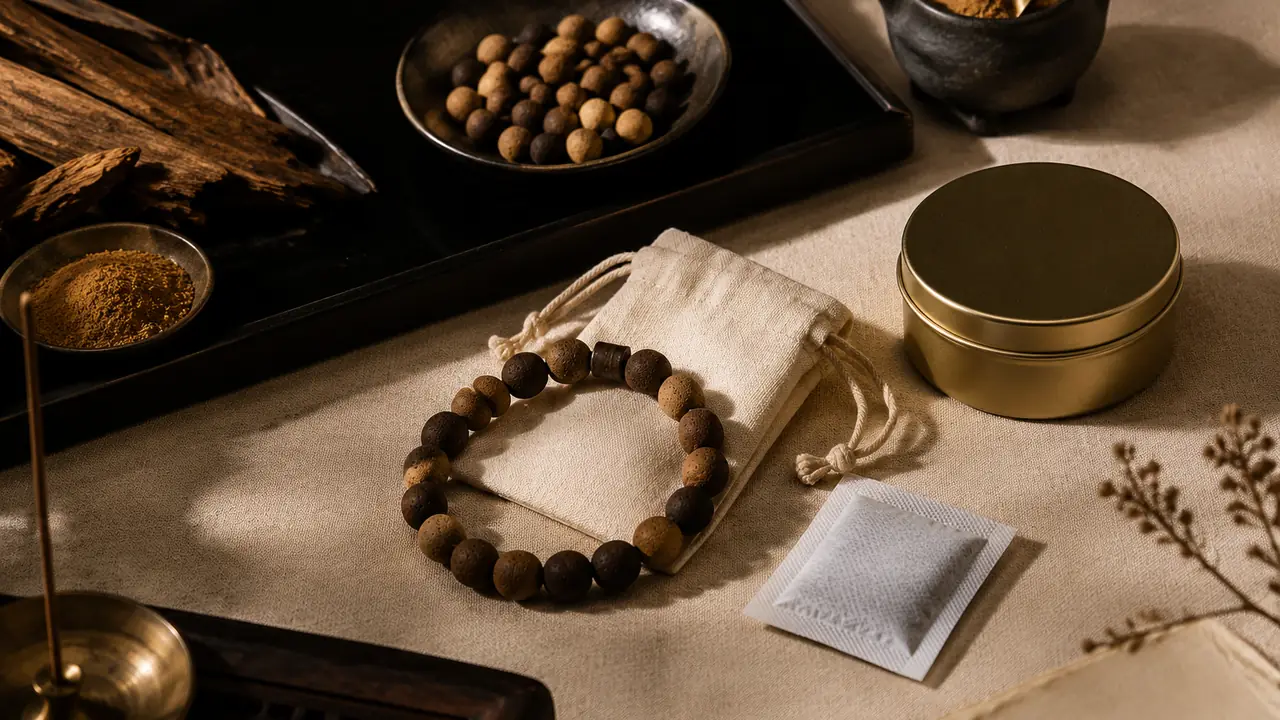
What water does to a bead
Incense beads are shaped from a dough of sandalwood or agarwood powder, nanmu bark binder and a little honey, then dried for days in the shade. The binder is the part that matters here. Nanmu powder turns sticky when wet, which is exactly how the dough is made, and it can partly soften again when a finished bead absorbs enough water. The bead then swells slightly, the surface goes tacky or chalky, and fine cracks can open as it dries unevenly. Scent suffers too: water dissolves and carries off surface material, so a washed bead often smells flat afterward.
Solid hardwood beads tolerate a splash because the wood is dense. Incense beads are powder-based and porous, so they behave more like a dried clay bead than a lacquered wooden one. That is the root of every rule that follows: keep them dry, and if they get wet, dry them gently and slowly.
Everyday situations
| Situation | Risk | What to do |
|---|---|---|
| Light sweat on a warm day | Low; a little moisture on the surface | Wipe with a dry soft cloth at the end of the day |
| Hand washing | Moderate; splashes reach beads and cord | Slide the bracelet up the arm or take it off |
| Rain or humid commute | Moderate; surface dampness | Pat dry, then rest in an open, airy place before sealing |
| Shower, bath, swimming | High; soaking, soap, chlorine, salt | Remove the piece before entering the water |
| Washing or soaking on purpose | Very high; swelling, cracking, scent loss | Do not do this; wipe instead |
| Sauna or steam room | High; heat and moisture together | Remove the piece beforehand |
Sweat is a special case
Because incense beads are worn against the skin, sweat is the most common source of moisture. A thin film does no harm, and the warmth that comes with it actually helps release scent. Over a long hot day or a workout, though, sweat carries salt, skin oil and cosmetics onto the surface. Those can leave a faint film and a darker patch near the cord holes. The fix is routine rather than repair: wipe the bracelet with a dry soft cloth after wearing, let it air for a few minutes and then seal it away. Customers who exercise in their bracelets should consider a separate piece for training days. Yoga and meditation studios, which often retail 108 strands, may want to print this on the card because customers practice in them.
If a bracelet does get wet
- Take it off at once and blot with a clean, dry cotton cloth. Do not rub hard; a wet surface is soft.
- Lay it flat on a dry cloth in a shaded, airy place at normal room temperature. Do not use a hairdryer, radiator, sunlit window or oven; fast heat cracks beads.
- Turn it over after a few hours so all sides dry evenly. Allow a day or two for a lightly wet bracelet and longer for a soaked one.
- Only when the beads feel fully dry and the cord is dry, put the bracelet in a sealed jar or pouch.
- If a white or green spot or a musty smell appears, stop wearing it and contact the seller; see preventing mold on incense beads.
A bead that has been fully soaked may not return to its original condition. Light dampness usually recovers well, and the scent can be brought forward again afterward by resting the bracelet in a closed jar, as described in reviving the scent of older incense beads.
Handling water risk in retail
Shops and studios face a different version of the problem: customers handle testers with damp or lotioned hands, and humid weather adds moisture to open displays. Keep a dry cloth by the tester tray, rotate testers out every few weeks and store the sealed stock away from windows, sinks and tea stations. If a tester gets visibly damp, remove it from the display and let it dry in an airy place before deciding whether it can return. Staff should know the one-line answer to give a customer who asks about swimming or showering: remove the piece and keep it dry. That single sentence prevents most water-related returns and keeps the product experience consistent.
What about the cord and findings?
Water affects the whole piece, not just the beads. Elastic cord gets weaker when repeatedly wet and dried, and sweat and soap speed up that aging. Silk cord stains and loosens its knots when soaked. Silver and plated findings can tarnish faster in water, especially with chlorine or salt. Specification choices help here: a more durable cord, knots finished with a drop of a suitable adhesive hidden in the knot, and clasps declared by material. Restringing is a normal maintenance step for a bracelet worn often, and it is described in restringing incense bracelets.
Waterproof coatings: a trade-off
Some buyers ask for a sealed or varnished finish so the beads survive water. A coating does reduce water uptake, but it also seals the surface where scent releases, adds a non-botanical component to the specification and changes the matte look that customers recognize. For a standard incense bead line, the usual and honest approach is to keep the botanical specification and ask customers to keep the piece dry. If a program really needs water tolerance, it is better served by a different product, such as plain wood beads, with incense carried in a separate format such as a tablet or sachet. The desk can discuss these options when you describe the use case.
What to print on the care card
Four short lines cover it: keep dry and remove before water; wipe, do not wash; sealed when not worn; away from heat and sun. Add that a damp piece should be air-dried slowly in shade and that mold or persistent odor means the piece should be set aside. Avoid health language and fixed claims about scent life; "lasts for years with proper storage" is enough. When you brief a workshop, ask for the care wording to be agreed in writing alongside the packaging, and ask for a foil pouch with desiccant so the product arrives dry. Use the quote form for the brief, and see packaging and gift boxes for options. Reference timelines are on MOQ and lead time.