
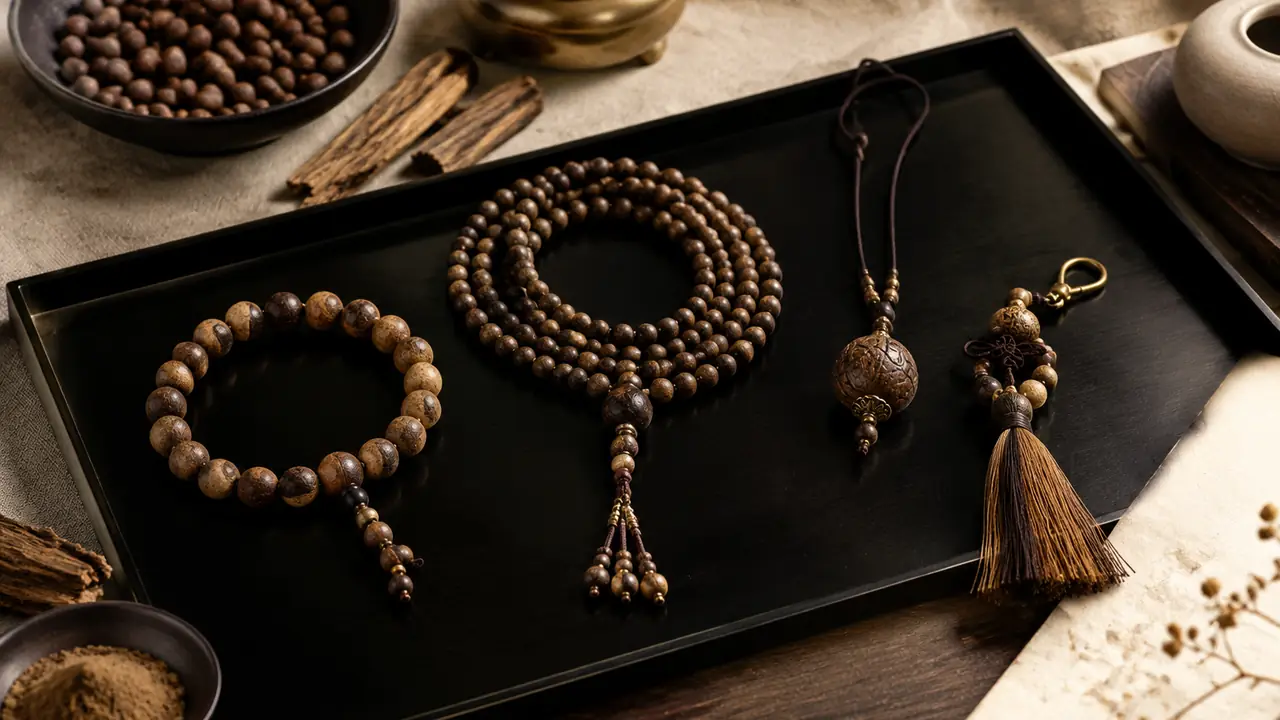
The parts of a set
A silver set pairs incense beads with metal components that the buyer chooses to give the piece a jewelry look. The common parts are spacers between beads, end caps for tassels, charms or pendants, and clasps for strands that do not use elastic. Metal is usually 925 sterling silver or copper with silver plating, and each part should be declared by material on the order. The beads themselves follow the standard specification: aromatic powder, nanmu bark binder and honey, with no synthetic fragrance oil and no industrial glue, confirmed in writing.
The pairing works because the two materials contrast: the bead is matte, soft and warm; the metal is bright and cool. A small amount of metal changes the feel of a bracelet more than a large amount of decoration.
Matching holes and findings
Holes commonly run 1.2-2.0 mm in incense beads. Spacers and caps have their own hole sizes, and the cord has to pass through both. A mismatch causes either rattling, which chips the bead edge, or tight fits, which split the bead. The practical rule is to decide the cord first, then the bead hole, then the finding hole.
| Part | What to match | Typical issue |
|---|---|---|
| Spacer between beads | Inner diameter to cord and bead hole | Spacer too wide, edges bite into the bead |
| End cap or tassel cap | Cap diameter to the bead or knot | Cap too small, wrong knot size |
| Charm or pendant | Loop size to cord thickness | Charm slides, wears the cord |
| Clasp | Cord end style, crimp or cap | Loose crimp, cord pulls out |
| Bead size | 6, 8, 10 or 12 mm diameter vs spacer width | Spacer looks oversized or lost |
Confirm the dimensions on a mocked-up sample strand, not from drawings. Bead diameters vary by a fraction of a millimeter after drying, so parts that look right on paper may need adjustment.
Silver, plating and what to declare
925 silver is an alloy of silver and copper; it tarnishes over time and cleans with a soft cloth. Copper with silver plating costs less, and it holds up as long as the plating is intact; once the plating wears, the base metal shows. Neither is better for every program, and the choice is a matter of price position and customer expectations. A fuller comparison is in silver vs copper findings.
Whichever you choose, ask the workshop for a written material declaration: which alloy, which plating, which supplier. A part marked 925 should be stamped and traceable. A plated part should be labeled as plated, never as silver.
Metal rules for target markets
Jewelry placed on the EU and US markets is subject to rules on nickel release and on heavy metals. The relevant frameworks include REACH in the EU and CPSIA in the US, and the exact requirements depend on the product type and the age group of the wearer. This site does not quote limits; they should be checked for the target market, and the lot should carry a test report if the market requires one. Incense beads are botanical and carry no metal, so the report applies to the findings. The details are in metal findings compliance, and the wider documents picture is on compliance and certifications.
Design patterns that sell
- Single charm. One silver charm on an elastic bracelet; lowest cost and lowest risk.
- Spacer rhythm. A spacer every five or six beads, which breaks up the strand without adding bulk.
- Tassel with cap. A cap on a cotton or silk tassel, common on 108 strands.
- Clasp bracelet. A silk-cord strand with a metal clasp; a more finished look, with higher labor and testing.
Weight is worth tracking. Metal parts are much denser than the beads, so even a few spacers can double the weight of a strand. Ask for the finished weight on the sample and check that it still feels comfortable on the wrist.
Care and presentation for metal-and-bead pieces
Mixed pieces need care instructions that suit both materials. Silver tarnishes in humid air and when it touches skin products, so the pouch should include an anti-tarnish strip or a small desiccant, and the care card should say to wipe metal with a soft dry cloth and keep the piece away from water, perfume and hot rooms. The beads should never be dipped in silver cleaner, which would stain the surface and carry a chemical smell. If the customer wants to clean the silver, tell them to wipe only the metal parts, using a dry cloth.
Presentation matters more for silver sets than for plain bracelets because they are positioned higher. A small rigid box, a printed card naming the materials and a cloth pouch for storage justify the price step and reduce returns. Describe the materials plainly on the card: botanical incense beads, 925 silver or silver-plated copper spacers, and cord type. Keep scent description to sensory words and avoid health claims.
Inspection points
- Check each part against the declaration: stamp, plating, supplier.
- Check hole fit on a sample of strands by threading and pulling.
- Check for burrs and sharp edges on spacers and caps.
- Check that metal parts are attached firmly and crimps hold under a gentle pull.
- Check finished weight and length against the sample sheet.
These sit in the scope described in testing and inspection. Metal and incense should also be packed so they do not scratch each other: a small pouch for the metal parts, a tissue separator and a desiccant sachet.
For jewelry brands
Jewelry brands often come with their own findings. Send them to the desk early with drawings and a sample, so holes can be drilled to match rather than the findings being re-sourced. If you use the workshop's findings, ask for the full list of parts and their materials. Minimums for branded or boxed programs are typically about 300-1,000 pieces per design, with stock bracelets from about 50-200, as reference ranges confirmed in writing per program. Brand-side requirements are covered on jewelry brands. Send the brief through the quote form.