
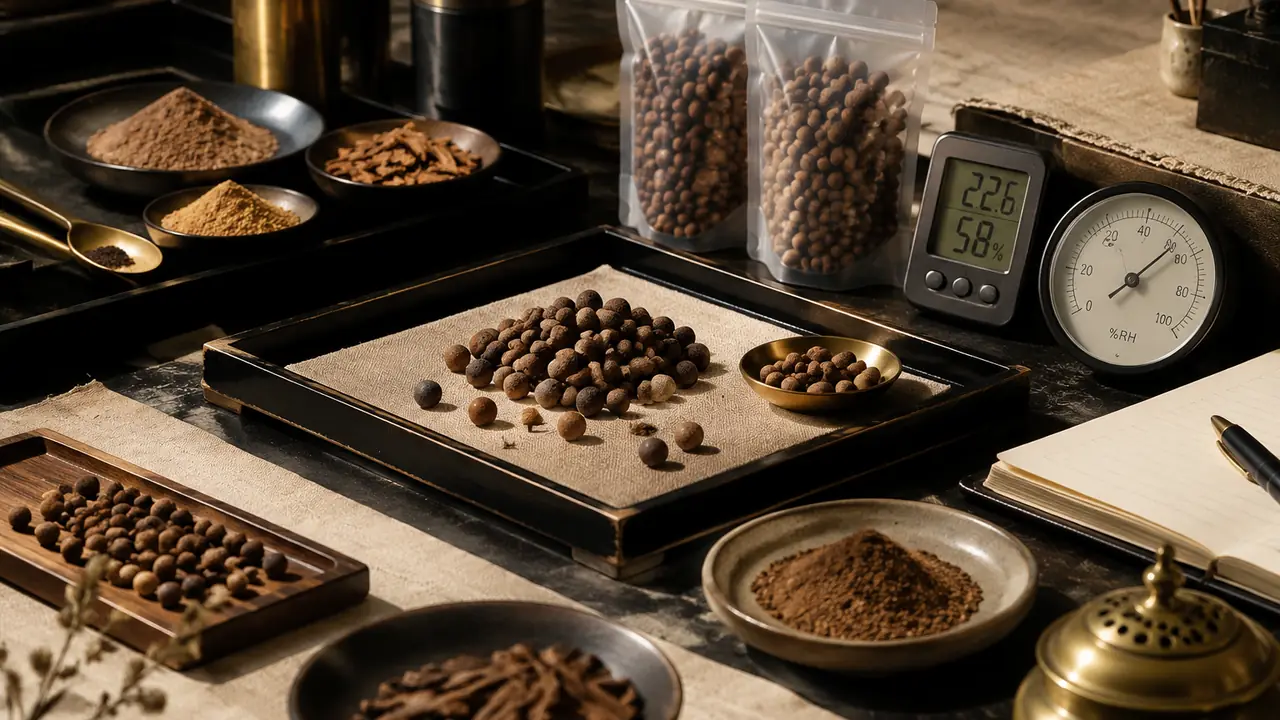
Simple tools, applied the same way every time
For a hand-rolled botanical bead the useful measurements are modest: how big, how heavy, how dry, how clean, and does it smell like the approved sample. A workshop does not need a laboratory to answer these, but it does need to measure the same way on every lot. The desk therefore specifies the tools and the method in the inspection plan, and records readings rather than impressions. Laboratories come in for a narrower set of questions, mostly about metals and declared ingredients.
Instruments and what they answer
| Tool or method | What it answers | How it is used |
|---|---|---|
| Digital calipers | Bead diameter and consistency | Measured on a sample, in two directions, since hand-rolled beads are not perfectly round |
| Precision scale | Bead weight, strand weight | Single beads and full strands, compared with the range on the plan |
| Hole gauge or pin | Hole size and centering | Gauge pin passes freely; hole sits near the middle of the bead |
| Magnifier and daylight | Cracks, mold spots, dust | Beads rotated under natural light, not warm lamps |
| Hygrometer in a sealed bag | Dryness | Beads sealed with a sensor for a set time, reading compared with the plan |
| Weight stability | Residual moisture | Same sample weighed again after a rest period |
| Humidity chamber (concept) | Behavior under damp storage | A sample held at raised humidity for a set time and checked for mold or tackiness |
A humidity chamber is not part of every program. It is an option for buyers shipping by sea to humid climates, and it can be run at a partner laboratory or a workshop with suitable equipment. The test conditions are agreed in writing, not fixed on this page.
The scent panel
Scent is the property buyers care about most and instruments measure least. The standard method is a comparison: the approved sample, sealed in a jar since pre-production, is smelled next to a sample from the lot by at least two people from the desk and the workshop, in a clean, unscented room, after the beads have rested for a few minutes. They note whether the character is the same, whether any off-note such as damp, sourness or burnt smell is present and whether the strength is comparable. Beads are warmed lightly in the hand first, since that is how they are worn. Results are written as same, slightly different or different, with comments. A buyer can run the same comparison with a duplicate of the retained sample sent in advance.
Third-party laboratory options
Where a target market or a retailer requires a laboratory report, the desk arranges tests at an independent accredited laboratory, at the buyer's cost and with a scope agreed in writing. Typical options are listed below.
- Metal findings. For silver spacers, clasps, charms and cord fittings, tests against the metal rules of the target market, for example nickel release in the EU and lead and cadmium in the US. See compliance and certifications for the rules by name.
- Material identification. Confirmation that a wood powder is the species stated, where a buyer asks for it.
- Allergen screening. Only relevant if any essential oil or extract is ever added, which the standard specification does not do. If an addition is agreed, the ingredient is declared and screened against the market's labelling rules.
- Microbial and mold screening. For lots that are shipped by sea or stored for long periods, on request.
Test scope, standard and result values belong to the laboratory report. This site does not quote values, and no result is implied before a test is made.
What a lot report contains
- Program name, lot number, workshop reference and date of inspection.
- Quantity, sample size and sampling rule from the plan.
- Readings: diameter, weight, hole, dryness, with the tolerance next to each.
- Surface and scent findings, with photos of the sample, the cartons and any defect.
- Findings classified as critical, major or minor, and the action taken.
- Material documents attached: origin statement, CITES paperwork for agarwood, ingredient declaration, any laboratory report.
The report is sent before shipment, so the buyer can approve the lot or ask for changes. For lead time effects, read MOQ and lead time; to request a test scope, use the quote form.