
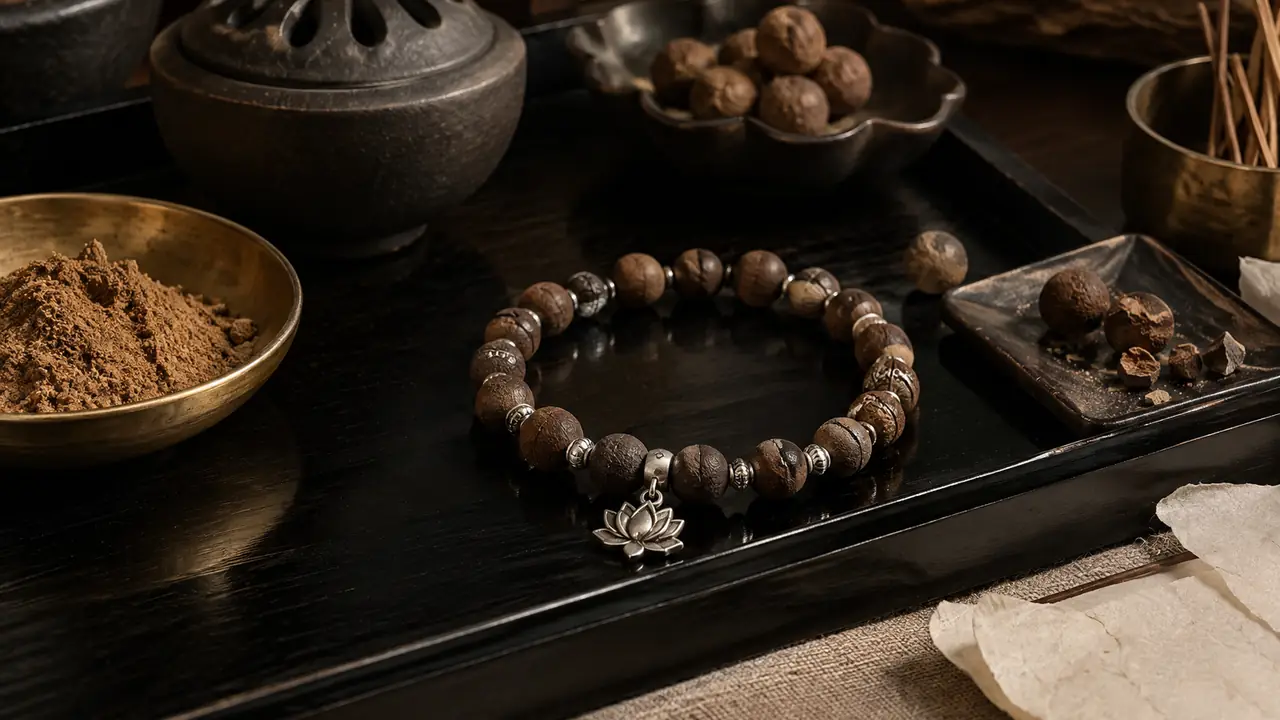
What a silver set is
A silver set is an incense bead bracelet combined with metal findings: spacers between beads, a small charm or tag, and a clasp or sliding closure. It turns a natural fragrance bead into a piece that sits in a jewelry range. The bead is either sandalwood or agarwood and is made by the same hand-rolled process used for the rest of the family, described on how incense beads are made. The metal parts come from separate jewelry workshops and are assembled and inspected before shipment.
Bead formula
| Component | Share by weight | Role |
|---|---|---|
| Sandalwood or agarwood powder | 60% | Scent and body |
| Nanmu binder | 25% | Natural plant binder |
| Honey and water | 10% | Plasticity while rolling |
| Botanical accents | 5% | Rounds scent, adjusts color |
This is the standard bead version. The agarwood version needs CITES Appendix II documents per lot, and the sandalwood version needs an origin statement per lot. No synthetic fragrance oil and no industrial glue are used in the standard specification, confirmed in writing.
Matching holes and findings
Jewelry brands care most about fit. A hand-rolled bead has a hole of 1.2 to 2.0 mm, and the spacer bore must match so that the piece sits flat without crowding or rattling. The desk shares a hole-size sheet with the jewelry partner before any silver is cut, and sample sets are checked for cord thickness, spacer movement and clasp strength. Larger bore spacers can be used with silk cord; smaller bores suit elastic or fine waxed cord.
| Part | Options | Note |
|---|---|---|
| Spacers | 925 silver, copper-silver plated | Bore matched to hole size |
| Charm or tag | Round, lotus, plain tag, engraved logo | Engraving needs artwork |
| Closure | Elastic, sliding knot, clasp | Clasp adds a metal declaration |
| Cord | Elastic, silk, waxed cord | Cord thickness set by hole |
Metal declarations and market rules
Metals need their own paperwork. The desk records the material of each finding as 925 silver or copper-silver plating, and the declaration travels with the lot. For the European Union and the United States, jewelry rules cover nickel release and heavy metals such as lead and cadmium; the relevant frameworks are named EU REACH and US CPSIA. Which rule applies depends on the target market and, for children's products, on the age grade. The desk checks the applicable framework with the buyer before production and asks the jewelry partner for the matching declaration. It does not state test values on this page, and any report is confirmed in writing for each order. Further background is on compliance.
Care for silver and beads
Silver tarnishes over time, especially in humid air or when worn against sweat. A soft dry cloth removes light tarnish; a silver-polishing cloth is gentler than liquid dips, which should never touch the beads. Keep the piece away from perfume, water and chlorine, and store it sealed with a small desiccant. Copper-silver plating may wear at contact points, so it suits fashion ranges better than daily wear. The beads themselves keep their aroma for years with proper storage. Add a short care card to retail packs; the desk can supply the text.
Assembly and inspection
- Beads are sorted by diameter and weight, and any with cracks or surface flaws are removed.
- Hole size and centering are checked against the spacer bore on a sample of each lot.
- Findings are matched to the declared material, and engraving is compared with the approved artwork.
- Sets are strung or knotted, then pulled gently to test the cord and closure.
- Scent is compared with the retained sample, then each set is sealed with desiccant.
Who buys silver sets
Jewelry brands use the set as a fragrance line within an existing range, often with their own charm design. Boutiques and gift sellers use it as a higher-priced tier above the plain bracelet. Because the metal is light and the pack is small, shipping stays inexpensive. The jewelry brand page explains how programs are structured.
Ordering notes
Stock sets typically start from 50-200 pieces per design; custom charms and engraving from about 300-1,000 pieces; private-label packaging in the same range. Custom findings add a mold or engraving step, so the lead time is longer than for plain bracelets. These are typical reference ranges, confirmed in writing for each program; see MOQ and lead time and send your artwork through the quote form.