
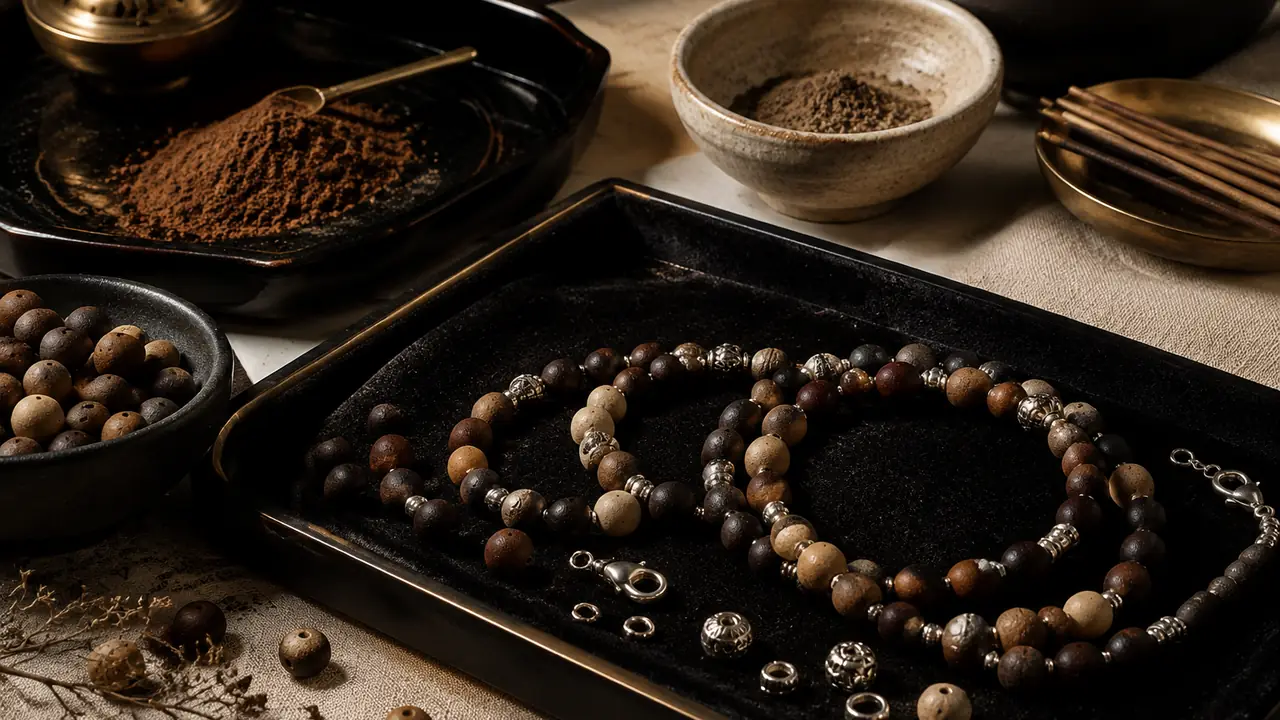
Why jewelry brands use incense beads
A jewelry brand's difficulty is rarely design; it is finding a component that behaves consistently when it is produced in quantity. Wood and botanical beads add warmth, scent and a natural texture beside silver, glass or stone, but they come with their own variables: dimensional consistency, hole alignment, dryness and a surface that can mark or crack under a clasp. This program is about reducing those variables by writing them into the specification.
Incense beads are hand-rolled from sandalwood or agarwood powder bound with nanmu bark powder and honey, as described in how incense beads are made. They are available in round sizes from 6 to 20 mm, with a matte, slightly grainy surface that can be polished to a soft sheen.
Matching beads to silver findings
The key technical figure for a designer is the hole. Partner workshops commonly pierce beads with a steel needle to 1.2-2.0 mm. A silver spacer or end cap that has a larger interior than the hole will wobble, and one with a smaller interior will force the cord into a tight fit and, over time, crack the bead. The desk therefore asks for the cord or wire diameter and the findings before it fixes the hole, and sends a few sample strands to check the fit.
| Bead size | Typical hole | Usual finding | Common use |
|---|---|---|---|
| 6 mm | 1.2-1.5 mm | Small 925 silver spacer, thin cord | Stacking bracelets, 108 strands |
| 8 mm | 1.5-2.0 mm | Silver spacer, bead cap, charm | Core bracelet size, 18-22 beads |
| 10 mm | 1.5-2.0 mm | Silver cap, accent bead | Statement bracelets, 17-19 beads |
| 12 mm and above | 2.0 mm or on request | Pendant bail, large cap | Pendants, necklaces |
These are typical figures from partner workshops; the sheet fixes the actual values for each design. See also the incense beads and silver set page, which describes the finished set.
Metal compliance and reports
Jewelry sold in the EU and the United States must meet limits on nickel release and certain heavy metals in the metal parts. The names that matter are REACH for the EU and CPSIA for children's products in the United States. This page names them as pointers only and quotes no values; the actual requirements depend on the product type, the market and the age group, and must be checked for your target market. The desk's role is to obtain a material declaration for 925 silver or silver-plated copper from the finding supplier, arrange a test report with an accredited laboratory when the brand requires it, and keep the report with the lot. The wood bead is a separate item, documented by an ingredient declaration and, for agarwood, CITES documents per lot. See compliance and certifications and testing and inspection.
Loose beads by the kilogram
Designers who string their own pieces buy beads loose. The desk supplies them by weight in sealed bags or jars, typically from about 1-5 kg per bead size, sorted by diameter. An 8 mm bead weighs about 0.3-0.5 g as a typical figure, so a kilogram holds roughly 2,000-3,300 beads; the sheet records the actual weight band. Loose beads are inspected for size consistency, cracks and dryness before they are sealed with desiccant. Details on options such as pre-pierced or unpierced beads are on the loose incense beads page.
Mixed-material designs
- Wood and silver. Incense beads between silver spacers; keep the metal off the bead surface by using caps with smooth inner edges.
- Wood and stone. Mixing weights and sizes: stone beads are heavier, so use a stronger cord and knot between beads.
- Scented and unscented. A few incense beads in a strand of plain wood make a quieter scent and reduce material cost.
- Care. Avoid water and perfume on the bead; store sealed away from heat.
Illustrative example
An illustrative, anonymous case: an independent jewelry label wanted a wrist stack with 8 mm sandalwood beads and small 925 silver spacers. It sent spacer samples, the desk matched the hole to 1.5 mm, ran a 20-strand sample, and a test report on the silver parts was obtained for its target market before the first full order.
Ordering notes
Reference ranges, confirmed in writing: loose beads from about 1-5 kg per bead size; strung designs from 50-200 pieces; private-label packaging from about 300-1,000 pieces. Please include cord or wire diameter, findings and target market when you send an enquiry through the quote form.