
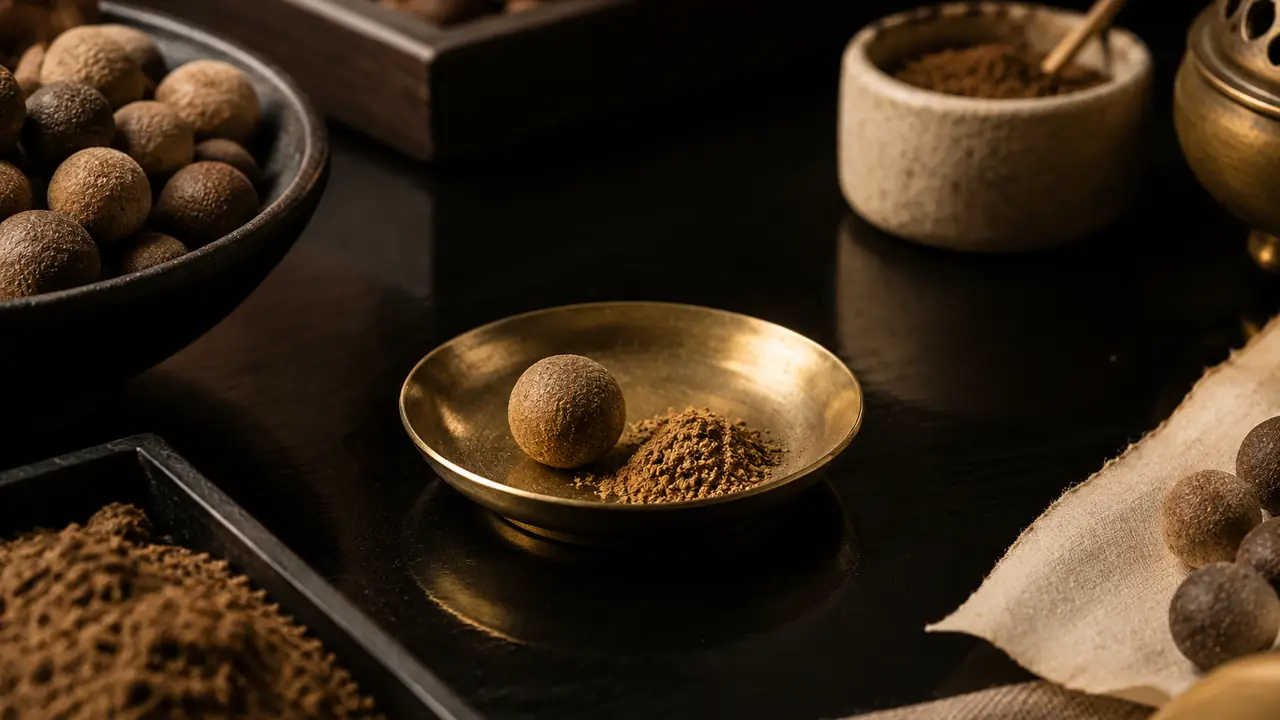
Why 108
The number 108 has been used for counting beads across several traditions, including Buddhist, Hindu and Daoist practice, though the explanations differ from one tradition to the next. Some give astronomical or numerological reasons; others link the number to lists of qualities, or to a convenient count that divides cleanly into 4, 9, 12 and 27. For commercial purposes, a buyer does not need to choose one explanation. It is enough to know that 108 is the established count, that customers who buy a mala expect it, and that many also buy shorter versions of 54 or 27 beads, which wrap the wrist several times.
Product copy should stay neutral. State that 108 is the traditional count used in several practices and describe the product; avoid ranking or judging any tradition, and avoid claims about spiritual or physical results.
The anatomy of a mala
| Part | Purpose | Typical specification |
|---|---|---|
| Main beads | The counted beads | 108 incense beads, 6 or 8 mm |
| Guru bead (mother bead) | Marks the start and end, so the count is not crossed | One larger bead, often 10 mm or more |
| Tassel or cord end | Finishes the strand and gives a place to hold | Cotton, silk or thread tassel |
| Spacers or markers | Divide the strand into counted sections | Optional; for instance at 27 or 54 |
| Counter beads | Track full rounds | Optional; small beads on a short string |
| Cord | Holds the strand together | Silk, cotton or strong thread with knots between beads |
The guru bead is the part that most often changes between designs. It can be a larger incense bead, a different material, or a bead with a metal cap. Because it does the work of marking the start, it should stand out clearly in the hand.
Building a mala in incense beads
An incense bead mala uses the same dough as a bracelet. What changes is the scale: 108 beads of 8 mm weigh about 32 to 54 g from the typical 0.3 to 0.5 g per bead, before the guru bead and tassel. Beads of 6 mm give a lighter and more compact strand that wraps several times on the wrist, while 8 mm gives a fuller look and is easier to handle for counting. Most studios choose one of these two sizes. Knots between beads are common because they keep the beads from rubbing and protect the strand if the cord breaks, and the spacing and cord strength should be written on the sample sheet.
Scent plays a different role here than on a bracelet. A mala is held in the hand and moved bead by bead, so friction and warmth release scent continuously, making the strand an aromatic object as well as a counting tool. The mechanism is explained in how incense beads release scent.
Choosing sizes and weights
- 6 mm. Light, easy to wrap, suited to wearing as a bracelet. Less comfortable for counting by thumb for long sessions.
- 8 mm. The most common choice for a mala. Good grip, a comfortable weight and room for a clear scent.
- 10 mm and above. Heavier and less common; suits a ceremonial or statement mala, and is mostly used for the guru bead.
Size choices tie into the channel. Yoga studios usually want a light strand that fits a retail display and a class mat bag. Retreat and temple shops tend to look for a plain, understated finish. The sizes article, incense bead sizes, gives counts and weights for all standard diameters.
Shorter strands and how they are sold
Not every customer wants a full 108 strand. Half and quarter versions with 54 or 27 beads are common because they are lighter, cheaper and easier to wear as a bracelet. Some shops sell a single scent line in three formats: a 108 mala for practice, a 54 wrap for the wrist and an 18 to 22 bead bracelet for everyday wear. This works well because the same dough and bead size serve all three, so development is done once. If you plan such a range, keep the bead size constant across formats so the scent and look are consistent, and label each format by count so customers are not surprised by the length. A sample set of all three is a sensible first order.
Specifying a 108 strand for an order
- Bead size and scent line: for example 8 mm sandalwood.
- Total bead count including or excluding the guru bead; make this explicit.
- Guru bead size, material and any cap.
- Knotting between beads or continuous stringing, and cord type.
- Tassel material and color.
- Any counters or markers, and where they are placed.
- Packaging: pouch, box or tin with desiccant.
Mistakes at this stage are the most common source of rework: a strand with 108 beads plus a guru bead is a different product from one with 108 including the guru. Write the count and the structure in the order, and ask the workshop to confirm the sample against it.
Minimums, timelines and quality checks
A 108 strand is more labor than a bracelet because there are more beads to roll, dry and thread. As a reference range, stock-style strands are quoted at about 50 to 200 per design, and branded or boxed programs usually start higher, around 300 to 1,000 per design; custom formulas are quoted from about 500. Typical sample times run 5 to 10 working days for stock lines and 15 to 25 days for custom formulas, with production in the 15 to 40 day range depending on the program. These are reference ranges, confirmed in writing for each order, and they are listed on the MOQ and lead time page.
For quality checks, count the beads on a random pull from each lot, check that all hole centering allows even hanging, pull-test the knots and weigh a sample strand. The count is easy to verify and is a cheap way to catch a workshop error before shipment.
Presenting a mala respectfully
Many buyers of 108 strands use them for practice, so presentation matters. Use clear and neutral language, avoid joking or decorative references to sacred objects, and provide a short card explaining care: keep dry, store sealed and handle gently. Customers appreciate a clear statement of what the strand is made from and how the beads were produced. For wider product guidance, see the yoga and meditation studios solutions page, or send your brief through the quote form.