
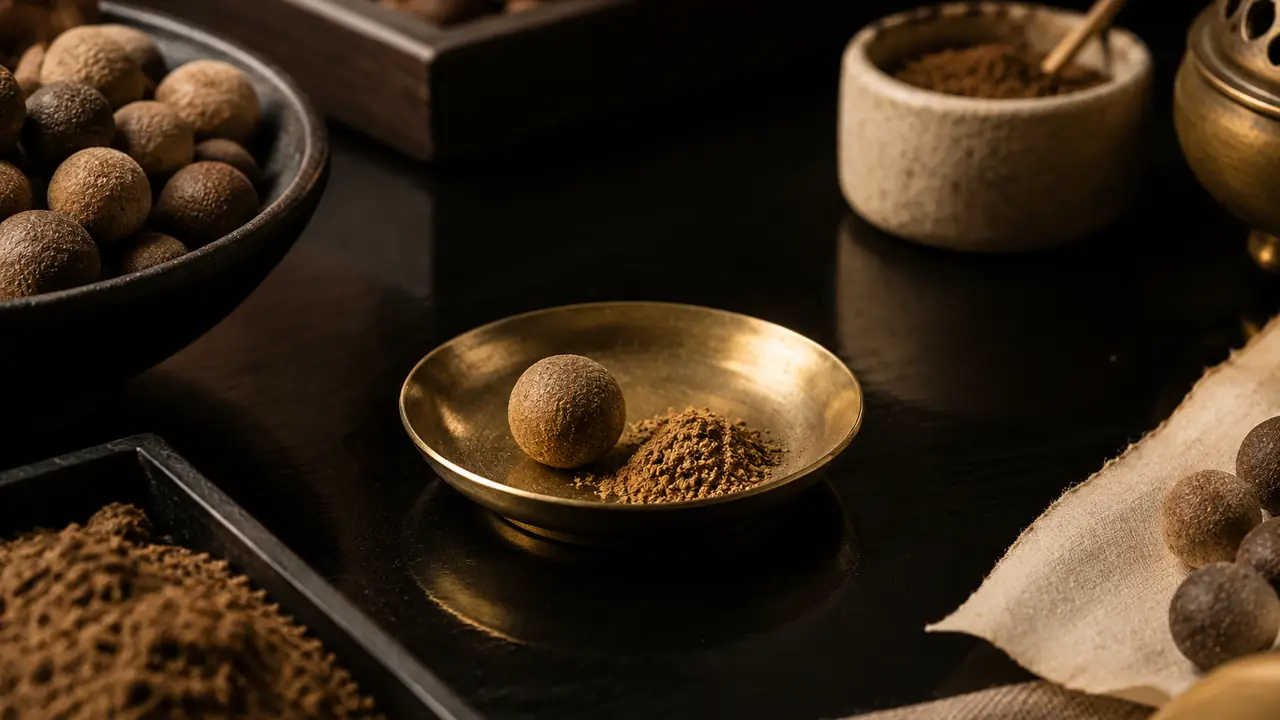
The standard size range
Workshops roll incense beads in a set of diameters that has become a de facto standard: 6, 8, 10, 12, 15, 18 and 20 mm. Smaller and larger sizes can be rolled on request, but the standard set matches the tools, molds and drying racks that partner workshops already use, which keeps lead times and minimums at their typical reference levels. Size is measured across the widest point of a dried and polished bead, because the bead shrinks as it dries.
Because beads are rolled by hand and weighed before rolling, the same nominal size can vary slightly from one bead to the next. A tolerance is agreed in the order, usually on the average of a sample strand rather than on each bead.
Size, count and weight at a glance
| Size | Typical count on a bracelet | Typical single-bead weight | Common use |
|---|---|---|---|
| 6 mm | More than 8 mm, set on the sample | Lighter than 8 mm | 108 strands, slim bracelets, women's wear |
| 8 mm | 18-22 | About 0.3-0.5 g | Standard bracelet, 108 strands |
| 10 mm | 17-19 | Heavier than 8 mm, workshop weighed | Fuller bracelets, men's wear |
| 12 mm | Fewer than 10 mm, set on the sample | Workshop weighed per design | Statement bracelets, necklace beads |
| 15-20 mm | Counts vary by design | Workshop weighed per design | Pendants, pocket beads, accent beads, charms |
Only the 8 mm and 10 mm figures are typical reference values; counts for other sizes depend on wrist size and on whether spacers are used, and weights are set by workshop weighing on the approved sample. Use the table to plan, then confirm the numbers on that sample.
A practical way to read the table is by wrist. A wrist of average size takes about 18 to 22 beads at 8 mm; going down one step adds beads and going up one step removes them, so the total strand length stays about the same. Sellers who offer a size range, such as small, medium and large, usually keep the bead size fixed and change the count by one or two beads, which is simpler to stock than changing the diameter. Ask the workshop to supply a count chart with the sample if your customers span a wide range of wrist sizes, and state on the product page which cord is used, because elastic and silk stretch differently.
What each size does well
- 6 mm. Delicate and light. It suits slim bracelets and 108-bead strands that need to wrap several times without bulk. Scent presence is moderate because there is less material per bead, although the many beads add up.
- 8 mm. The default. It balances weight, scent, appearance and cost, and it is the size most formulas are developed at. If you are launching one SKU, 8 mm is the lowest-risk choice.
- 10 mm. A fuller look with a stronger presence on the wrist. It reads as a gift-quality bracelet and suits men's lines, though it is heavier and costs more for the same bead count.
- 12 mm. A statement size. Usually offered with fewer beads or as a necklace element.
- 15 to 20 mm. Accent beads, pocket beads and charms. They are bought singly or in small groups, often as the centre bead of a hanging charm or a mala guru bead.
Holes, cords and findings
The hole is as important as the diameter. Common hole sizes run from 1.2 to 2.0 mm, and the right choice depends on the cord. Elastic cord needs a hole just large enough to pass the cord twice for knotting, silk cord needs room for a knotted tail, and metal findings with set pins need an exact match. A hole that is too large lets the bead rattle and chip; one that is too small makes stringing difficult and can split the bead. The pierce also has to be centered, since an off-center hole makes a strand hang unevenly. Hole size is decided at the sample stage and should be written into the order together with the cord type. Details for silver spacers and caps are in incense beads with silver.
Size effects on cost and production
| Factor | Smaller beads | Larger beads |
|---|---|---|
| Material per piece | Less per bead, more beads per strand | More per bead, fewer beads |
| Rolling effort | More beads to roll for one strand | Fewer beads but more to shape and dry |
| Drying time | Quicker, lower crack risk | Slower, higher crack risk |
| Freight volume | Compact | Bulkier by volume, still light |
The cost of a strand moves with both material weight and the number of beads handled, so a 6 mm strand with many beads may cost about the same as an 8 mm strand with fewer, even though it uses less powder. Large beads dry more slowly and are more likely to crack if rushed, which is why they can need a longer window. See the making process for the drying step.
Checking size consistency
- Agree the nominal size and the tolerance on the order, as an average across a sample strand.
- Measure ten beads from the sample with calipers and record the range.
- Weigh a full strand and write the weight on the approved sample sheet.
- Check hole centering by threading a pin through ten beads.
- Repeat the measurements on a random pull from each production lot before shipment.
Keep one sealed reference strand from the approved sample so any later lot can be compared directly, rather than relying on memory.
Choosing a size for your channel
Yoga studios and retreat shops usually want 6 or 8 mm for 108 strands. Fragrance brands and gift programs usually choose 8 mm for the core range and 10 mm for a premium variant. Jewelry brands often use 8 or 10 mm to match their metal findings. When in doubt, request sample strands in two sizes and compare them on the wrist before committing. Once you have chosen, enter the size, count and hole into the quote form; the desk will return a formula sheet and typical reference timelines from MOQ and lead time, confirmed in writing per order.