
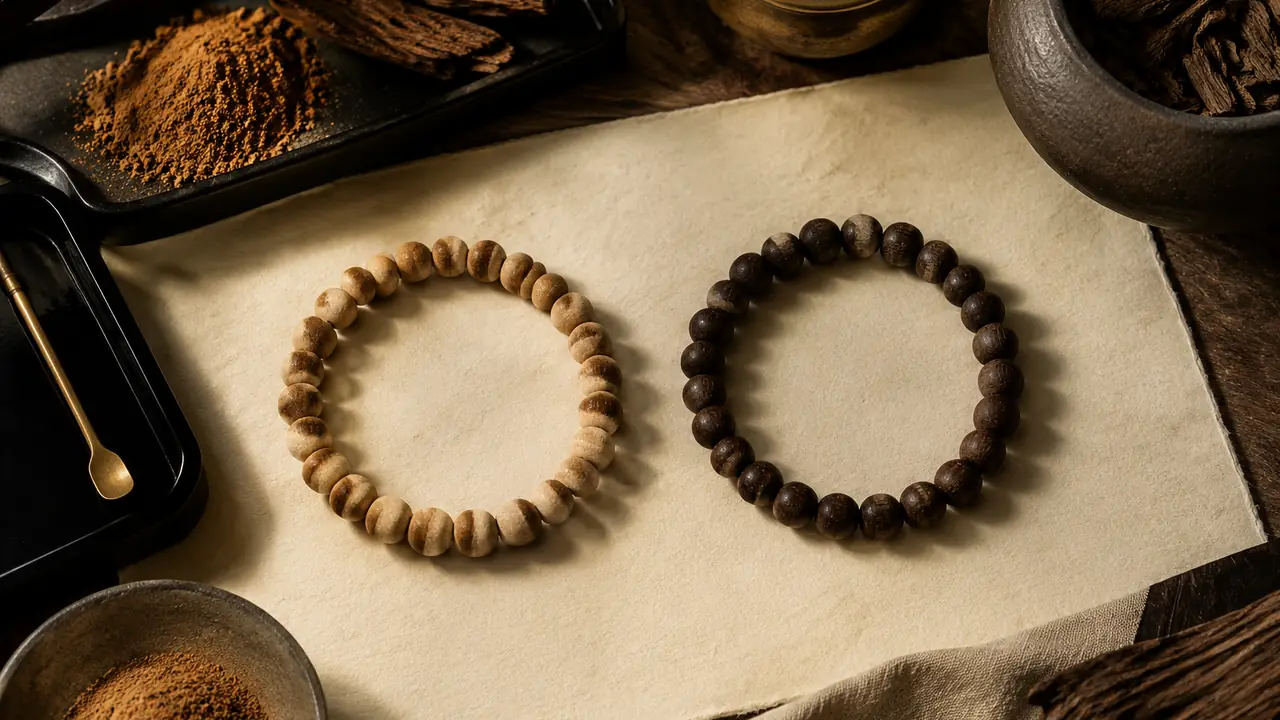
Why these three sizes
Partner workshops roll incense beads in a standard set of diameters, and 6, 8 and 10 mm are the sizes at which most formulas are developed, sampled and sold. Smaller sizes feel delicate, larger sizes feel substantial, and 8 mm sits between them. A fourth size, 12 mm, appears in statement pieces, but for first programs the three below are enough. Each size uses the same dough, the same binder and the same process, so the decision is about product design and channel, not about the material.
Side-by-side comparison
| Criterion | 6 mm | 8 mm | 10 mm |
|---|---|---|---|
| Scent character | Soft and close; builds with many beads and with wear | Balanced; the size formulas are tuned for | Fuller and more present on the wrist |
| Scent life | Years with proper storage; less material per bead | Years with proper storage | Years with proper storage; the most material per bead |
| Weight and feel | Lightest; slim, delicate look | Typically about 0.3-0.5 g per bead; medium feel | Heavier per bead; fuller, gift-like feel |
| Bead count on a bracelet | More than 8 mm; set on the sample | Typically 18-22 | Typically 17-19 |
| Documents needed | Same as the line: ingredient declaration, origin, CITES for agarwood | Same | Same; more material may mean more powder to document per lot |
| Typical channel | 108 strands, slim and women's bracelets | Core bracelets, gift, e-commerce, fragrance retail | Premium and men's lines, gift boxes, specialist retail |
| Relative cost factors | Less powder per bead, more beads to roll and pierce | Reference point for most quotes | More powder per bead, longer drying, higher crack risk |
How the size changes the product
6 mm: delicate and flexible. The small bead allows a longer strand without bulk, which is why 108-bead meditation strands are usually offered in 6 or 8 mm. A 6 mm bracelet can wrap twice and sit comfortably under a cuff. The drawback is that the scent per bead is low, so the overall impression depends on the number of beads and on wear. The small size also makes consistency of hole and roundness more visible, so quality checks matter more.
8 mm: the default. Most buyers should start here. It gives enough material to carry a real scent, a comfortable weight and a count that fits a normal wrist. Sample sheets, packaging inserts and cord choices are most readily available at this size. The reference is the sandalwood incense bead bracelet line.
10 mm: the premium step. A larger bead reads as a gift and feels weightier, with a more noticeable scent when the wrist is warm. It uses more powder per piece and dries more slowly, so it sits higher in price for the same bead count. It suits men's bracelets and boxed gifts, and it pairs well with larger silver or metal spacers. See also the agarwood incense bead bracelet, which is often specified at this size for a premium tier.
Production and logistics effects
Size changes the production picture in three ways. First, bead count: a smaller bead means more beads to roll, weigh, pierce and sort for a single strand, so labor does not drop in proportion to material. Second, drying: larger beads dry more slowly and need more careful humidity control to avoid cracking, which is why a 10 mm run can take longer than a 6 mm run within the same drying window. Third, freight: all three are light, but 10 mm cartons are bulkier by volume, which shows up in carton count rather than weight.
None of this changes the typical reference MOQ for stock designs, which is in the range of 50 to 200 pieces per design, confirmed in writing for each program. Ranges for samples and production are on MOQ and lead time.
How to decide
- Pick 8 mm if you want one low-risk core SKU.
- Pick 6 mm if the product is a 108 strand, a layering bracelet or a women's slim line.
- Pick 10 mm if the product is a premium gift, a men's line or a piece paired with larger metal findings.
- If your range will have two sizes, choose 8 mm plus either 6 or 10 mm, not 6 and 10 together, so the difference between them is clear to customers.
- Request sample strands in the sizes you are considering and wear them on a real wrist before approving the order.
Holes, cords and consistency by size
Hole size interacts with bead size. Common holes run from 1.2 to 2.0 mm, and a 6 mm bead has less wall around the hole than a 10 mm bead, so a wide hole in a small bead leaves it fragile and prone to chipping at the opening. Elastic cord is normally doubled through the hole, which sets a practical lower limit on hole size, while silk cord with a knot needs room for the tail. Ask the workshop to confirm the hole and the cord together, and to check hole centering on a sample of ten beads. A pierce that wanders is more visible in a small bead and more likely to split it.
Consistency checks also scale with size. Calipers read a small bead with less margin for error, so agree the tolerance as an average over a sample strand rather than per bead. Weigh a full strand and write the weight on the approved sheet; strand weight is the quickest way to catch a lot that has drifted in size or density. Keep a sealed reference strand from the approved sample so any later lot can be compared directly. The same discipline applies to all three sizes, but it pays off most with 6 mm, where small variations in diameter change how the strand sits on the wrist.
Matching size to channel
Yoga and meditation channels tend to prefer 6 or 8 mm for malas, as described in bracelet vs 108 mala. Fragrance and gift programs usually choose 8 mm for the core and 10 mm for an upper tier. Jewelry brands choose the size that matches the proportions of their metal findings, since the size of the spacer and the bead should look balanced. When the target customer is unknown, a mixed sample pack of 8 and 10 mm usually reveals the preference quickly.
Once you have chosen, state the size, count, hole size and cord in your brief. The quote form collects these details and the desk will return a formula sheet with a typical reference timeline for the program.