
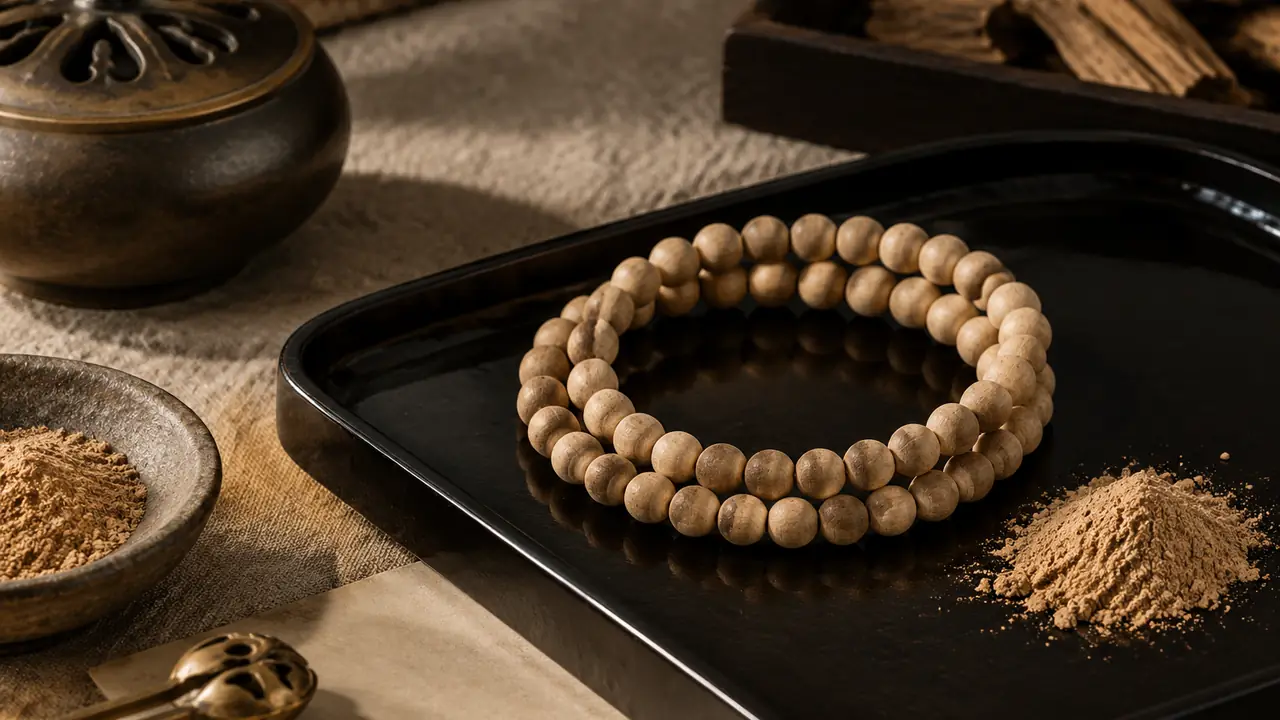
What the bracelet is made of
The standard sandalwood bracelet uses Santalum album powder as its main material, about 60% of the dry mix by weight. Nanmu bark powder, a natural plant binder, makes up roughly a quarter, honey and water provide plasticity, and a small share of botanical accents rounds the scent. No synthetic fragrance oil and no industrial glue are used in the standard specification, and any change is confirmed in writing before production.
| Component | Share by weight | Role |
|---|---|---|
| Sandalwood powder | 60% | Scent and body |
| Nanmu binder | 25% | Holds the bead together |
| Honey and water | 10% | Plasticity while rolling |
| Botanical accents | 5% | Rounds the scent, adjusts color |
These are standard-version figures; they move slightly with bead size and the dryness of the powder, and the formula sheet is confirmed for each program.
Origin and the word Laoshan
Santalum album is listed as vulnerable by IUCN and is not a CITES Appendix species, but India restricts the export of sandalwood, so the legal supply for most buyers is Australian plantation wood. Some lots use legally sourced Indian material. The desk states the origin for every lot rather than assuming it.
You will see the phrase Laoshan sandalwood in the trade. It is a trade term for old-stock sandalwood from the Mysore region and is not a certification. Ouvare describes beads by their actual source and does not use the phrase as a quality claim. The sandalwood guide explains how to read origin statements, and agarwood vs sandalwood beads compares the two materials.
Scent and appearance
Sandalwood reads as creamy, milky and softly woody, with a quiet sweetness and none of the sharp edge of resinous woods. On the wrist it stays close to the skin rather than projecting. The color runs from pale tan to warm light brown and darkens gently with handling and age. Many users describe the scent as calming; that is a sensory description and not a claim of any effect.
Sizes, counts and weights
| Bead size | Typical beads per bracelet | Typical use |
|---|---|---|
| 6 mm | About 28-32 | Slim wrists, layered stacks |
| 8 mm | 18-22 | Standard unisex size |
| 10 mm | 17-19 | Statement piece |
| 12 mm | About 14-16 | Bold men's size |
An 8 mm bead weighs about 0.3-0.5 g, so a finished bracelet is about 7-9 grams (typical). Holes are normally 1.2 to 2.0 mm. Larger sizes up to 20 mm exist but are rarely used for bracelets.
Options worth specifying
- Cord. Elastic for volume lines, knotted silk or waxed cord for a finer finish.
- Findings. Plain, or with a spacer and charm as in the silver set.
- Finish. Matte or polished; a light polish gives a soft sheen without lacquer.
- Branding. Foil pouch with desiccant as standard; cards, cloth bags and boxes for retail, see packaging and gift boxes.
- Blend. A small share of agarwood can be added for a darker, longer scent; this becomes a custom formula.
Who buys it and why
Sandalwood is the line that sells most easily because the scent needs no explanation. Lifestyle brands use it as a core wearable fragrance item, gift buyers like the neutral color and the soft aroma, and online sellers value a light, low-risk product that ships in a small pouch. Retailers often pair two bead sizes under one design name so that customers can choose by wrist, and some add a second tier with a small share of agarwood. Because the base is a plain, natural powder, it also takes branding well: a clean card, a printed pouch and a short origin note are usually enough to present it properly. The fragrance and lifestyle brand page shows how these programs are usually built.
Care and storage
Keep the bracelet away from water, perfume and hot surfaces. Take it off before washing, swimming or exercise, since sweat and soap shorten the scent and can weaken the cord. When not worn, store it sealed in a pouch or small jar. Because the scent is activated by warmth and friction, a bracelet worn regularly keeps its aroma for years with proper storage, and a faded one revives after a day in a closed jar. For retail, include a short care card; the desk can supply the text.
Inspection and ordering
Each lot is sampled for diameter, weight, hole centering, surface cracks and mold spots, dryness and scent against a retained sample, as described in testing and inspection. Stock bracelets typically start from 50-200 pieces per design, private-label packaging from about 300-1,000 pieces and custom formulas from about 500 pieces with sample rounds. Batch production commonly takes 25-40 days. All ranges are typical references confirmed in writing for each program; send your sizes through the quote form.