
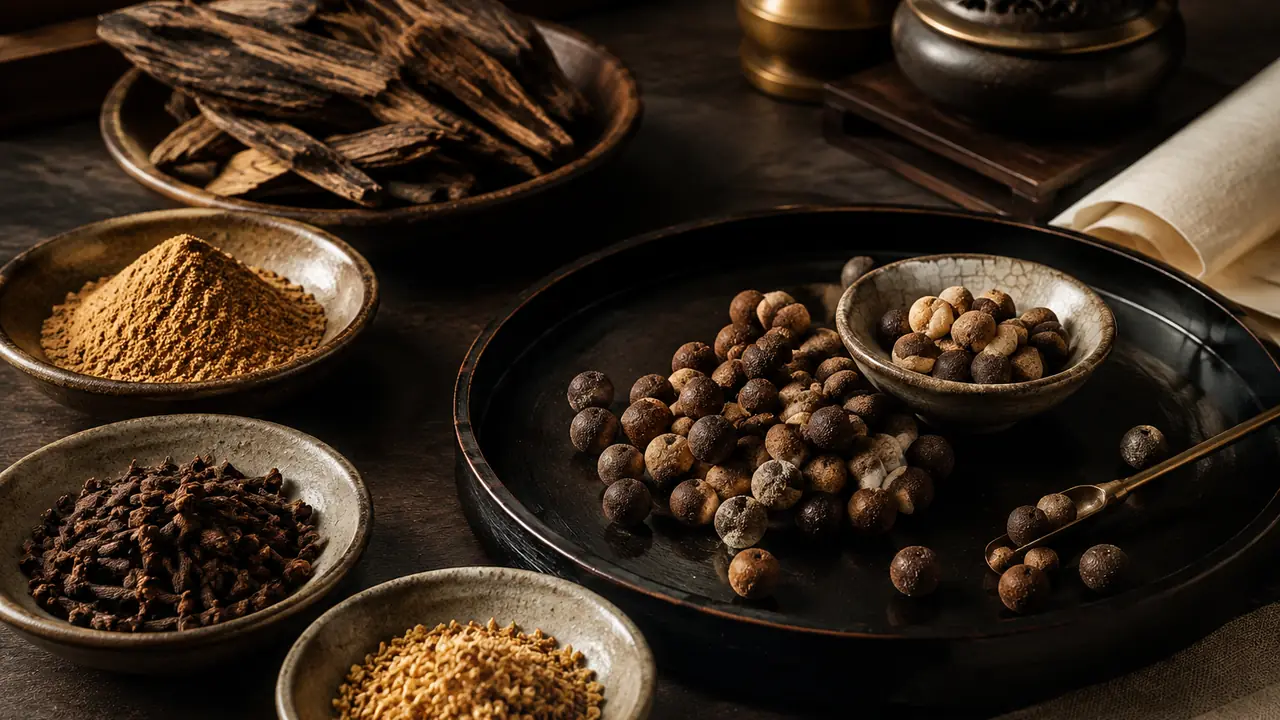
Why botanicals are added
A bead made only of sandalwood powder, nanmu binder and honey is calm and simple. Adding botanicals gives a formula a name and a direction: a warmer spice note, a sweeter floral top, a green herbal edge. In Chinese blended incense, the base wood is called the body and the botanicals are the supporting notes; a good formula balances them so that no single note stays dominant for long. In bead work, additives are usually a small share of the powder, often just a few percent, because a strong spice can overwhelm a mild wood.
The additives are ground to powder together with the base materials, so they are part of the bead rather than a coating. Nothing here is a fragrance oil: the standard specification uses no synthetic fragrance oils and no industrial glue, confirmed in writing for each order.
Common botanicals and what they contribute
| Botanical | Part used | Scent contribution | Handling note |
|---|---|---|---|
| Clove | Dried flower bud | Warm, spicy, sweet, sharp | Strong; used in small share; may be a declared allergen in some markets |
| Cinnamon | Bark | Warm, sweet, woody spice | Strong; small share; darkens the dough |
| Osmanthus | Dried flower | Soft, apricot-like floral sweetness | Delicate; scent fades faster than wood |
| Rose | Dried bud or petal | Soft floral | Fine texture; lightens the scent of heavier woods |
| Mugwort | Leaf | Green, herbal, dry | Traditionally used in sachets and incense; fibrous, needs fine milling |
| Patchouli | Leaf | Earthy, sweet, deep | Blends well with agarwood; strong |
| Star anise | Fruit | Sweet, licorice-like spice | Small share |
| Frankincense | Resin | Bright, resinous, lemony | Softens when warm; keep share low so beads do not get tacky |
The materials above are traditional in blended incense and are widely available in the trade. Which ones appear in a particular bead is stated on its formula sheet, with percentages, for the order in question.
Floral, spice and herbal directions
- Floral. Osmanthus and rose lift the base and suit a gift or daily-wear line. They are delicate, so the share should be modest and the packaging should protect scent.
- Spice. Clove, cinnamon and star anise add warmth and an immediate lift. They suit autumn and winter collections but should be balanced with sandalwood so they do not dominate.
- Herbal. Mugwort and other leaf materials give a dry, green character. Traditional use of mugwort is in sachets and in incense for the home; in a bead it is a scent note, nothing more.
- Resin. Small amounts of frankincense or other resins add a bright resinous top note and are used with care because of their softness.
Handling and workmanship
Each botanical behaves differently in the dough. Flowers and leaves are light and dry, and they add bulk without adding stickiness, so the binder share must be checked. Resins can melt or become tacky when warmed by the hand, so they are kept low. Spices are oily and strong, and a coarse spice powder leaves visible flecks on the bead surface. Fine milling and sieving solves most of these issues, as does aging, which allows the individual notes to settle into one scent. Partner workshops commonly rest the dough, shade-dry the beads for five to ten days and then polish and age them; see how incense beads are made.
Seasonal and regional collections
Botanicals are the easiest way to build a range without changing the base material. One sandalwood bead can become four or five collection scents by changing only the supporting notes, and the same size, cord and packaging keep the cost of the range manageable. A few examples of how brands usually organize this are below; these are directions to discuss with a workshop, not fixed recipes.
- Spring. Sandalwood base with rose or osmanthus, light and floral, in small 6 or 8 mm beads.
- Summer. Sandalwood with a dry herbal note such as mugwort, cleaner and greener.
- Autumn. Sandalwood with osmanthus and a touch of cinnamon, warm and sweet.
- Winter. Agarwood-accented blend with clove or star anise, deeper and spicier.
Each variant needs its own approved sample, and because the scent of delicate flowers fades faster than that of wood, the packaging should be sealed and dry. A range of this kind is easier to launch when the base bead is the same across all scents; the workshop can then keep a stock of base beads and finish each variant after the botanical blend is approved.
It also pays to test how a botanical reads after several weeks, not just on day one. Spices often smell strongest in the first days and settle after aging, while florals can soften quickly. Ask the desk for a sample that has been aged to the same time as your production lot, so that what you approve is what the customer will receive.
Compliance and declaration
Natural does not mean exempt from labeling. Some botanicals contain naturally occurring substances that are treated as fragrance allergens in certain markets, and ingredients sold into the EU or US may need an ingredient list and care in claims. Keep the following in the file for each program.
- A full formula sheet listing every botanical by common name and Latin name, with percentages.
- A statement that no synthetic fragrance oil, dye or industrial glue is used, confirmed in writing.
- A note on which botanicals may be relevant for allergen rules in the destination market, to be checked against current requirements.
- Product copy that describes scent only; no claim about health, sleep, mood or pests.
The broader subject is covered in natural ingredient declarations and compliance and certifications.
Building a botanical formula with a workshop
A practical brief gives the workshop a scent direction in words, a base material, a bead size and a mood board of two or three notes, and asks for two or three formula variants. The sample round then does the rest: wear, compare, adjust the share of one note and repeat. Custom blends need more time than a catalogue formula, typically reference ranges of 15 to 25 days for a custom formula sample, because drying and aging cannot be rushed. Quantities and timing are confirmed in writing per program. When your brief is ready, start from the custom blended incense page or send it through the quote form.