
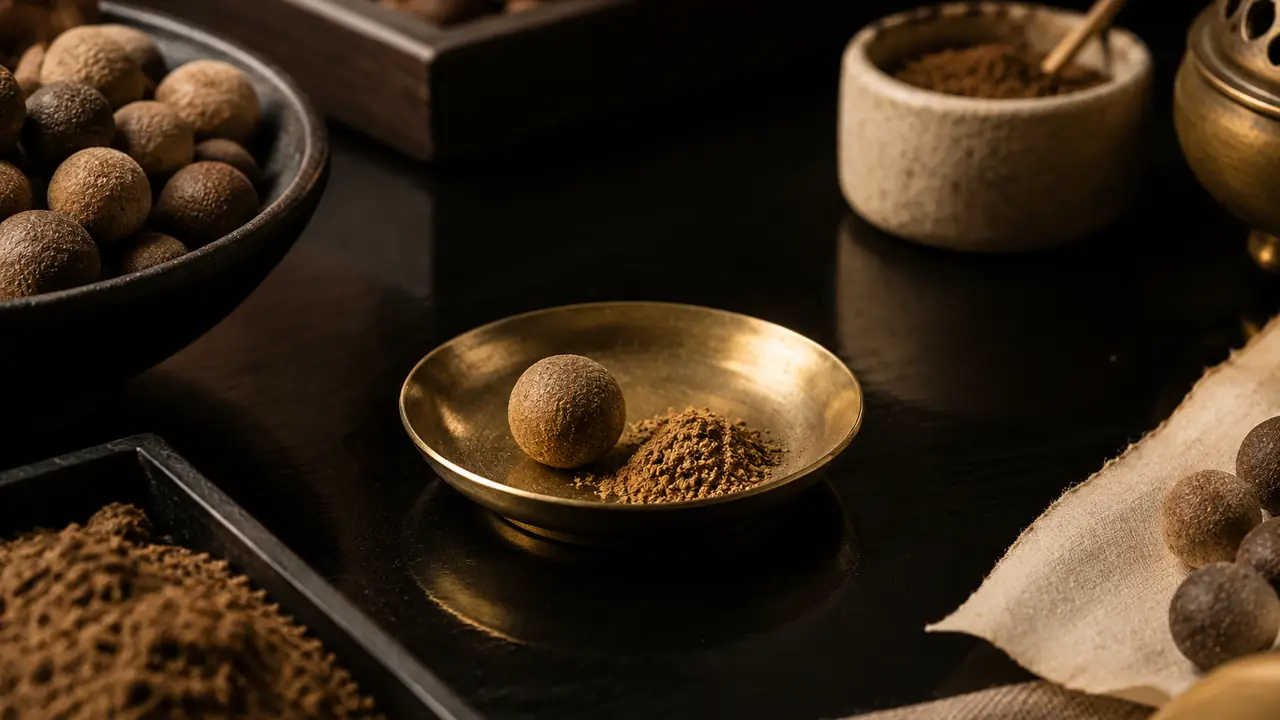
The four layers of a formula
Most incense beads can be read as four layers: a lead aromatic, supporting aromatics, a binder system and an optional finish. Each layer has a job, and the ratios between them determine scent, strength and durability.
| Layer | Typical materials | Example share (by weight) |
|---|---|---|
| Lead aromatic | Sandalwood or agarwood powder | About 50-60 |
| Supporting aromatics | Resins, herbs, spices, flowers | About 5-10 |
| Binder system | Nanmu bark powder, honey, water | About 30-35 |
| Finish | Gold or silver leaf, polish | Surface only |
The numbers are illustrative of a standard version; each line has its own sheet with exact percentages. For instance, a sandalwood line might be roughly 60 percent sandalwood powder, 25 percent nanmu binder, 10 percent honey and water, and 5 percent botanical accents.
Aromatic woods
Wood powders are the foundation. Sandalwood (Santalum album) gives a creamy, milky and warm scent; the origin is stated per lot, either Australian plantation wood or legally sourced Indian wood. Agarwood (Aquilaria) gives a deeper, resinous, slightly sweet scent; it is listed in CITES Appendix II, so documents come per lot. Other woods, such as cedar or camphor wood, appear in some blends as supporting notes. Each wood is dried and milled to a fine powder and sieved. Fineness matters, because coarse powder leaves a grainy bead and releases scent unevenly. Details on origins and grades are on the sandalwood guide and agarwood guide pages.
Resins
Resins add depth and fix the lighter notes so they last longer. Frankincense, benzoin and similar tree exudates are common in hexiang recipes. They are sticky and oily, so a formula with much resin needs a different binder balance, and resins that are too strong can overpower wood. Resin quality varies a lot, and some resins are regulated under their own trade rules, so ask for origin and documents when a resin is a named ingredient.
Herbs, spices and flowers
Dried herbs and spices are the supporting cast. Clove, cinnamon, star anise and similar kitchen spices add warmth or sweetness; dried flowers such as osmanthus or rose add a soft floral top note; peels such as tangerine or citrus add brightness. In traditional recipes these materials are valued for their fragrance, and in some texts for other uses. The standard buyer-facing description keeps to scent: these are aromatic accents, not functional additives. Product copy should not promise any health effect from any herb. A longer discussion appears in the article on botanical additives in incense beads.
Binder, honey and water
Binder turns powder into dough. Nanmu bark powder is the standard, at about a quarter of the powder weight; honey is a plasticizer that makes the dough supple and rounds the scent; water or a botanical liquid such as pear or flower water wets everything. Beeswax sometimes appears in small amounts. These choices are what separate a botanical bead from one made with glue or oil. Read more in the nanmu binder guide.
Finishes
Some beads carry a thin layer of gold or silver leaf applied by hand, or a light polish. These are decorative and do not change the scent, though a leafed bead may release scent slightly slower where it is covered. If you are specifying a finish, state its material in the order, since gilt leaf and metal powder are not the same and may carry different declarations.
Why ratios matter more than ingredient lists
Two beads can list the same ingredients and smell nothing alike. A formula with sixty percent sandalwood and one with forty percent behave differently in the hand and on the wrist: the first is fuller and more expensive, the second quieter and cheaper. A small change in the supporting layer has an outsized effect, because strong spices and resins dominate quickly. This is why a formula sheet should give percentages, why sample rounds are needed for any custom blend, and why a reference bead is kept. When comparing quotes from different workshops, compare the lead aromatic share first, because it explains most of the price difference.
Documents that follow each ingredient
| Ingredient | What to ask for |
|---|---|
| Sandalwood powder | Species and origin per lot, plantation or legally sourced statement |
| Agarwood powder | Species, origin, and CITES documentation per lot |
| Resins and herbs | Names and origin of named ingredients |
| Nanmu binder and honey | Source statement and food-grade handling for honey |
| Leaf and findings | Material declaration, plus metal test reports where findings are used |
Requesting these at the sample stage, not at shipment, avoids delays at customs. The compliance side is set out on the compliance and certifications page.
What is left out
- Synthetic fragrance oils. Not used in the standard specification; they would be a declared custom request.
- Industrial glue. Not used in the standard specification.
- Dyes and colorants. Not used unless specified; color comes from the powders and ageing.
- Fillers of unknown origin. A hidden filler lowers the aromatic share and weakens scent.
Confirm all of these in writing with the order, since what is not on the formula sheet is hard to challenge later.
How to read a formula sheet
- Check that the lead aromatic is named by species and that its origin is stated.
- Check that supporting ingredients are listed by name, not as a mystery blend.
- Check that the binder is named and quantified.
- Check that percentages add to 100 and use weight, not volume.
- Check that exclusions - no oil, no glue, no dye - are written, not implied.
A sheet that passes these five checks gives your compliance team what it needs for an ingredient declaration, and it gives the workshop something to repeat from lot to lot. Keep a reference bead from the approved sample so a later lot can be compared directly. The comparison with products that only look similar is set out in incense beads vs scented wood beads.
To put a formula into your own project, describe the lead scent, size, format and quantity in the quote form. Typical reference minimums for custom formulas are listed on MOQ and lead time, and are confirmed in writing for each program.