
Why the process is slow
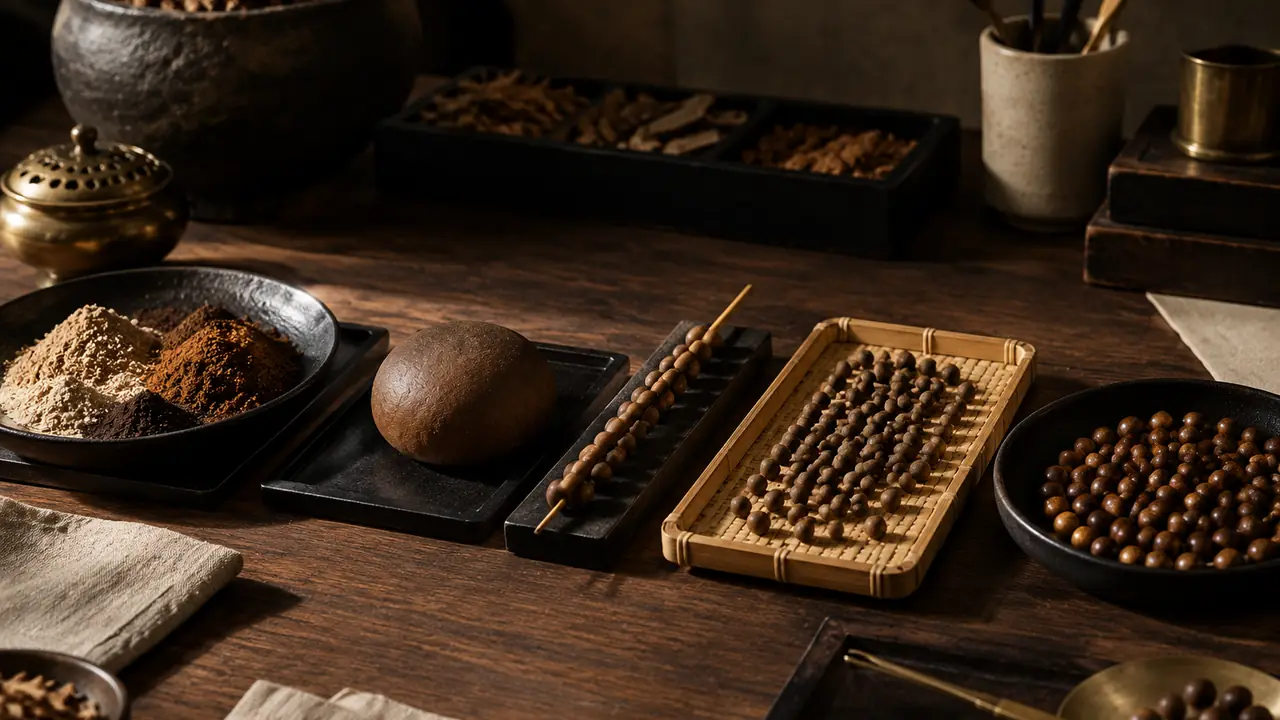
An incense bead cannot be hurried. The powders must be dry and fine, the dough must rest, and the bead must lose its water gradually or it cracks. Apart from milling, the steps are performed by hand, which is why partner workshops in the Fujian and Guangdong incense clusters count minimums in dozens and hundreds rather than thousands, and why a formula sample takes 15-25 days. The sequence below is the common workshop practice coordinated by Ouvare, described as typical rather than as a certified standard.
The seven steps in depth
- Material preparation. Woods and botanicals are selected, cleaned and, where the formula requires, prepared by methods such as steaming with fruit juice or soaking in herbal liquid. Wood is cut small enough to dry evenly. Moisture and foreign matter are checked at intake.
- Shade-drying and milling. Prepared material is dried in shade, away from direct sun that would drive off volatile scent, then milled and sieved. Milling is the only mechanized step. A fine sieve gives a smooth bead; a coarse one leaves a rough surface.
- Blending into dough. Powders are weighed by the formula sheet, mixed with nanmu bark powder, about 25% of the total powder, and combined with warm water, herbal liquid or honey. The mixture is kneaded until it holds together without sticking. See the nanmu powder binder.
- Resting the dough. The dough is sealed and left for about 24 hours, sometimes with a round of pounding. The binder hydrates evenly, the moisture spreads through the mass and the aroma starts to marry.
- Rolling and piercing. The dough is cut into pieces by weight, rolled round between the palms or in a mold and pierced with a steel pin. Weight control at this step decides how consistent the finished diameter is.
- Shade-drying the beads. Beads are laid in trays in a cool, ventilated place for five to ten days, turned regularly. Workshops often aim for about 25 C and 60% relative humidity. Direct sun or a hot oven causes splitting and a flat scent.
- Polishing and aging. Beads are polished by hand or in a tumbler to a soft sheen, sorted, then sealed in jars to age so the scent settles. Aging can run from days to weeks, depending on the formula.
What is controlled and for how long
| Step | What is controlled | Typical time |
|---|---|---|
| 1. Material preparation | Species, moisture, cleanliness | Days, depending on method |
| 2. Drying and milling | Dryness, sieve fineness | 1-3 days |
| 3. Blending | Weights, binder share, water | Hours |
| 4. Resting | Sealed, uniform moisture | About 24 hours |
| 5. Rolling and piercing | Weight per bead, roundness, hole position | Hours to days by volume |
| 6. Shade-drying | Temperature, humidity, turning | 5-10 days |
| 7. Polishing and aging | Surface, scent settling | Days to weeks |
Times are workshop reference figures, typical rather than fixed for a specific lot, and are confirmed in writing for each program.
Drying parameters as workshop practice
Shade-drying is where most failures occur. Beads that dry too fast crack at the hole or split along the surface; beads that dry too slowly develop mold spots. Workshops therefore aim for stable conditions, about 25 C and 60% humidity, and turn the trays so that all sides dry evenly. In the rainy season a dehumidifier or a longer drying time is used; in dry winters, trays may be covered with cloth to slow the surface. These values are working practice, not a standard that Ouvare certifies, and the desk asks workshops about their method when shortlisting. Weight stability over two or three days is a good sign that a bead is dry.
Checks along the way
- Intake: moisture and cleanliness of powders.
- After rolling: weight and diameter on a sample from each tray.
- After drying: cracks, mold spots and hole centering.
- Before packing: scent against the retained sample and final humidity.
The full inspection routine is on quality control and testing and inspection. A fuller description of a partner arrangement is on production process.
What this means for your order
The two longest steps, shade-drying and aging, cannot be compressed without a visible loss in quality. That is why custom formulas take about 40-60 days from approval, why samples must wait for drying, and why rushing a program usually costs more than planning ahead. For your own formula, see custom blended incense. Typical minimums and lead times are on MOQ and lead time, all confirmed in writing for each program; send the details through the quote form.