
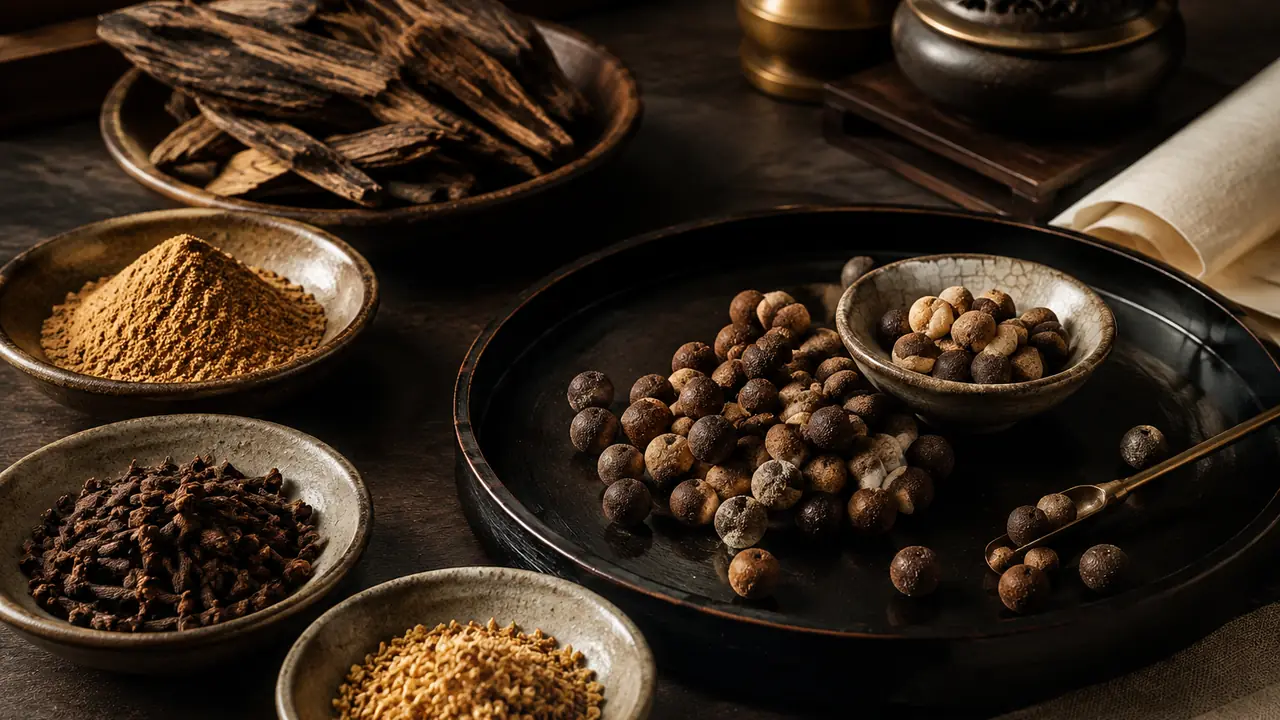
The problem a binder solves
Ground sandalwood or agarwood is dry and has almost no natural stickiness. Pressed on its own it falls apart when dried. A binder gives the particles something to hold onto; a plasticizer keeps the dough soft and cohesive during rolling and piercing. A bead maker needs both, in the right proportions, and the choice of these two materials decides the bead's strength, surface, color and even its scent.
In the standard Ouvare specification the binder system is plant-based: nanmu bark powder as the main binder, honey as the plasticizer, and water or a herbal infusion to bring the dough together. No industrial glue and no synthetic fragrance oils are used, and this is confirmed in writing for each order.
Nanmu bark powder: the main binder
Nanmu powder is ground from the bark of Phoebe trees, long used in Chinese incense making. When mixed with water it forms a smooth, sticky mucilage, and when dried it sets firm. It is nearly scentless, which is exactly why it is preferred: it holds the bead together without competing with the aromatic powders. In bead work it commonly makes up about a quarter of the powder weight, though the exact share depends on the grain of the other powders and on bead size.
Too little nanmu and the bead cracks or crumbles; too much and the bead turns hard, dark and gluey in feel, and the aromatic share in the formula drops. A workshop that knows its powders will adjust the ratio by hand, testing a small piece before each batch. This is part of why bead making is craft work. More detail is in what is nanmu powder.
Honey: plasticizer, not glue
Honey in beads is used in small amounts, as a plasticizer. It softens the dough, helps it spread under the palm and slows surface cracking during drying. It also gives a slight sweetness and a faint sheen after polishing. It is not the main binder, and a bead made with too much honey will stay tacky, attract moisture and risk mold. Beeswax is sometimes used in small amounts for extension in the dough, as noted in workshop practice. Both are traditional materials in Chinese blended incense.
Binder materials compared
| Material | Role | Effect on bead | In standard spec |
|---|---|---|---|
| Nanmu bark powder | Main binder | Firm, matte, nearly scentless hold | Yes, about a quarter of powder weight |
| Honey | Plasticizer | Workable dough, fewer cracks, slight sweetness | Yes, small share |
| Beeswax | Extender | Smoother rolling, subtle sheen | Optional, small share |
| Water or herbal infusion | Carrier | Activates the binder; may add a note | Yes |
| Sticky rice paste | Traditional binder in some historic beads | Softer, more moisture-prone | Not standard |
| Industrial glue or resin | Synthetic adhesive | Hard, scent-dulling, not botanical | No |
Historic court beads are recorded as using honey and sticky rice, but those formulas are for dry, controlled climates and are rarely suited to export shipping.
How the dough behaves in the workshop
- The aromatic powders are dry-mixed with the nanmu powder until the colour is even.
- Warm water and a little honey are added gradually while the dough is kneaded.
- The dough is wrapped and rested in a sealed container for about 24 hours so the binder hydrates fully.
- Pieces are divided by weight, rolled into spheres and pierced with a steel pin.
- Beads are shade-dried for five to ten days, turned regularly, in a cool, ventilated room.
Resting matters more than it appears. A dough that has been rolled too soon is uneven, and the beads crack as they dry. The full sequence is described in how incense beads are made.
Binder choice and climate
A bead is a small piece of hygroscopic material, and its binder system decides how it reacts to the weather. Nanmu-bound beads dried to a stable state are firm and keep their shape in ordinary conditions. Beads with a higher honey share absorb moisture more readily, which can make the surface feel slightly tacky in tropical climates and increases the chance of mold in a closed shipping carton. That is why the sealed foil bag, desiccant and dry carton are part of the specification, and why workshops usually dry beads in a controlled room around 25 C and 60% relative humidity before they are packed.
For importers selling into humid regions, it is reasonable to ask for a lower honey share in the formula, or a sample that has been through a simulated humid period before the program is approved. For dry markets the difference is less visible. Either way, the binder system should be written into the specification so that reorders use the same formula, and so that any change, even a small one, is raised before production rather than discovered at delivery.
Remember also that scent and binder interact. A very high binder share dilutes the aromatic powders, and the bead may smell flat even if the powders are premium. The workshop will balance the two, and a short sample round is the best way to confirm that the balance suits your product.
What goes wrong, and how it shows
- Surface cracks. Often too little binder, too fast drying or dough that was not rested.
- Hard, glassy feel. Too much binder, or a binder that is not nanmu.
- Tacky or damp surface. Too much honey or insufficient drying. Risk of mold in a humid shipping container.
- Weak scent. Binder share too high, leaving too little aromatic powder; or an industrial adhesive masking the aroma.
- Beads that fall apart under a pin. Insufficient binder or uneven mixing.
Quality checks the desk runs on samples and pre-shipment lots, such as hardness by finger pressure, surface cracks and mold spots, are described in quality control.
What to ask the workshop
Ask for a written statement of the binder system: which binder, approximate share, whether honey or beeswax is used, and whether any synthetic adhesive, dye or fragrance oil is present. Ask also what the workshop does when a batch shows surface cracks, and whether a retained sample is kept. The statement goes into the specification and stays with the order. If your brand needs to describe the binder to customers, a line like hand-rolled with natural nanmu bark binder and a little honey is accurate and easy to understand.
Typical reference MOQ and lead time are on MOQ and lead time and are confirmed in writing per program. To start a specification, use the quote form.