
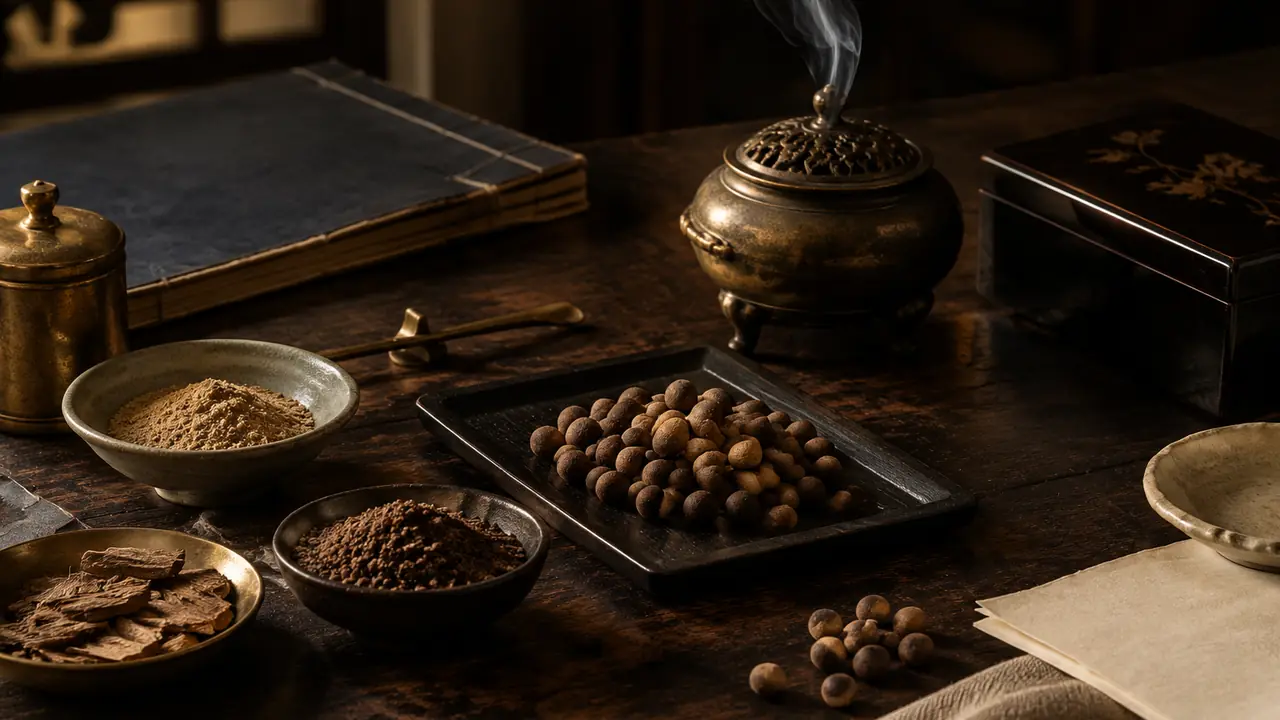
Why these four
The incense manuals of the Song and Ming periods, including Chen Shi Xiang Pu, Hong Chu's Xiang Pu and the compendium Xiang Sheng, give space to many materials: resins, barks, flowers, spices and roots. Four of them stand out because they show up in so many formulas and because each plays a distinct role in a blend. Agarwood and sandalwood are woods that carry the body of a scent. Musk and ambergris are animal materials valued as fixatives that deepen and hold a blend. A good way to read a classical recipe is to ask which of the four it uses, and in what role.
The four at a glance
| Material | Source | Traditional role | Status in Ouvare lines |
|---|---|---|---|
| Agarwood | Resin-infused heartwood of Aquilaria trees | Deep, resinous body of a blend | Used; CITES documents per lot |
| Sandalwood | Heartwood of Santalum album and related trees | Soft, creamy, woody body | Used; origin stated per lot |
| Musk | Secretion of the musk deer | Fixative that gives depth and persistence | Not used |
| Ambergris | A waxy substance from sperm whales, found at sea | Fixative with a soft, sweet depth | Not used |
Agarwood
Agarwood forms when certain trees of the genus Aquilaria respond to injury or infection by producing a dark, fragrant resin in the heartwood. The resinous wood is cut, graded and ground, and has been prized in Chinese, Arabic and South Asian traditions for centuries. In a blend it provides the deep, resinous center. Today the whole genus is listed in CITES Appendix II, so export of agarwood products requires permits and documentation for each lot. Plantation material from Dianbai in Guangdong and from Hainan is part of the modern supply, alongside imported stock. Details are in the agarwood guide.
Sandalwood
Sandalwood, chiefly Santalum album, supplies the soft, milky, woody note that most people associate with incense beads. In classical formulas it is the other great wood, often the supporting material to agarwood as in the goose pear formula, in which sandalwood is a tenth of the agarwood by weight. Santalum album is listed as vulnerable by the IUCN but is not in the CITES appendices; India restricts the export of sandalwood, and legal supply today comes mainly from Australian plantations, with origin stated per lot. The trade term Laoshan refers to old Indian stock and is used here only as a trade term. See the sandalwood guide.
Musk and ambergris in history
Musk is the aromatic secretion of the male musk deer, and ambergris is a waxy substance formed in the digestive system of sperm whales and found afterward floating or washed ashore. Classical writers valued both as fixatives. Added in small quantity, they were said to deepen a blend and make its scent last. Many Song and Ming formulas include one or the other, and any serious reading of the old books has to account for them.
That history is the reason they appear in the phrase, and it is not a reason to use them today. Musk deer are protected, and trade in natural musk is restricted by conservation law in many jurisdictions. Whales are protected too, and the legal treatment of ambergris differs from country to country, which makes it difficult to document across borders. In both cases the material is expensive, hard to verify and open to substitution, since much of what is sold under the names is not what the label says.
What a fixative does, and what stands in
A fixative in a blend slows the evaporation of lighter notes, so that the scent holds its shape for longer. Musk and ambergris played that part in the classical formulas. In a hand-rolled bead the work is shared among several plant elements. The dense resinous base of agarwood slows the release of lighter notes. Sandalwood, which is itself a slow-evaporating wood, steadies the middle of the scent. Honey and nanmu bark powder form a matrix that holds the powders in place and shapes how fast scent leaves the surface. Long resting and aging in sealed jars then let the components settle together. None of this reproduces the character of an animal fixative exactly, and it does not need to; the aim is a coherent plant-based scent that holds up through wear.
Where Ouvare draws the line
Musk and ambergris are not used in any Ouvare line. The reasons are practical and ethical: documentation across import markets is unreliable, verification is hard, and nothing is gained for a wearable bead, since sandalwood, honey and nanmu binder give a body and hold that suit the format. Beads that need a classical profile use the plant materials the formula calls for, and the formula sheet notes where a historical recipe would have used an animal fixative. This also keeps the standard specification clean: botanical powders, nanmu bark binder and honey, with no synthetic fragrance oil and no animal-derived scent materials.
- Classical recipes that call for musk or ambergris can be rebuilt without them, with the substitution disclosed.
- Any supplier who offers natural musk or ambergris beads should be asked for legal origin and import documents; if none exist, decline.
- Descriptions such as musk-like can describe a scent character, but should not be used for a bead that contains no musk.
Using the phrase in marketing
- Present the four as a historical grouping, referenced to the classical manuals by name.
- State plainly which two are used in the product and which two are not.
- Do not imply a product contains all four.
- Keep claims to scent character and tradition; no claims about effects.
A one-line note on a product card, for example that the line uses two of the four classical materials and none of the animal ones, is usually enough, and it protects the brand from questions in markets that are sensitive to animal-derived ingredients. It also gives retail staff a simple, accurate answer when a customer who has read about the old recipes asks whether the beads contain musk. The answer is no, and the formula sheet shows what is in them instead. To put a bead line together around agarwood or sandalwood, open a brief on the quote form; reference minimums are on MOQ and lead time. Related reading: agarwood vs sandalwood beads.