
Why old formulas still matter
Chinese incense was written about as an art long before it became an industry. From the Song dynasty onward, scholars collected compound incense formulas, recording each ingredient by weight, the preparation method and a name for the result. These texts are the origin of the hexiang craft behind modern blended incense beads. For a brand, an old formula brings two things: a balanced starting point that has survived centuries of use, and a story that can be told honestly. This page is a scholarly summary, not a recommendation of use, and makes no claims about health or effect.
The main source texts
| Text | Period | What it contains |
|---|---|---|
| Chen Shi Xiang Pu (Master Chen's Incense Manual) | Song dynasty | A compilation of compound incense formulas, with ingredients and preparation, including the goose pear recipe |
| Xiang Sheng (Incense Compendium) | Ming dynasty | A wide collection of incense knowledge, materials and formulas gathered from earlier sources |
Both texts are quoted by later authors and by modern researchers. Details such as the exact meaning of an ingredient name or the weight of a liang vary between editions, which is why reconstructions are interpretations and not exact copies. The partner ateliers work from published modern editions and from the household knowledge of heritage practitioners.
The goose pear formula
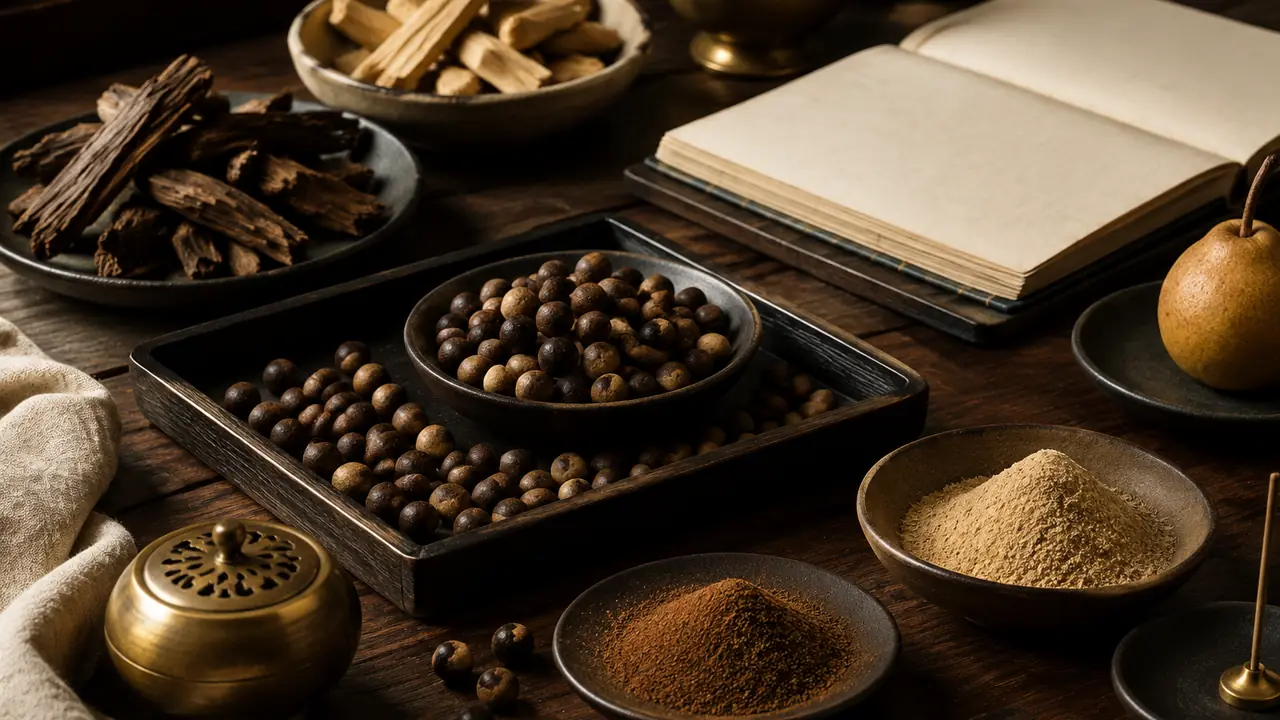
The best-known example is the goose pear tent incense, e li zhang zhong xiang. The classic text calls for one liang of agarwood powder, one qian of sandalwood powder and ten goose pears. The pears are hollowed and filled with the powder, capped, steamed three times, and the pulp and powder are then ground together. Tradition attributes the recipe to Li Yu, last ruler of the Southern Tang, though that attribution is a matter of tradition and later accounts. Burned or worn, it yields a sweet, fruity scent over dark resin. The bead version is explained on goose pear incense beads and in goose pear incense history.
Palace medicine beads
Court records and later accounts also describe scented beads made in palace workshops, where aromatic woods, resins and herbal materials were combined into pills and beads for wear and for gifts. Such objects are often called palace beads. Because surviving records are partial and sometimes literary, they are cited here as a historical background to bead making, not as a source of specific formulas, and Ouvare does not claim to reproduce any named palace recipe. Whatever such materials were used for historically, the beads supplied today are sold for their scent and craft.
How ateliers adapt formulas to beads
An old formula is written for burning, so it must be translated to a wearable bead. The adaptation typically covers five points:
- Units. Liang and qian are converted to percentages, so a ratio such as 10 to 1 becomes a share of the mix.
- Binder. A plant binder, nanmu bark powder at about 25% of the powder, is added so the powder can be rolled. See the nanmu binder guide.
- Fineness. Powders are milled finer than for burning so the bead is smooth.
- Drying. Shade-drying for five to ten days replaces the quick drying suited to loose incense.
- Material sourcing. Agarwood requires CITES documents per lot and sandalwood requires an origin statement; see the agarwood guide and sandalwood guide.
The adapted formula is written as a sheet and sampled, and the result is compared with the old text for balance, not for literal identity.
Reading a classical recipe
A classical entry usually lists ingredients and weights, then gives a short method: grind, sieve, steam, mix with honey or fruit pulp, seal and bury or store for a period. Three habits help when reading one. First, ingredient names changed over centuries, so the same word may point to different plants in different periods; scholars compare several editions before settling on an identification. Second, the weights are relative; a liang is ten qian, so a recipe of one liang to one qian is a ratio of ten to one, and the absolute amount is a matter of batch size. Third, the method matters as much as the list: steaming with fruit or storing the mix sealed changes how the scent develops. Ateliers therefore record both the ratios and the method when they adapt a text, and the formula sheet notes where the bead version departs from the original.
Starting a program from an old text
If you want to base a product on a historical recipe, send the text or the name in your brief. The desk will shortlist a partner atelier, prepare the formula sheet and run sample rounds, as described on custom blended incense. Typical minimum is about 500 pieces and the typical batch time about 40-60 days, confirmed in writing for each program. See MOQ and lead time and the quote form.