
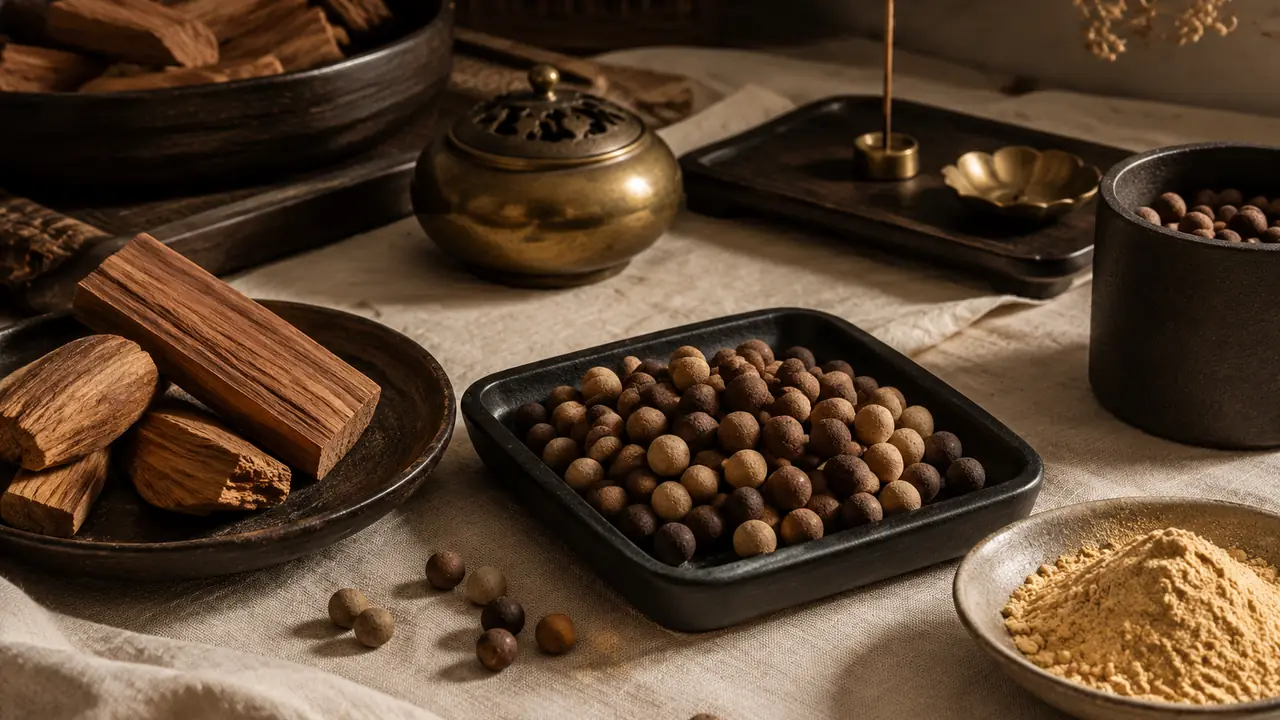
Two species, two scents
Most of what is sold as sandalwood comes from one of two species. Santalum album, white or East Indian sandalwood, is the classic material: creamy, milky, slightly sweet, with high levels of the aromatic compound santalol. Santalum spicatum, Australian sandalwood, grows wild and in plantations in Western Australia; its heartwood smells drier, more resinous and less sweet and is more often used in sticks, cones and blends. Hand-rolled beads for the Ouvare range use Santalum album as the main material, because the creamy scent works for wearing against skin. Both species are described on the lot, not assumed.
India, export rules and plantation supply
Indian sandalwood historically came from the forests of Mysore and neighboring states, and India has long restricted the felling and export of sandalwood. Cut wood is state controlled, and exports of heartwood are limited, so the legal flow of old Indian material to export markets is small. Since the 1990s, Australia has grown Santalum album in large irrigated plantations, mainly in the north of Western Australia and the Northern Territory, and that supply has become the mainstream legal source for powder. Where Indian wood is used, the lot comes with the paperwork that documents its legal source, and the origin is stated on the lot as either Australian plantation or legally sourced Indian wood.
| Origin | Typical species | Scent character | What the lot should show |
|---|---|---|---|
| Australian plantation | Santalum album | Creamy, milky, soft | Origin statement, harvest year if available |
| Legally sourced Indian wood | Santalum album | Rounder, deeper, older wood notes | Origin statement and supporting legal documents |
| Western Australian wild or plantation | Santalum spicatum | Dry, resinous | Species and origin named on the lot |
IUCN status, not CITES
Santalum album is assessed as Vulnerable on the IUCN Red List. That is a conservation status, not a trade listing: sandalwood is not in CITES Appendix I, II or III, so no CITES permit is required for beads. This difference matters in practice. The paperwork for sandalwood is an origin statement per lot and, for Indian material, proof of legal source, while agarwood needs CITES permits as explained in the agarwood guide. Importers should still check their own country's plant-material rules.
Laoshan as a trade term
In Chinese trade usage, laoshan tan, meaning old mountain sandalwood, refers to old-growth Indian (Mysore) sandalwood, prized for a deeper, sweeter scent. It is a market term, not a legal or scientific classification, and it is used loosely. Ouvare describes wood by its actual source on each lot and does not use the term as a quality claim. If a buyer requests laoshan material, the desk asks the partner workshop for the origin documents and states the origin as shown on them; where documents are incomplete, it says so. Background on the difference between woods is in agarwood vs sandalwood beads.
Powder grades
As with agarwood, there is no universal grade scale. Powder is described by how it is made and how it smells:
- Heartwood powder. Milled only from the aromatic core, pale yellow to tan, with the creamiest scent.
- Mixed powder. Includes some sapwood, paler and lighter in scent, usually lower cost.
- Sieve fineness. Finer powder gives smoother beads; coarse powder leaves a rough surface.
- Freshness. Freshly milled powder is brighter; older powder matures but should not smell musty.
Buyers should ask for a physical reference sample, a statement of whether the powder is heartwood only, and the origin on the lot. Sandalwood-type incense is the biggest sub-category of the stick market; Dataintelo puts it at about USD 0.52 billion, roughly 26% of the segment.
Storage and handling of powder
Sandalwood powder takes up moisture and odors easily. Partner workshops keep it in sealed bags or lined drums, away from sunlight and from strongly scented goods such as incense sticks or spices, and they sieve it again before blending if it has clumped. For beads, powder that has been stored damp will cause mold spots during the five to ten days of shade-drying, so moisture is checked at intake. Buyers who store powder for their own DIY work should do the same: keep it cool, dry and sealed, and use a desiccant pouch inside the container.
Ordering notes
Sandalwood bracelets typically start from 50-200 pieces per design, with origin stated per lot and confirmed in writing for each program. Sandalwood is the main body of the loose DIY beads and the sandalwood-led formulas in blended incense beads. See MOQ and lead time or send the brief through the quote form.