
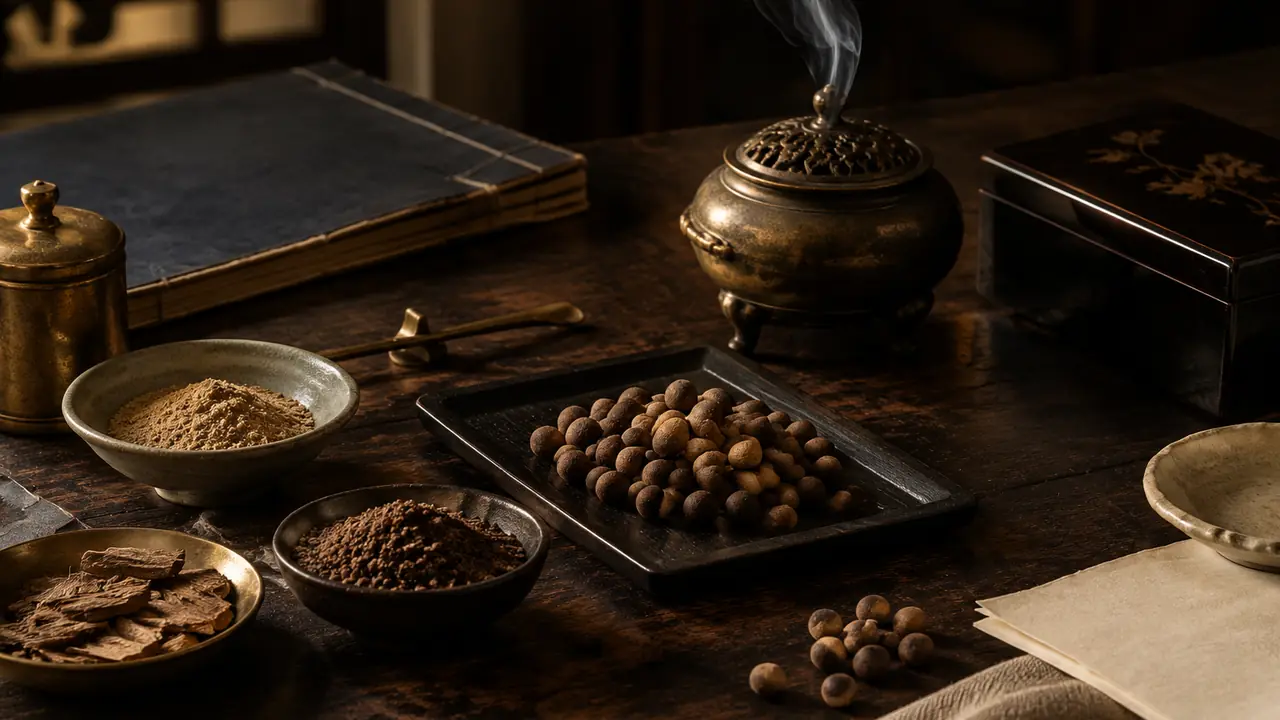
What the text records
The formula appears in Chen Shi Xiang Pu, the Song dynasty incense formulary compiled by Chen Jing. In the usual modern reading the entry calls for agarwood powder, one liang; sandalwood powder, one qian; and ten goose pears, with the instruction that the material is steamed three times. The liang and the qian are the traditional units of weight, and a qian is one tenth of a liang, so the recipe is built on a ratio of about ten parts agarwood to one part sandalwood by weight, with the pears supplying the moisture and the sweetness.
The entry is short, as most entries in such books are. It lists the materials, gives the quantities and describes one decisive process step. It does not say how fine the powder should be, how long each steaming lasts or how the finished material was shaped. Anyone reconstructing the recipe has to fill those gaps with workshop judgement, and an honest reconstruction says so.
The link to Li Yu
The name tent incense refers to the incense burned within the curtained bed or tent, a use common in the households of scholars and courts. Tradition attributes the goose pear version to Li Yu, the Southern Tang ruler of the tenth century who is remembered as a poet and a patron of incense. It is worth separating the layers. The formula text itself is found in a Song book. The attribution to Li Yu is a long-standing tradition, repeated in later writing on incense, and it gives the recipe its romantic reputation. A buyer can use the story in marketing as story, with the wording traditionally attributed to, and should not present it as a documented fact about a particular person making a particular batch.
Reading the formula part by part
| Element | In the classical text | In a modern bead |
|---|---|---|
| Chief material | Agarwood powder, 1 liang | Agarwood powder from plantation or legally documented stock, with CITES papers per lot |
| Supporting material | Sandalwood powder, 1 qian | Sandalwood powder, origin stated per lot |
| Fruit element | Ten goose pears | Goose pear or a close pear variety, as juice and pulp |
| Process | Steamed three times | Powder steamed with pear in repeated rounds, then dried |
| Binder | Not stated | Nanmu bark powder, with a little honey as plasticizer |
The last row matters most for bead makers. The classical formula describes a compounded incense, not a bead, so the binder is an addition of the modern product. That is a reasonable adaptation, and it should appear on the formula sheet as such.
Why the pear
The pear does more than flavor the blend. Steaming agarwood powder with fruit softens the sharp edge of the raw resin and gives a sweet, fruity, rounded top note that sits above the woody base. Many users describe the finished scent as sweet and soft compared with plain agarwood. In craft terms the pear juice also wets the powder evenly, so the repeated steaming cycles work like a slow infusion. Which pear is used matters. Goose pear is the classical name; modern workshops often use goose pear where it is in season and a similar pear when it is not, and any substitution should be stated plainly in the specification.
The result is a scent profile quite different from a straight agarwood bead. The pear note leads while fresh, then recedes as the beads age and the resinous base comes forward. How this compares with plain material is discussed in the agarwood guide.
How a workshop rebuilds the recipe
- Select and mill the agarwood and sandalwood to a fine, even powder.
- Prepare the pears: wash, core and press to juice, keeping the pulp.
- Combine powder and pear, then steam; repeat the steaming three times, drying lightly between rounds as the workshop judges.
- Dry the steamed material in the shade and mill again if it has clumped.
- Blend with nanmu bark powder and a little honey into a dough, rest the dough for about 24 hours, then roll, pierce and shade-dry the beads for several days.
- Polish and age the beads in sealed jars so the pear note settles into the base.
The steaming, resting and drying are why this is a slow line. Typical reference lead time for a custom classical formula is longer than for stock beads and is confirmed in writing for each program; see MOQ and lead time. The general sequence is explained in how incense beads are made.
What is faithful and what is adapted
A responsible description of a modern goose pear bead states three things. First, the ingredients follow the Chen Shi Xiang Pu entry: agarwood, sandalwood and pear, steamed three times. Second, the proportions of the finished bead include a binder and honey, which the classical text does not mention, so the proportions of the finished bead are not the same as the ten-to-one ratio of the recipe. Third, the absolute weights are scaled to a workshop batch, with the liang and the qian converted to grams. A brand that writes this on its product page is far more credible than one that implies a bead identical to a tenth-century one.
There is also a legal side. Agarwood belongs to the genus Aquilaria, which is listed in CITES Appendix II, so export of agarwood powder or beads needs documentation for each lot. The classical formula says nothing about this, but a modern buyer needs the papers. The desk asks partner workshops for the documents at lot level and describes them as documentation per lot on the order sheet.
Choosing a goose pear program
- Standard formula or custom. A standard formula is quicker. A custom variant, such as a different agarwood share or an added herb, needs sample rounds.
- Bead size. 8 mm is the common bracelet size; 6 or 10 mm are available. Larger beads hold more scent and take longer to dry.
- Presentation. The story suits a card that names Chen Shi Xiang Pu and the traditional attribution, set beside a plain statement of what is adapted.
- Retail fit. Temple and retreat shops, tea houses and gift programs tend to respond to the history. See solutions for temples and retreats.
The longer survey of classical recipes is in ancient incense formulas, and the formulary itself is the subject of Chen Shi Xiang Pu: Song dynasty incense formulas today. To start a sampling plan, send the bead size, quantity and packaging through the quote form.