
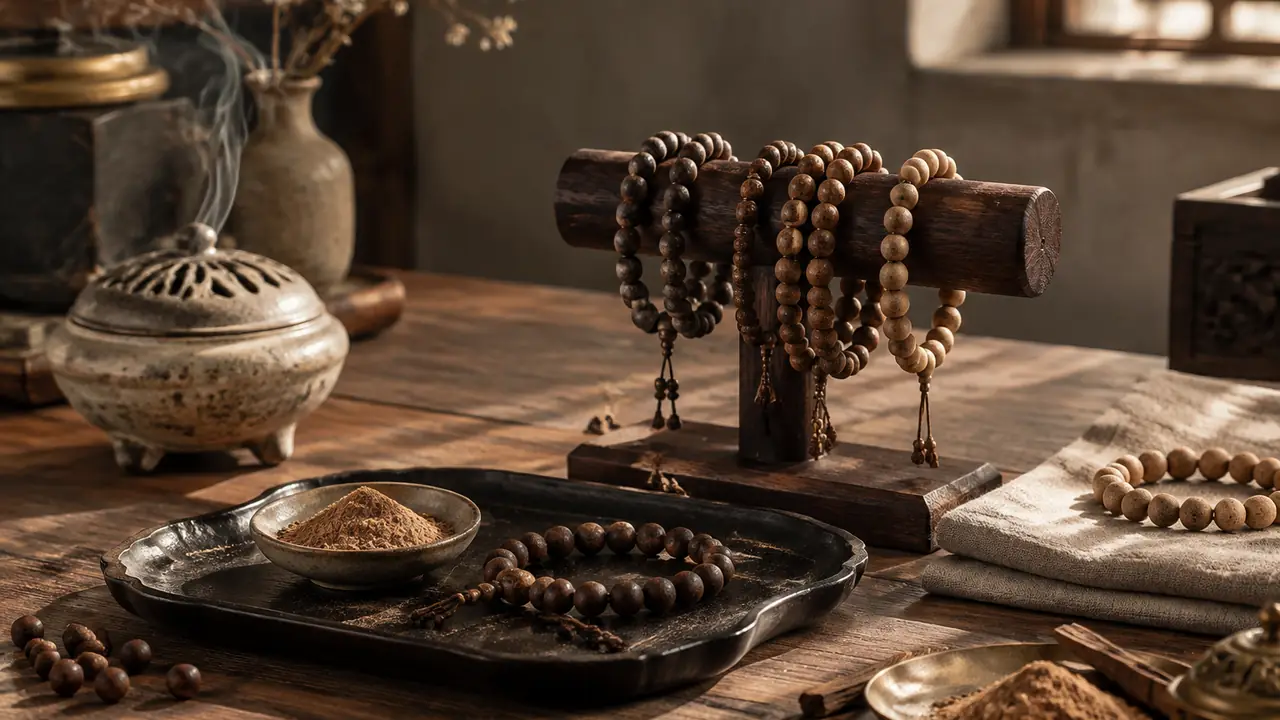
A shared material language
Tea and incense come from the same culture of attention. Both start with plant material prepared with skill, both are experienced slowly, and both reward small rituals: warming a cup, lighting a stick, turning a strand of beads in the hand. A shop that already sells tea, ceramics or tableware has a customer base that appreciates these links and expects products to be honestly described and well made.
Incense beads give such a shop a wearable item, a take-home keepsake that does not need a stand or a flame. Incense sticks and pills give a burned item for those who want a scent in the room. Combs and small tools give a durable object that suits a gift shelf. Together they make a small, coherent range that uses little floor space.
A range for the shelf
| Item | Role in the store | Typical spec |
|---|---|---|
| Incense bead bracelet | Entry item, impulse buy at the counter | 8 mm, 18-22 beads |
| Goose pear beads | Story item, pairs with fruit-note teas | Fruit-and-wood classical formula |
| Incense stick or pill box | Home use, gift | Bamboo-core or coreless sticks, pills, holder optional |
| Sandalwood comb | Gift, daily object | Wood origin stated per lot |
| Incense tools | Collector add-on | Holder, tongs, spoon, box |
Product pages for these items are the goose pear incense beads, incense stick and pill gift boxes, sandalwood combs and incense tools and the incense goods hub.
Pairing scent with tea
Pairing is a merchandising idea, not a science, and it should be described that way. A few reliable principles help staff recommend confidently.
- Match weight to weight. A soft, creamy sandalwood suits delicate green and white teas; a deeper agarwood suits aged or roasted teas.
- Match notes to notes. The sweet, rounded fruit in the goose pear formula echoes the fruity notes of some black teas and oolongs.
- Do not compete. Never burn incense at the tasting table while serving tea. Beads are better for this because they scent only the hand, not the air.
- Offer, do not prescribe. Say that the pairing is a suggestion based on the character of each; avoid statements about taste improvement or health.
A small card at the tea counter that lists two or three combinations is enough. It also turns a one-product sale into a basket of two.
Display in a scented space
A tea house is already full of aromas: leaves, steam, baked goods. A tester left open there is quickly lost in the noise. Place a lidded tin of testers on a separate shelf away from the tea bar, let customers open and warm a strand, and refresh it every few weeks. For sticks and pills, display unlit samples in the box and mention that they are best burned at home, not in the shop. Do not burn incense in a tea service area unless the space is designed for it.
Humidity needs attention, since steam rooms and kettles raise ambient moisture. Keep sealed stock in a dry cupboard, not on a shelf over a kettle station. Beads and boxes stored near steam may dull or grow mold on the surface; foil pouches and desiccant protect them. The care notes are in how to store incense beads.
Storytelling that fits the store
Customers in this channel expect more than a product name. A short note on the origin and the craft goes a long way: the powder is milled and sieved, kneaded with nanmu bark powder and honey, rolled by hand, dried in the shade for days and aged in a sealed jar. The goose pear formula, recorded in a Song dynasty formulary, offers a story that fits a tea house particularly well, since the recipe belongs to the world of scholars and gardens. Keep to the facts, mark classical references as references and avoid mystical or medicinal claims. Cultural background is given in goose pear tent incense.
Gift sets and seasonal moments
Tea houses and lifestyle stores do much of their business around a few seasonal peaks: festivals, mid-year gifting and the end-of-year period. Incense products adapt easily to a set. A bracelet and a small box of incense pills with a card is a coherent gift in its own right. A comb in a cloth sleeve alongside a bracelet reads as a considered present for a person who has everything. Because the pieces share materials and a color palette, a store can assemble sets itself from stock, which avoids a new minimum and lets staff tailor a gift to a customer in minutes.
If a store wants a repeatable set with its own name and packaging, that becomes a small private label program, typically from about 300 to 1,000 pieces per design for branded or boxed items. Plan such sets well ahead of the season, since artwork approval and hand production cannot be rushed, and keep one sealed set as the reference for later lots.
Finally, a note on staff knowledge. In a tea house, the person at the counter is the product expert. Give them a one-page summary of each item, a simple way to demonstrate warming a strand, and clear guidance on what not to say about health or effect. That small investment makes every sale more confident and every return less likely.
Ordering for a small shop
Lifestyle stores usually order several categories in small quantities, which is where the sourcing desk is most useful. Rather than negotiating with separate workshops for beads, sticks and combs, the shop sends one brief and the desk coordinates partner workshops for each line, then consolidates the shipment. Reference minimums are about 50 to 200 pieces per design for stock bracelets, 200 to 500 boxes for incense sticks and pills, and from 1 to 5 kg per size for loose beads. These are reference ranges only and are confirmed in writing for each program; they are listed on MOQ and lead time.
- Choose two or three categories to start, such as bracelets, a stick box and a comb.
- Pick a single scent family so that the range reads as a unit.
- Decide on packaging that matches the store's materials: kraft, linen, wood or ceramic.
- Request samples; stock samples typically take 5 to 10 working days.
- Place a consolidated order and plan shelf space and testers before the goods arrive.
Next steps
Send the categories, quantities and packaging preference through the quote form. The desk will shortlist partner workshops, return sample options and give a timeline confirmed in writing. If your shop is part of a chain or a group of stores, mention the number of locations so the volume can be planned across them.