
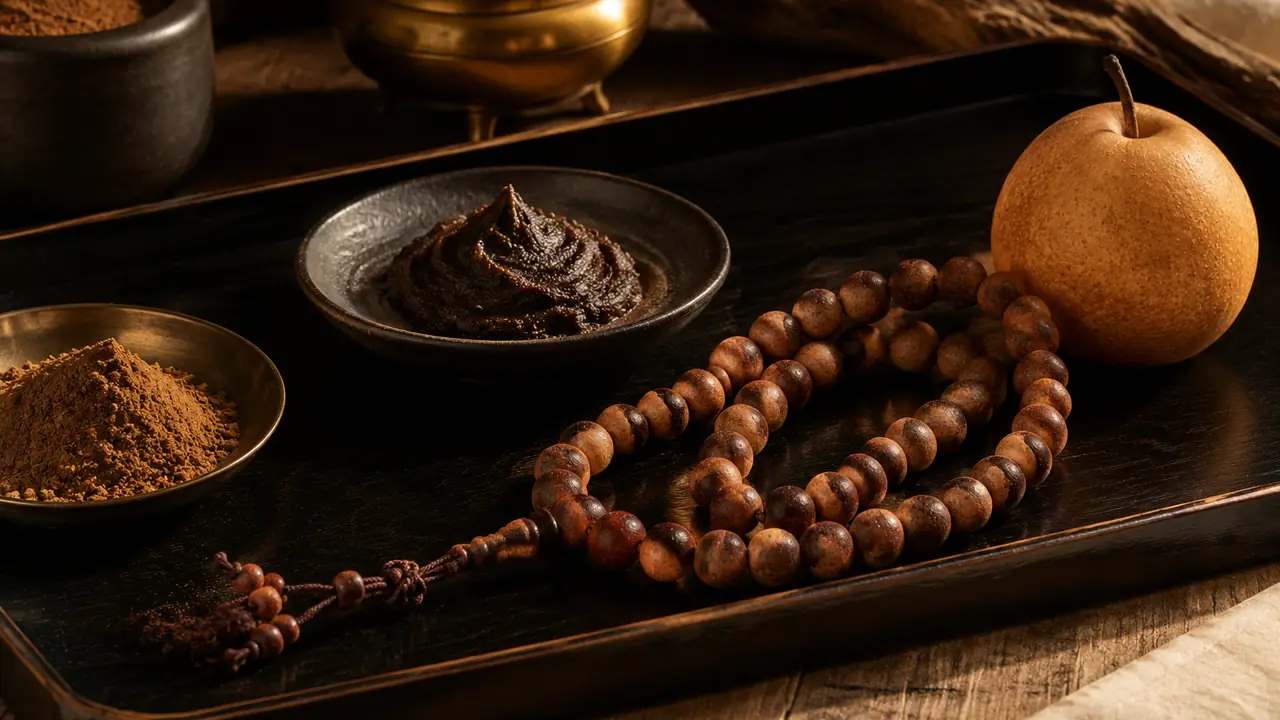
What goose pear incense is
Goose pear tent incense, or e li zhang zhong xiang, is a formula first recorded in a Tang dynasty note and written out in full in the Song dynasty Chen Shi Xiang Pu and the Ming compendium Xiang Sheng. The classic text is short: one liang of agarwood powder, one qian of sandalwood powder and ten goose pears. The pears are hollowed, filled with the powder, capped and steamed three times, then the pulp and powder are ground together and left to rest before use. Tradition attributes the formula to Li Yu, the last ruler of the Southern Tang, which is why it is also called the Jiangnan Li ruler's tent incense.
The point of the pear is not sweetness for its own sake. Agarwood and sandalwood burned alone can smell dry and sharp; steaming the powder in pear juice softens that edge and adds a rounded, fruity top. In a bead that is never burned, the same effect shows up as a scent that opens sweet and settles into warm resin against the skin.
How the formula becomes a bead
A burned incense and a worn bead ask different things of the same recipe, so partner ateliers adapt the classic text rather than copy it. The powder is steamed with pear juice and pulp as the text describes, dried back to a workable moisture, then blended with nanmu bark powder, which is the natural binder that holds a bead together without glue, and a little honey for plasticity. The dough rests for about a day, is rolled by hand to a fixed weight, pierced, shade-dried for five to ten days and polished, then aged in sealed jars so the pear and the resins settle into one scent. The full sequence is on how incense beads are made.
| Element | Classic text | Bead version (standard) |
|---|---|---|
| Agarwood | 1 liang | About 45% by weight |
| Sandalwood | 1 qian | About 10% by weight |
| Pear | Ten pears, steamed three times | Juice and pulp, about 15% |
| Binder | None (burned as loose incense) | Nanmu powder about 25%, honey about 5% |
| Finish | Rested, then burned | Shade-dried, polished, aged |
The percentages are the standard version and shift with the grade of agarwood and the bead size; the sheet is confirmed in writing for each program.
Sizes, counts and weights
Goose pear beads are made in 6, 8, 10 and 12 mm. An 8 mm bracelet usually carries 18 to 22 beads depending on wrist size and weighs about 7 to 9 grams; a 10 mm bracelet carries 17 to 19 beads. For 108-bead strands the 6 and 8 mm sizes are used. Hole size is normally 1.2 to 2.0 mm so the beads take elastic cord, silk cord or a silver spacer without cracking. Because every bead is rolled to weight rather than cut from a block, the surface is matte and slightly grainy; that is how a real botanical bead looks, and polishing brings a soft sheen without a lacquer coat.
Options worth specifying
- Agarwood grade. Cultivated Dianbai or Hainan agarwood is the standard; higher-resin grades change the scent and the cost. The agarwood guide explains grades and documents.
- Sandalwood origin. Stated per lot, usually Australian plantation Santalum album. See the sandalwood guide.
- Findings. Plain elastic, knotted silk, or 925 silver spacers and a charm as in the silver set.
- Finish. Matte, polished, or gold-leaf flecked, applied while the bead is half dry.
- Packaging. Foil pouch with desiccant as standard; cloth bag, kraft or lacquer-style gift box for retail.
Where the beads are rolled
Goose pear beads come from small ateliers in and around the Fujian incense clusters, where Yongchun's incense industry and Xianyou's bead trade sit close together, with agarwood supplied from Guangdong and Hainan growers. Apart from milling, the steps are manual, which is why minimums are counted in dozens and hundreds rather than thousands. The desk shortlists ateliers by their steaming and aging practice, because that is where goose pear beads succeed or fail. More on the clusters.
Inspection before shipment
- Bead diameter and weight against the formula sheet, sampled per lot.
- Hole size and centering; cord and findings checked for fit.
- Surface: cracks, mold spots and dust, under daylight and a magnifier.
- Dryness by weight stability and a humidity check before sealing.
- Scent compared with the retained sample, then packaging and desiccant.
Details on testing and inspection.
Ordering notes
Stock bracelets typically start from 50-200 pieces per design; private-label packaging usually from about 300-1,000 pieces; a custom variation of the formula from about 500 pieces with sample rounds. Formula samples take 15-25 days because steaming, drying and aging cannot be rushed; batch production commonly takes 25-40 days. These are typical reference ranges confirmed in writing for each program. Send sizes and quantities through the quote form.