
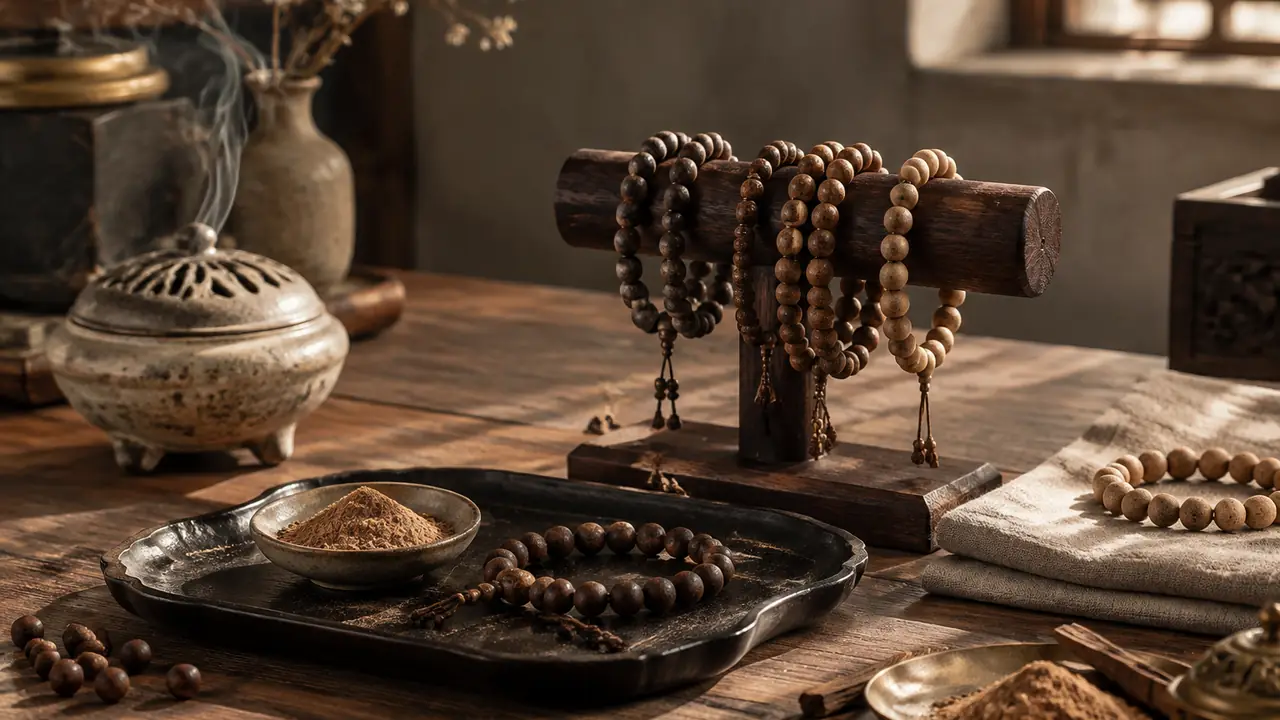
Why this product suits a studio
Studio retail has a narrow job. Customers are there for a class, they have a few minutes before and after, and they are open to small objects that extend the session. Mats and clothing are bulky and size-dependent; candles and sprays are crowded categories with obvious price comparison. A strand of incense beads is small, needs no sizing, ships flat and has a story that staff can tell in two sentences: it is rolled from sandalwood or agarwood powder, it is worn, and the scent is released by warmth and touch.
It also fits the way many people already use beads in practice: held between the fingers during a seated sitting, wrapped on the wrist during a flow class, or kept in a pocket. Nothing is burned, so there are no smoke rules to negotiate with a landlord or neighboring tenants, and no alarm issues. That single point often decides whether a studio can stock a scent product at all.
Formats that work
| Format | Typical spec | Role in the shop |
|---|---|---|
| 108-bead mala | 6 or 8 mm, guru bead, tassel or counter | Hero item, teacher recommendation |
| Wrist bracelet | 8 mm, 18-22 beads, elastic cord | Entry item at the front desk |
| Pocket bead or single charm | 15-20 mm bead with cord | Small gift, course completion token |
| Loose beads and cord | Sorted by size, sold by weight | Workshop and make-your-own sessions |
The 108 format has the most obvious fit; the structure and its background are covered in why 108 beads, and the product line is on the meditation incense beads 108 page. The wrist bracelet is the easier first sale because it needs no explanation and sits at a lower price point.
Sizing an opening order
Studios usually have limited cash and shelf space, so the aim is variety in small quantities rather than depth in one design. Stock bracelets are typically offered from about 50 to 200 pieces per design, which is a reference range that applies to workshops with ready lines. A studio that wants several scents and sizes can reduce risk in three ways.
- Pool with other sites. A group of studios or a teacher training network can combine volume under one specification and split the delivery.
- Use loose beads for variety. Beads sold by the kilogram, from about 1 to 5 kg per bead size as a typical reference, let a studio assemble its own strands in house. See loose incense beads for DIY.
- Limit scent families. Two or three scents, such as a soft sandalwood and a deeper agarwood, are easier to explain than six.
These are reference ranges only and are confirmed in writing for each program; the current numbers are on the MOQ and lead time page.
Display and testers
Scent products are bought by smell, and a tester that has sat open for weeks no longer represents the stock. Keep one strand per scent in a lidded tin at the desk, warm it in the hand when a customer asks, and swap it for a fresh strand every few weeks. Keep sealed stock out of the light and away from the heater, since heat drives off the lighter notes early. A small card beside each strand should say what the scent is in plain words, what the beads are made from, and how to keep them dry.
Avoid placing incense beads near open windows in humid climates, and do not leave them in a damp bag on a treatment-room shelf. Mold on the surface is rare in dry storage and common in humid storage, which is why export lots travel in foil pouches with desiccant.
Wording that stays accurate
Studios attract customers who read labels. The honest description is short: aromatic wood and herb powders, bound with nanmu bark powder and honey, hand-rolled, shade-dried and aged, with no synthetic fragrance oil in the standard specification, confirmed in writing for each order. Describe the experience in sensory and traditional terms. Many users describe the scent as calm and grounding in their own words, and the beads are traditionally associated with ritual and focused attention. Do not promise any effect on stress, sleep or health, and train front-desk staff not to improvise such claims; the line is covered in the wider compliance notes at compliance and certifications.
Teachers, courses and events
Studios sell more when a product has a role in the schedule. A few ideas that need little setup: a bracelet given as a course-completion token; a limited scent used in a seasonal retreat; a bead-stringing evening where participants assemble their own strand from loose beads and cord; a teacher-recommended mala at the start of a meditation series. For event use, branded packaging or a printed card with the studio name adds recognition at a small additional minimum, typically in the several hundreds of pieces per design for private label, which is a reference range and not a promise.
A care card that reduces questions
Most after-sale questions in a studio shop are about the same four things, and a small card inside the box answers them before they are asked. Keep it to a few lines in plain language.
- Keep the beads dry: remove the piece before showers, swimming and hot yoga, and wipe it with a soft cloth rather than washing it.
- Store it sealed when not worn, away from heaters, direct sun and a hot car.
- Expect the scent to change: lighter notes leave first and the woody base comes forward over months.
- Restring on silk or elastic if the cord loosens; the beads themselves can be reused.
The hot-yoga line deserves emphasis. Sweat and steam are the most common cause of surface dulling, and a studio that runs heated classes should tell customers to take the mala off before the room warms up. Pairing the card with a small cloth pouch gives the customer somewhere to keep the strand during class.
Ordering steps
- Choose formats: a 108 mala and a bracelet are enough for a first order.
- Choose one or two scents and the bead size, 6 or 8 mm for malas.
- Decide cord, guru bead, tassel and packaging, and whether a small studio card goes in the box.
- Request samples; reference timelines for ready lines are 5-10 working days, with bulk lots typically 15-25 working days, confirmed in writing.
- Approve a sample strand, keep it sealed as the reference, and place the order.
Send the brief through the quote form and the desk will shortlist partner workshops and return a formula sheet with each proposal.