
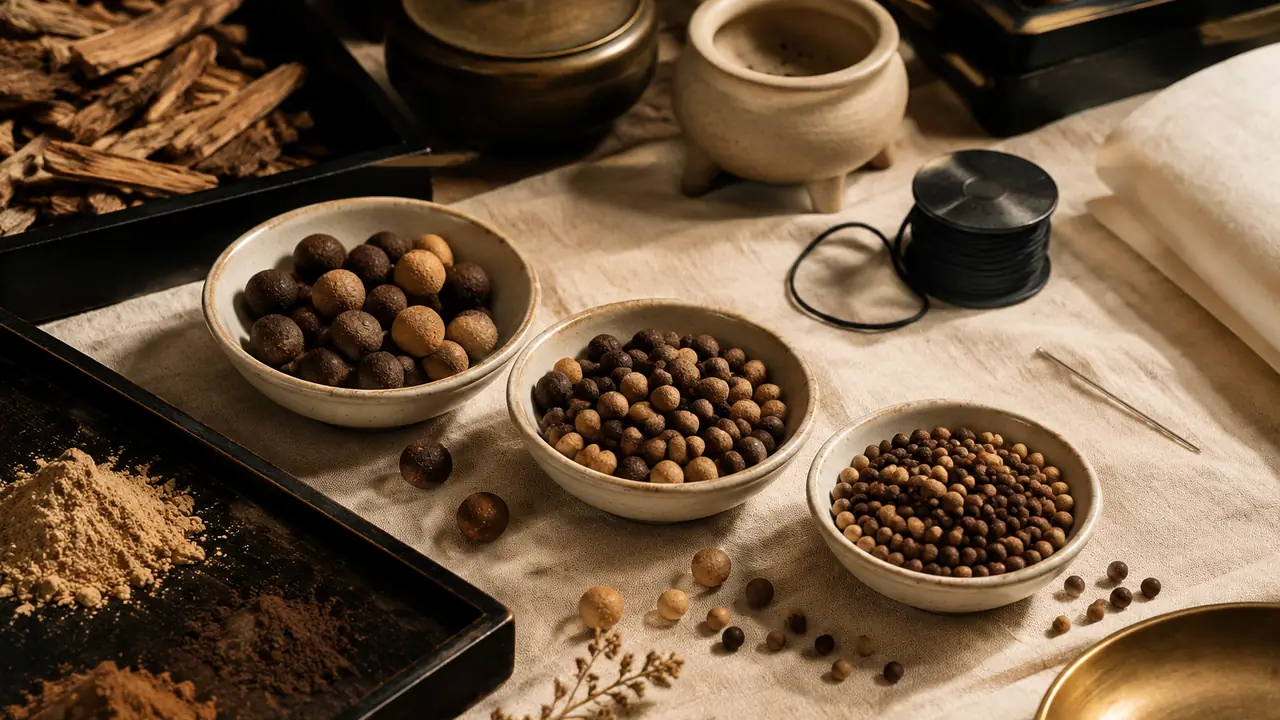
What loose DIY beads are
Loose incense beads are the same hand-rolled beads used in finished bracelets, supplied unstrung and sorted by diameter. The standard version is sandalwood-led: sandalwood powder as the main body, nanmu bark powder as the binder, a little honey for plasticity, and a small share of botanical accents. They are bought by brands that finish the product themselves, by studios that run bead-stringing sessions, and by online sellers who pack kits and refills. Because the beads are not burned, the scent comes from the powders alone and is released by warmth and handling.
The beads are made through the same seven-step sequence as every other line, described on how incense beads are made. What is different here is the finishing: sorting, counting by weight and packing for transport, rather than stringing.
Sizes, weights and quantities
Sizes run from 6 to 20 mm. A single 8 mm bead typically weighs about 0.3-0.5 g, and weight rises roughly with volume as the diameter increases. Orders are counted in kilograms rather than pieces, and the typical starting quantity is about 1-5 kg per size. Bead counts per kilogram are approximate and are stated on the quotation once the formula and size are fixed.
| Diameter | Typical weight per bead | Common use | Hole |
|---|---|---|---|
| 6 mm | Light, under the 8 mm figure | 108 strands, fine bracelets | Pierced, usually 1.2-2.0 mm |
| 8 mm | About 0.3-0.5 g, typical | Standard bracelets, DIY kits | Pierced, usually 1.2-2.0 mm |
| 10-12 mm | Heavier, by weighing | Statement bracelets, necklaces | Pierced, usually 1.2-2.0 mm |
| 15-20 mm | By weighing per program | Pendants, hangings | Pierced or blind, by agreement |
Weights are typical reference figures from partner workshop weighing and are confirmed per program.
Sorting and tolerance
Hand-rolled beads vary slightly, so after drying they are passed through graded sieves or gauges and grouped by diameter. A tolerance is agreed per program, for example a tight band for jewelry brands who need consistent spacing, and a looser one for kits where the maker will not notice. Beads with cracks, flat spots or off-centre holes are removed during sorting. Because the surface is matte and slightly grainy, small natural differences remain, which is how a botanical bead looks. Ask for the tolerance in writing if you need it for stringing machines or paired findings.
DIY kit components
For studios and kit sellers, the desk can add the other parts of a kit to the same order so that everything ships together.
- Nanmu powder. The natural binder, typically about 25% of the powder in a bead, supplied in small sealed bags for people who want to roll their own. Background on the nanmu powder binder.
- Sandalwood powder. Fine, sieved powder for blending, with origin stated per lot. See the sandalwood guide.
- Molds. Wood or resin rolling molds and piercing pins for the common bead sizes.
- Cord. Elastic or waxed cotton, silk and knotting needles, matched to hole size.
- Instruction card. A printed sheet in your language and brand, from about 300-1,000 pieces for branded printing.
Why brands choose the loose route
Buying loose gives control over the last stage of the product. A brand can choose its own cord color, knot style, spacer metal and gift packaging, and can change the design from season to season without re-ordering the beads. It also lets one lot of beads feed several products, for example a bracelet, a necklace and a refill pouch. The trade-off is that stringing, quality control of the finished piece and any metal declaration for findings become the brand's responsibility, unless the desk is asked to coordinate stringing at a partner workshop as a separate step.
Packaging with foil and desiccant
Moisture is the main risk for loose beads in transit. They are packed in aluminium foil pouches or sealed jars with a desiccant, then in cartons, so they arrive dry and keep their scent. Open pouches only when you are ready to string, and reseal after use. Avoid high-temperature storage and direct sunlight, which can cause cracking or scent loss. Freight is light; small lots usually go by express in 3-7 days and larger lots by air or sea, covered in logistics and shipping.
Ordering notes
Typical starting quantity is about 1-5 kg per size. Stock-size samples take 5-10 working days; a change of formula, such as a different binder share or botanical accent, follows the process on custom blended incense. These are typical reference ranges, confirmed in writing for each program. Send your sizes through the quote form or read the family overview at loose beads and custom formulas.