
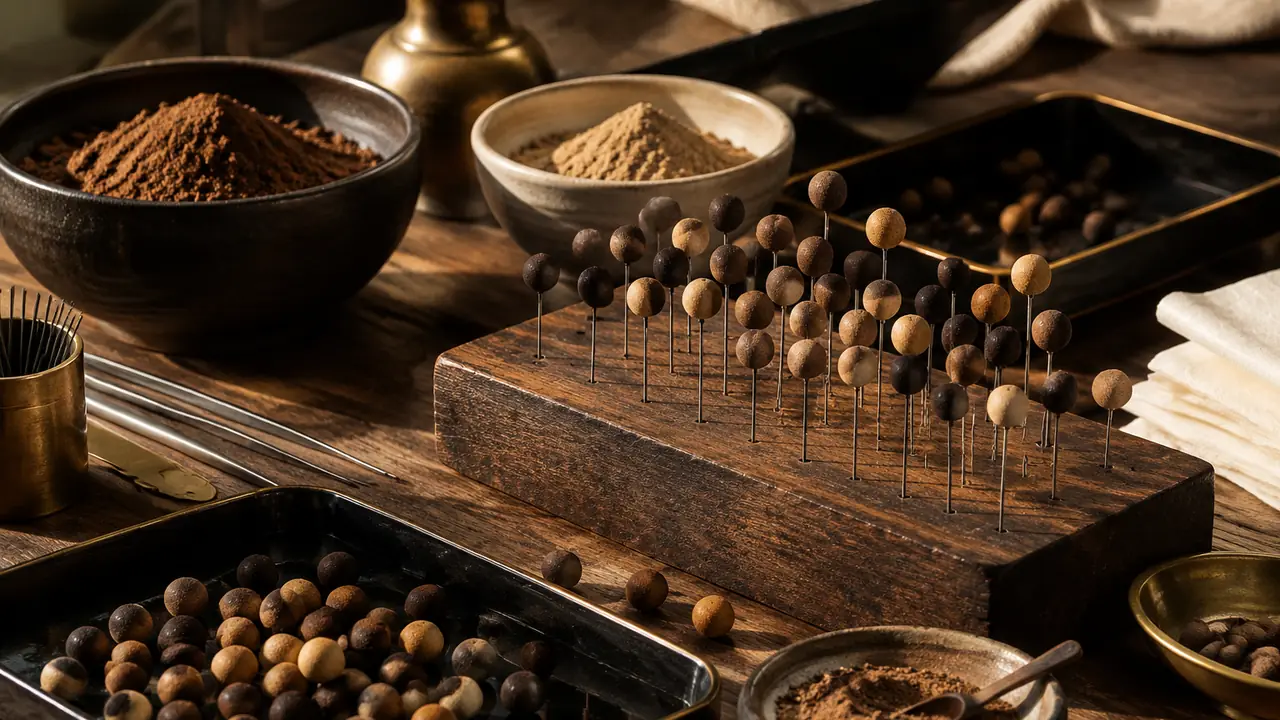
Why powder comes first
An incense bead is made almost entirely of powder: the aromatic wood or resin, the nanmu bark binder and any botanical accents. Each of them is ground separately before it meets the others. The quality of that grinding decides how the dough feels in the hand, how round the bead rolls, how it polishes and how evenly it releases scent. In the incense clusters of Fujian and Guangdong, milling is the one stage where mechanical equipment is accepted without argument, because a mill produces a fineness no hand can match. Everything downstream, from the dough to the polish, is still led by people, as described in how incense beads are made.
Drying before grinding
Wood and botanicals are dried before they are milled, and workshop practice is to dry them in the shade or with gentle airflow. Strong heat drives off the volatile notes that give sandalwood its creamy character and agarwood its depth, so an oven-dried powder tends to smell flatter. Moisture is the opposite problem: damp material clogs the mill, packs into the sieve and carries a mold risk once it is stored. The target is material that feels dry and brittle, not baked.
Resinous agarwood needs a different hand from plain wood. Resin softens under friction, so it is often ground in short cycles to keep the mill from heating up. Dry herbs and flowers are lighter and bulkier and are ground in their own runs, not mixed in with the wood, so their share in the formula can be controlled at the weighing stage.
Milling stage by stage
| Stage | Purpose | Common failure |
|---|---|---|
| Coarse crushing | Reduce chips or bark to small pieces the mill can take | Foreign matter left in the material |
| Fine milling | Grind to a uniform powder | Heat build-up that dulls scent |
| Sieving | Separate fine powder from coarse particles | Coarse fraction passed into the dough |
| Re-milling | Grind the coarse fraction again | Mixing batches of different origin |
| Storage | Hold powder dry until weighing | Moisture pickup, mold spots |
Each material is kept as its own lot with a label for origin and date. That record matters most for sandalwood and agarwood, where origin and documents are stated per lot; see the sandalwood guide and the agarwood guide.
What sieving changes in a bead
Sieving is where a coarse, grainy powder becomes a smooth one. Workshops pass milled material through a fine screen and send what stays on top back to the mill. The benefits show up in several places:
- Surface. Large particles leave pits and pale specks after polishing. Fine powder gives a close, satin surface.
- Roundness. A uniform dough rolls into a rounder sphere and holds a straight pin hole.
- Drying. Even particle size means even shrinkage, which lowers the risk of cracks in the drying room.
- Scent. Finer powder exposes more surface to warmth and friction, so the scent comes off more easily on the wrist.
There is a balance, because a very fine powder is not always the goal. Some formulas keep a little texture on purpose, and a slightly grainy matte surface is a legitimate look for certain lines. What matters is that fineness is chosen and kept consistent from lot to lot.
Binder and accent powders
Nanmu bark powder is milled to a fine, soft powder of its own and is usually weighed at about a quarter of the total powder. If it is coarse, it hydrates unevenly and leaves weak spots in the dough. The binder is covered in the nanmu binder guide. Accents such as osmanthus, clove or dried rose petal are milled separately and weighed in small amounts so that the base scent is not overwhelmed. For custom blends, a buyer who specifies the percentages of each powder gets a sample that can be repeated in bulk, which is the point of a written formula sheet.
Blending the powders
Once the separate powders are ready, they are weighed against the formula sheet and blended dry before any liquid is added. Dry blending is a small step with a large effect: a base of sandalwood with a few percent of clove, for example, only smells the same from bead to bead if the clove is spread evenly through the whole batch. Workshops mix by hand or in a tumbling drum, then draw a small test portion and compare color and scent with the retained sample. If the blend looks streaky, it goes back for more mixing.
The weighed batch is also the moment when the formula is locked. Any change after this point, a different origin of sandalwood or a substitute herb, should be reported before the dough is made, not discovered afterward. That is why the formula sheet lists materials by name and origin, and why substitutions are agreed in writing. For agarwood lines, the lot documents are matched to the material at this stage, so the paperwork and the powder travel together through the rest of the process.
Questions a buyer can ask
- Is each material milled and stored as a separate, labeled lot?
- How is heat controlled when milling resinous material?
- Is the coarse fraction re-milled, and does it stay with its original lot?
- How is powder stored between milling and weighing, and for how long?
- Can the fineness used for the approved sample be repeated in bulk, and how is that checked?
Answers are recorded in the sample paperwork and confirmed in writing for each program. The wider checklist is on quality control, and a sample request goes through the quote form.
What it means for sourcing
Powder quality is difficult to see in a finished bead, which makes it a matter of trust and records instead of a glance. The practical protections are a retained sample, a written formula, and a comparison of surface, roundness and scent across lots. A desk that visits partner workshops looks at the milling room, the sieves and the storage as closely as at the rolling tables. Reference timing for custom formulas, which include a sample round, is on MOQ and lead time.