
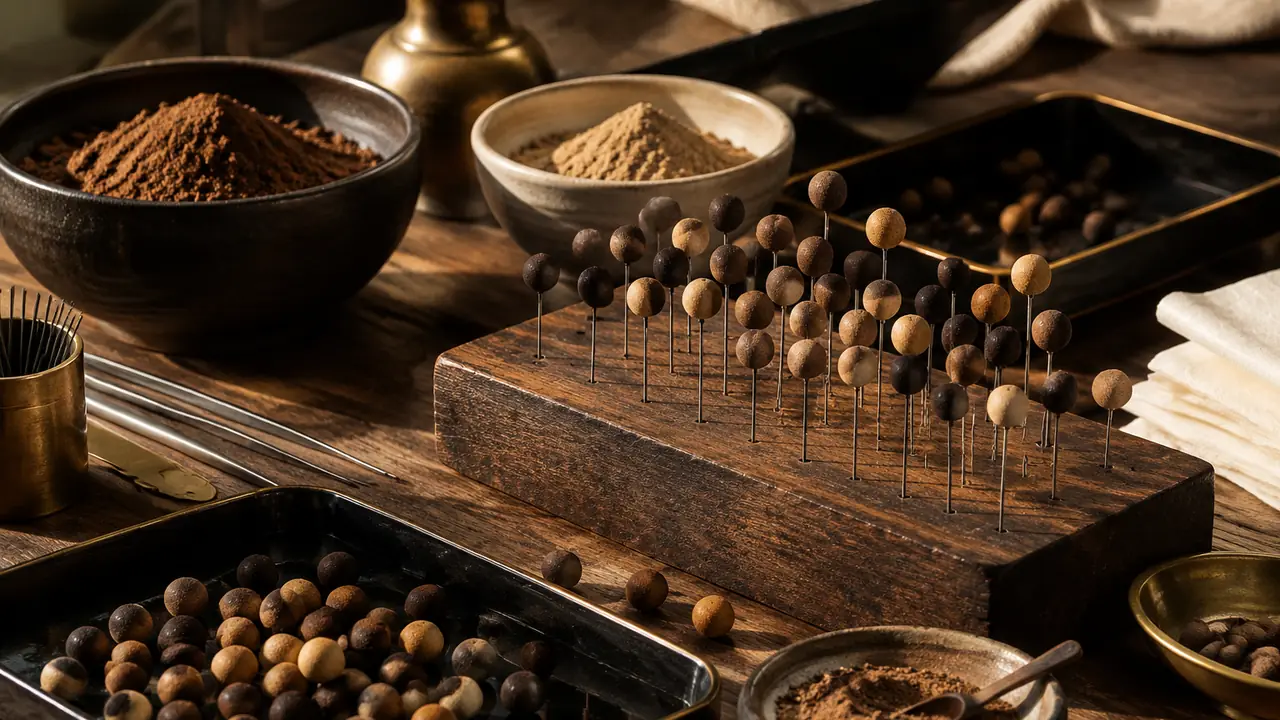
What the rest is
Once the powders, the nanmu binder and the liquid have been kneaded into a firm dough, partner workshops seal it in a container or wrap it in damp cloth and leave it for about 24 hours. Different workshops call this stage by different names, including resting the dough, waking the dough or fermenting and pounding it. The name varies, the principle does not: the mixture needs time to become uniform before it is cut and rolled. It is the fourth of the seven steps described in how incense beads are made.
The rest is not a chemical process of the kind associated with brewing. In practice it is a matter of moisture and binder. Water spreads from the wetter outer parts of the dough to the drier inner parts, the nanmu bark powder takes up liquid and develops its sticky, gel-like character, and the dough relaxes so that it can be shaped without tearing.
What happens during the 24 hours
- Moisture evens out. Freshly kneaded dough is never perfectly uniform. After a day in a sealed container, the water content is much closer to the same everywhere.
- The binder hydrates. Nanmu powder, usually about a quarter of the powder weight, needs time to absorb liquid. Used immediately, it binds only partly, and the bead is weaker once dry.
- Honey disperses. A small amount of honey acts as a plasticizer. Time lets it spread through the dough instead of sitting in streaks.
- Aromatics start to blend. Powders and liquids begin to meld, which gives a more rounded scent at the sample stage.
- The dough relaxes. Kneading tightens the dough. Rest lets it soften so it rolls smoothly without fighting back.
What goes wrong without it
| Shortcut | What shows up | When it shows up |
|---|---|---|
| Rolling right after kneading | Wet core, dry skin, uneven density | During drying |
| Rest too short | Weak binding, crumbling edges at the pin hole | At piercing and polishing |
| Container not sealed | Crust on the dough, dry flakes in beads | At rolling |
| Rest too long or too warm | Sour smell, risk of mold spots | In aging jars |
| Different rest per batch | Scent and hardness vary between lots | On inspection |
The most common visible result of skipping the rest is cracking. A bead with a wet center and a drier skin shrinks unevenly as it dries, and fine surface cracks open in the days that follow. The details of that stage are in shade drying incense beads. Cracks may not appear until the beads are already in jars, which makes the problem expensive to catch late.
Why the number is about 24 hours
The figure is workshop practice, not a physical constant. It reflects a rhythm that fits a working day: dough is kneaded in the afternoon, rested overnight and rolled the next morning. Shorter periods are used for small test pieces, and some formulas, especially wet fruit-based ones such as goose pear, are managed more carefully because the liquid content is higher. Different weather changes things too, since a dry day pulls moisture out of the container surface faster than a humid one. Buyers should read about 24 hours as the typical reference and ask the workshop to state the actual rest for the formula in the sample paperwork, confirmed in writing for each program.
Because the time is built into the process, it is one reason that a custom formula takes longer than a catalogue bead. A sample needs dough, a day of rest, rolling, days of drying and a period of aging. Reference timing is on MOQ and lead time, and the milling and sieving note covers the step before it.
How a good rest looks on the floor
A visitor to a partner workshop can usually recognize a well-managed rest without asking a single question. Dough sits in lidded tubs, wrapped bundles or sealed bags, each marked with the formula name and the time it was made. There is no skin on the surface when a container is opened, and the dough is cool, even in color and slightly tacky. When pressed with a thumb it recovers slowly instead of cracking. A workshop that cannot show dough of a known age is usually working from memory, and memory does not scale from a sample of fifty bracelets to a lot of several hundred.
The reverse picture is just as telling. Open bowls on a bench, dough with a dry rim, or kneading and rolling happening within the same hour are signs that the rest is being skipped to meet a date. For a buyer, the most useful habit is to ask when a sample was kneaded and when it was rolled, and to expect the two times to be about a day apart.
How a buyer can check it
- Ask for the rest time and the container type in the sample record.
- Look for a note of dough age on the day beads were rolled.
- Compare the surface of dried beads against the approved sample; fine cracks suggest a short rest or fast drying.
- Check that the same rest applies in bulk, not only for the sample.
- Where a formula includes pear juice or other wet ingredients, ask whether the rest was adjusted and why.
These checks sit alongside the wider list on quality control. The point is not to micromanage the workshop but to make sure the quiet step stays in the schedule.
Planning schedules around the rest
Buyers who plan a launch sometimes picture the making process as a continuous run, but a day of rest, 5 to 10 days of drying and a period of aging are fixed blocks that cannot be compressed without a visible cost in quality. A realistic plan puts the approved sample first, then bulk, and leaves the drying and aging inside the lead time rather than after it. Custom formulas with a sample round run longer than catalogue lines, and a written schedule from the sourcing desk shows each block. To start a program with a formula, size and quantity, send the brief through the quote form.