
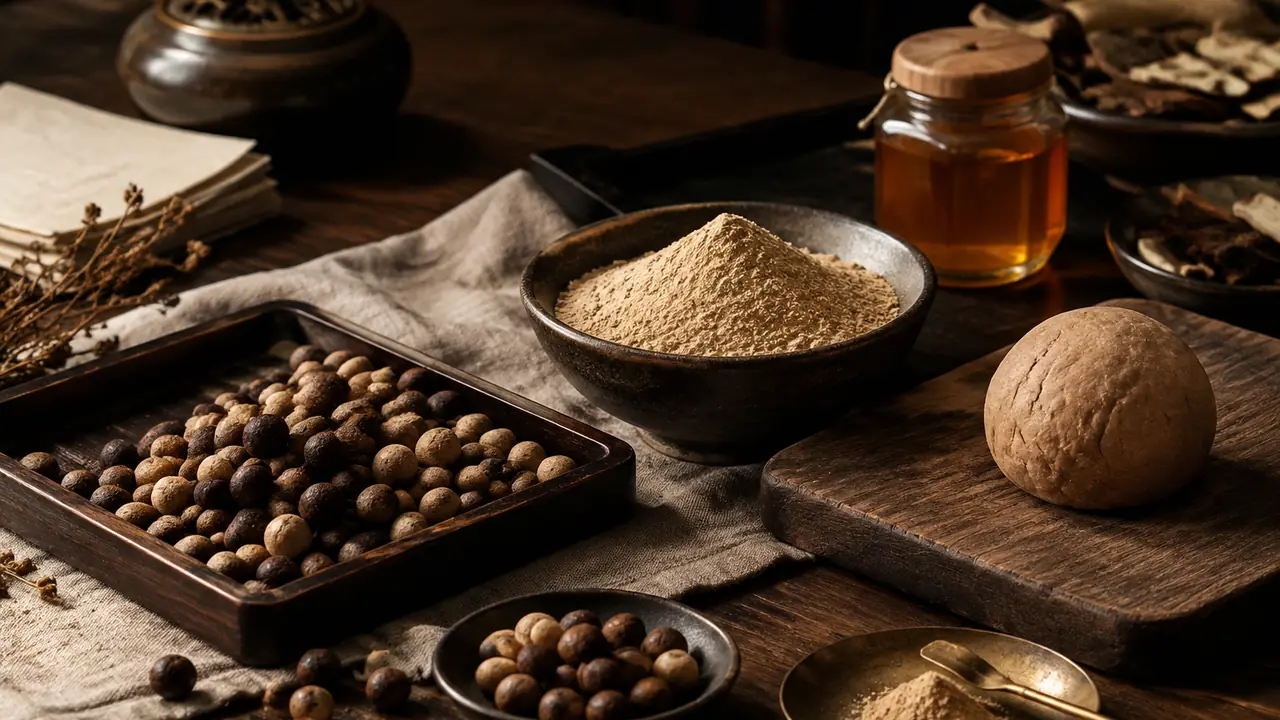
What nanmu powder is
Nanmu bark powder is a fine, pale to tan powder milled from the dried inner bark of trees in the genus Phoebe, called nanmu in Chinese and used as a plant binder across the incense trade. It has almost no scent of its own, which makes it useful: it contributes structure without competing with sandalwood or agarwood. It is the most common plant binder in Chinese hand-made incense, used for sticks, cones and, in this range, beads. The wider craft is described on how incense beads are made.
How it binds
Bark of this type contains mucilage, a gel-forming plant polysaccharide. When the powder is mixed with warm water, the mucilage swells and becomes sticky, wrapping the other powders and holding them in a workable dough. As the bead dries over five to ten days in the shade, water leaves and the mucilage sets, leaving a firm bead in which each particle is held in place. No chemical reaction is involved, which is why the process is fully reversible in principle: a dried bead softened in water will go back toward a paste, which is also why beads must be kept dry.
The binder share matters. Too little and the bead is crumbly and cracks; too much and the scent is diluted and the bead becomes very hard. Standard beads use nanmu at about 25% of the total powder weight, adjusted by bead size and by how fine the main powders are.
The role of honey
Honey, with a little warm water, is added as a plasticizer. It makes the dough smoother and slower to dry on the surface, so the bead can be rolled round without surface cracks. Honey also adds slight weight and a gentle shine after polishing. It is used in small amounts, around a few percent of the formula, and does not make the bead sticky once dry. Buyers with dietary or vegan requirements should ask for a honey-free version, which is sampled separately because the dough behaves differently.
Why no industrial glue
Synthetic glue would make rolling easier and speed up the process, but it has three drawbacks for an incense bead. It can change or mute the scent. It may emit volatile compounds when warmed by the wrist. And it undermines the natural, botanical claim of the product. For these reasons the standard specification excludes industrial glue and synthetic fragrance oils, confirmed in writing for each order. The same stance applies in the blended incense beads formula sheets, where the binder is always named.
How to check a bead for glue
No home test is conclusive. Laboratory testing is the only reliable method, and the desk can arrange it where required. The checks below are practical clues for a first look, and each has limits.
| Check | What a natural bead usually shows | What may raise a question |
|---|---|---|
| Smell | Woody, plant-like, slightly sweet; no sharp note | Plastic, solvent or sweet chemical smell when warmed |
| Cut surface | Matte, fine-grained, even color through the bead | Glossy, translucent or rubbery areas inside |
| Surface | Matte, slightly grainy | A hard, plastic-like gloss on every bead |
| Water test | A cut piece placed in a little warm water softens and loosens over hours | A piece that stays rigid and shiny after a long soak |
For the water test, use only a cut fragment, never a whole bead you intend to sell, and regard the result as a clue rather than proof. Binder, honey and wax content, bead density and drying all affect how a bead soaks. If something looks unusual, ask for the formula sheet and the ingredient declaration, or request a laboratory test. See testing and inspection.
Handling and storage
Because the binder softens in water, finished beads must be kept dry: foil pouch or sealed jar with desiccant, away from steam and high humidity. Beads that have been damp may swell, develop mold spots or lose their roundness. Wearing them in the shower or swimming is not recommended, and perspiration should be wiped off.
Ordering notes
Nanmu powder is available in small sealed bags for DIY programs and is the standard binder in all bracelets. Stock bracelets typically start from 50-200 pieces per design, DIY nanmu powder by agreement, all confirmed in writing for each program. See MOQ and lead time and the quote form.