
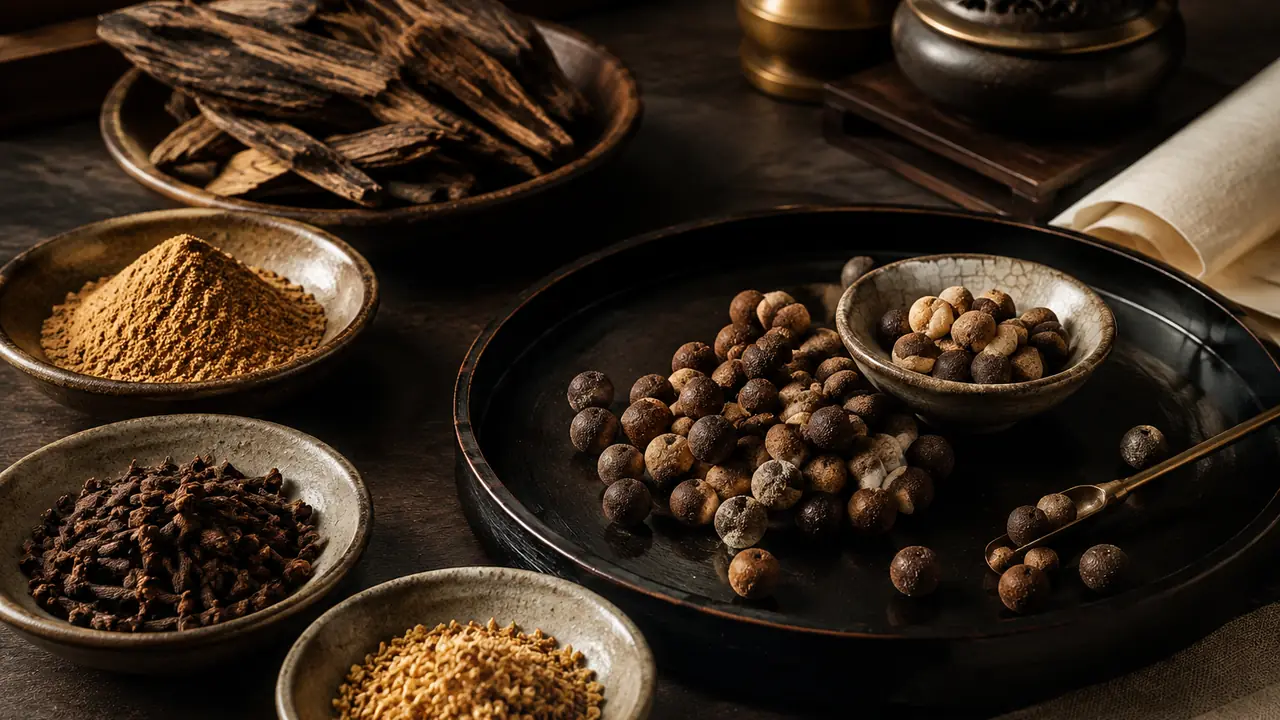
Two meanings of the same word
In cosmetics and household goods, fragrance-free often means that no scent has been added, and the product has little or no smell. For incense beads, that meaning cannot apply: the bead is a scented object, and its scent is the reason to buy it. What the term can honestly mean is narrower and more useful. The scent comes entirely from the ground woods, resins, herbs and flowers in the bead, and no synthetic fragrance oil, perfume compound or artificial scent has been added. A clearer phrase for customers is no added fragrance oils or no synthetic fragrance.
The distinction matters because the market contains many beads that look like incense beads but are wood beads soaked in fragrance oil. They are cheaper, loud on day one and quiet after a few months. The claim of no synthetic oils is how a legitimate incense bead line separates itself from them.
How scented wood beads differ
| Point | Incense bead (standard spec) | Oil-scented wood bead |
|---|---|---|
| Source of scent | Ground sandalwood, agarwood, botanicals through the whole bead | Fragrance oil applied to or soaked into the surface |
| Cut bead | Smells the same inside as outside | Inside is nearly scentless |
| Scent life | Years with proper storage | Weeks to months |
| Binder | Nanmu bark powder and honey | Not applicable; solid wood or a pressed composite |
| Labeling | Natural botanical ingredient list | May need fragrance allergen labeling in some markets |
| First impression | Quiet, grows on the wrist | Loud at first sniff |
A fuller comparison is in incense beads vs scented wood beads, which also lists simple checks a buyer can do on an incoming sample.
Why a brand would choose this specification
There are three practical reasons. The first is positioning. A brand that sells natural wearable scent needs a claim its customers can understand, and no added fragrance oils is short, concrete and easy to repeat on a product page, a hang tag or a shelf card. The second is consistency over time. Beads that are aromatic through their whole volume do not lose a surface coating, so a customer who wears the strand for a year still has the product they bought, only softer and more settled. This lowers disappointment and return rates compared with oil-scented beads.
The third reason is regulatory simplicity. A formula made only of named natural materials is easier to document than one containing a fragrance compound with an undisclosed composition. Suppliers of synthetic fragrance often protect their formulas as trade secrets, which makes full ingredient disclosure difficult. A bead made from a published list of woods, herbs, bark powder and honey can be described plainly.
The cost of this choice is time and material. Real woods cost more than fragrance oil, and the aging stage cannot be skipped. A buyer who wants a very strong, immediate scent at a very low price is better served by a different product category, and the desk will say so rather than offer a compromise that would break the claim.
What the claim includes and excludes
A workable definition for a specification sheet has four parts.
- Included. Ground heartwoods, resins, spices, flowers and leaves, nanmu bark binder, honey and water.
- Excluded. Synthetic fragrance oils, perfume compounds, artificial musks, scent boosters and aroma chemicals.
- Excluded. Dyes and industrial glues in the standard specification.
- Allowed with notice. Natural essential oils, only on request and only if declared on the formula sheet. By default, none are used.
Without that definition the phrase is only an adjective. With it, the claim can be checked and written into the contract.
How to verify
No single test proves a negative, so the verification is a combination of documents, process and sample checks.
- Written formula. Every ingredient listed by name and percentage, signed by the workshop and kept with the order.
- Process visit. At a workshop audit, the desk checks that the storage and mixing areas contain the listed materials and no fragrance oils. See workshop audit.
- Sample behavior. A cut bead should smell the same inside as outside; scent should be soft before wear and grow with warmth, not hit the nose from the bag.
- Retained sample. Each production lot is compared with the approved reference sample for scent and surface.
- Laboratory testing, if required. Where a market or customer asks for a test report, the desk arranges it with an accredited laboratory for the specific method required, rather than quoting a generic result.
The ordering of these steps is documents first, process second, sample third. More on inspection in testing and inspection.
Wording for labels and product pages
Keep the claim specific, truthful and free of health language. Examples that work:
- Scented only by its ingredients: sandalwood, agarwood and botanicals. No added fragrance oils.
- Hand-rolled with nanmu bark binder and honey. No synthetic fragrance, dye or industrial glue.
Avoid sweeping words such as pure, chemical-free or allergy-safe. Natural ingredients are not free of chemistry, and some botanicals contain naturally occurring fragrance allergens that can matter to sensitive wearers or to regulators in certain markets. Keep the ingredient list complete so you can answer a customer question, and never describe the beads as treating, soothing or relieving anything. The ingredient side is covered in natural ingredient declarations, and the claims side in health claims and incense products.
What buyers should do
If you want the no-synthetics claim for your product, put it in the purchase specification, not just in the quote. Ask for the signed formula, the binder statement, the retained sample and a confirmation that the claim covers every component, including the cord, the packaging inserts and any scented cards that sit in the box. A fragrance oil on a gift insert can undermine a no-added-fragrance statement as easily as one in the bead itself.
Start the specification through the quote form, and see the binder system in honey, nanmu and plant binders. Reference ranges for MOQ and lead time are on MOQ and lead time, confirmed in writing per program.