
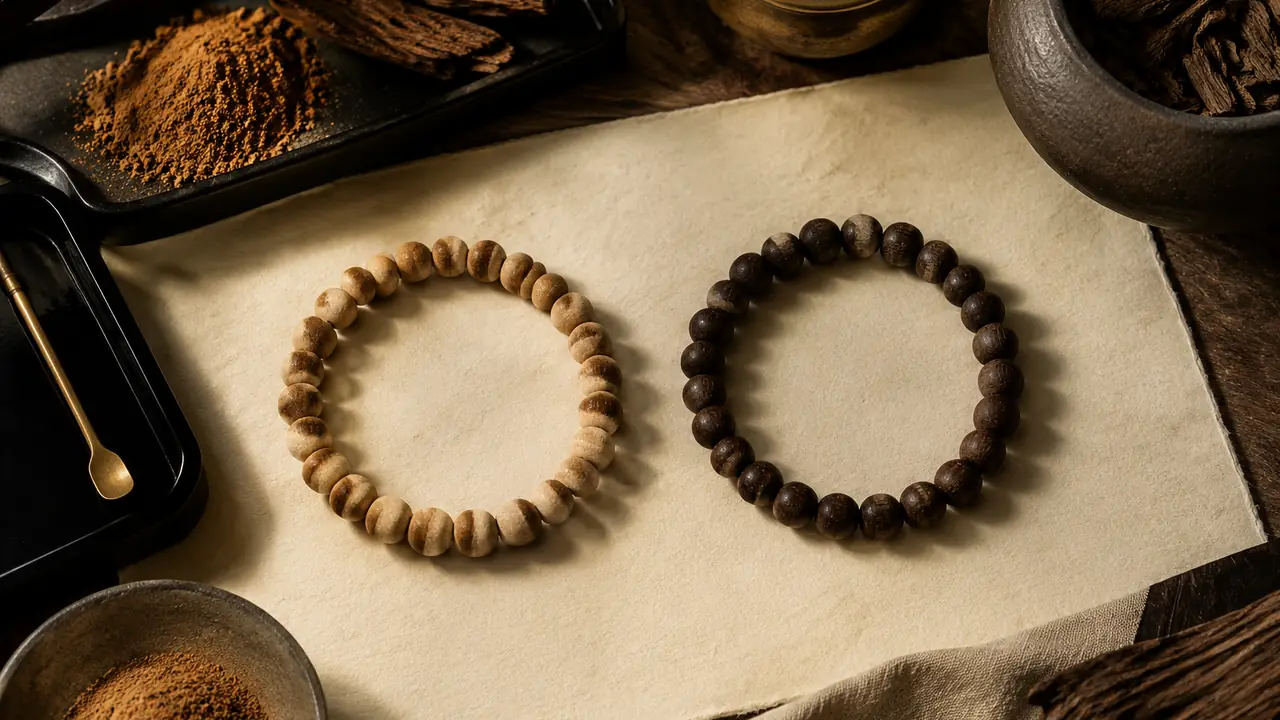
What each binder is
Nanmu powder is ground bark from Phoebe trees. Mixed with water it releases a sticky mucilage that makes aromatic powder cohesive enough to roll, and it dries to a firm bead. In a standard specification it makes up about a quarter of the powder weight, with honey as a plasticizer. It is a plant material, so the whole bead remains botanical. The detailed explanation is in what is nanmu powder.
Synthetic glue, in this context, means an industrial adhesive such as a polymer or resin emulsion mixed into the dough. It is cheap, quick and forgiving, and it can bind almost any powder, including low-grade or filler-heavy mixes. Some factories use it to speed up production and to reduce cracking. The standard Ouvare specification excludes it, and the choice is confirmed in writing per order.
Side-by-side comparison
| Criterion | Nanmu binder | Synthetic glue |
|---|---|---|
| Scent character | Nearly neutral; the aromatic powder leads | Can add a chemical note or mute the wood scent |
| Scent life | Years with proper storage; the bead stays porous and breathes | Scent can be sealed in, so release is slower and flatter |
| Weight and feel | Dry, matte, slightly soft, light | Harder, plasticky or waxy surface, sometimes denser |
| Documents needed | Ingredient declaration: botanical powders, nanmu, honey | Adhesive identity and safety information, and a revised declaration |
| Typical channel | Natural fragrance, gift, meditation, specialist retail | Low-cost promotional goods |
| Relative cost factors | Binder is a material cost; slower drying and more care needed | Lower material and labor cost; faster, more forgiving production |
Why the choice changes the product
Declaration and positioning. A bead bound with nanmu and honey can be declared as an entirely botanical product with no industrial glue. That sentence is the foundation of a natural positioning and is often the first thing a careful buyer asks about. Once an adhesive is added, the statement cannot be made, and the importer has additional documents to collect.
Scent. The binder is a quarter of the powder in a nanmu formula, so a scentless or complementary binder matters. Synthetic adhesives are not designed for aroma and can introduce an off-note that becomes noticeable when the bead is warmed. They can also reduce the porosity of the bead, which slows release.
Aging. Plant-bound beads settle during aging in a sealed jar, and the scent rounds out over weeks. Glued beads often look finished earlier but do not change in the same way, which is why a quick sample can appear fine and then disappoint later.
Feel and finish. A nanmu bead polishes to a soft satin; an adhesive-bound bead may polish to a hard gloss or show a plastic sheen. Experienced buyers learn to tell the difference by touch.
What nanmu costs in practice
Nanmu is not free of trade-offs. It needs more attention in drying, because the water that activates the mucilage must leave slowly, over days in shade and controlled humidity, or the bead cracks. Workshops often control temperature near 25 C and humidity near 60 percent RH, turn the beads and keep them out of direct sun. That patience is part of why handmade incense beads have longer lead times than glued ones. The process is covered in the making process. The extra care is also why the clean declaration costs more, and buyers should compare quotes only on the same written specification.
How to decide
- If you want to say natural, botanical or no industrial glue, choose nanmu and write it into the order.
- If your product is a low-cost promotional bead with no scent claim, an adhesive-bound bead may meet a price target, but it is not what Ouvare supplies as incense beads.
- If a supplier offers an unusually low price, ask what holds the beads together before comparing anything else.
- If you are unsure what a sample uses, ask for the formula sheet and a cut bead; the surface, scent and cross-section tell most of the story.
- If your market has strict labeling, choose the binder that you can declare in full and keep the documents with the lot.
Spotting the difference in a sample
Binder choice leaves traces that a buyer can learn to read without a laboratory. Start with the cross-section: cut one spare bead and look at the cut face. A nanmu-bound bead shows a uniform, slightly fibrous powder texture with no shine. An adhesive-bound bead can show a glossy, compact face or tiny bright specks where the glue has pooled. Next, smell the cut face. The wood scent should be clear and unbroken; a sharp or sweet chemical edge is a warning.
Then look at the surface and the holes. Plant-bound beads polish to a soft satin and the pierced hole has a clean, dry wall. Glued beads often have a slightly sticky or waxy hole and a surface that attracts dust. Finally, consider behavior over time. Leave the sample strand in a sealed bag for two weeks and open it: a plant-bound blend smells rounder after settling, while a glue-bound blend smells the same or flatter. None of these checks replaces a written declaration, but together they let you screen samples before you spend time on formal rounds.
Remember that a low price with a vague description is the commonest sign of a shortcut. Ask what holds the beads together as the first question rather than the last, and keep the answer in the order file so that the same specification is applied to every later lot.
How to write it into the order
Put three lines in the specification. State that the binder is nanmu bark powder with honey as plasticizer, that no industrial adhesive is used and that no synthetic fragrance oil is added. Ask the workshop to confirm all three in writing, and keep a sealed reference bead from the approved sample for comparison with later lots. During inspection, check for surface gloss that looks out of place and for a faint chemical note when a bead is warmed. The companion note why fragrance-free means no synthetic oils explains the matching rule for scent, and quality control lists the checks that apply.
When you are ready to specify an order, send your brief through the quote form; reference timelines and minimums are on MOQ and lead time, with final terms confirmed in writing per program.