
Two different constructions
A scented wood bead starts as a solid piece of wood, often a dense and inexpensive species, turned on a lathe and polished. Scent is added afterward by soaking the bead in fragrance oil, brushing it on, or tumbling it with an aromatic liquid. The wood is the structure, and the scent is a coating that penetrates a little way into the surface.
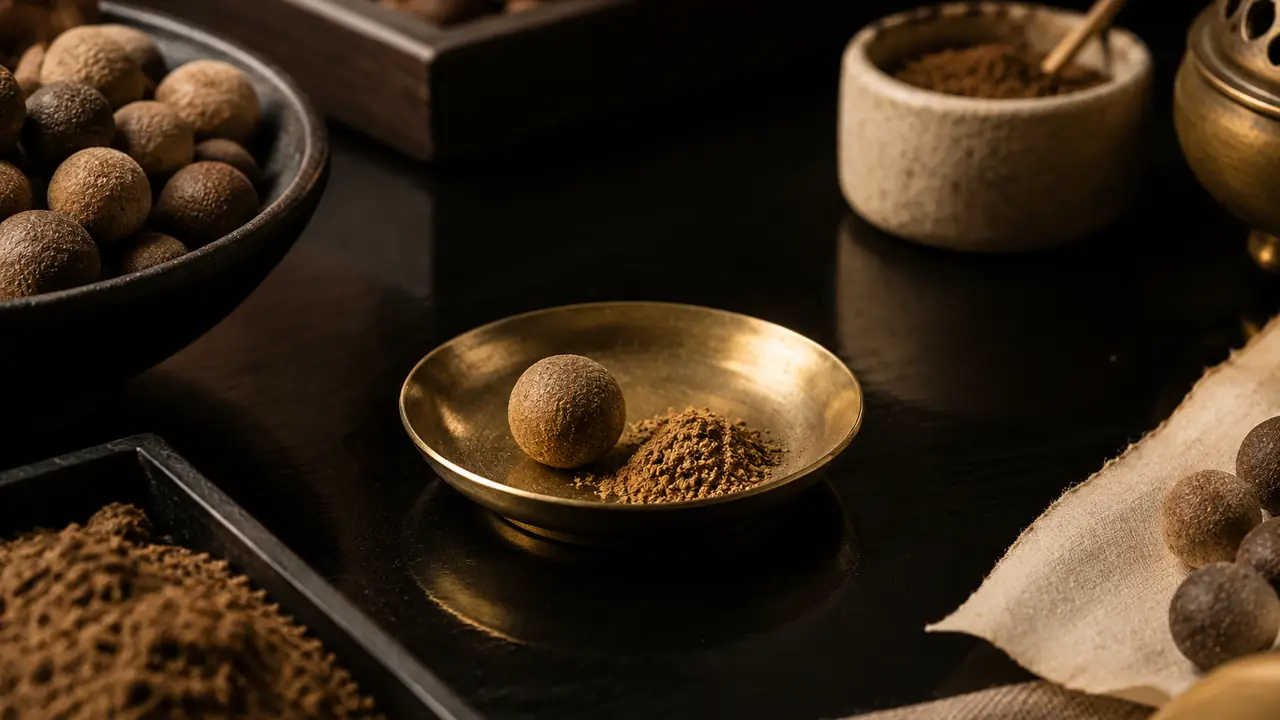
An incense bead has no solid wood core. It is made from fragrant powders - sandalwood, agarwood, herbs, sometimes fruit - mixed with a plant binder into a dough, rolled and pierced by hand, then dried and aged. The scent is not applied; it is the substance of the bead. That is the heart of the difference, and everything else follows from it. The workshop sequence is described in the making process.
A side-by-side comparison
| Point | Incense bead | Scented wood bead |
|---|---|---|
| Core | Pressed aromatic powder with nanmu binder | Solid wood, usually unscented species |
| Where scent sits | Throughout the bead | On and just below the surface |
| Cut test | Inside smells like outside | Inside is faint or smells of plain wood |
| Scent life | Years with proper storage | Typically weeks to months |
| Surface | Matte, fine grain, slightly soft | Smooth and often glossy |
| Ingredient declaration | Botanical powders, binder, honey | Wood plus fragrance compounds |
| Production | Hand-rolled in small lots | Machine turned, large volume |
| Cost position | Higher, driven by material and handwork | Lower, driven by wood and finishing |
Five practical tests
- The cut test. Ask for one spare bead and cut it in half with a blade. An incense bead smells the same inside; a scented wood bead smells of little or of plain wood.
- The water test. A drop of water on a scented wood bead may lift color or scent from the finish. Test on a spare bead, not on stock, because incense beads should not be soaked at all.
- The weight and feel test. Incense beads are a touch lighter than hardwood and have a dry, fine, almost chalky feel. Glossy and heavy points toward solid wood.
- The time test. Leave a sample bracelet in the open for two weeks. A surface scent drops sharply; a bead that is aromatic through its volume changes only a little.
- The paperwork test. Ask for the formula sheet. An honest incense bead supplier lists powders and binder by percentage; a scented bead supplier will mention an oil or a scent treatment.
Why the distinction matters commercially
For a brand, the difference is a positioning question as much as a quality one. An incense bead product can be described as a natural botanical bead with no synthetic fragrance oil in the standard specification, which is a clear selling point to buyers who read ingredient lists. A scented wood bead cannot honestly make that statement, and in some markets the fragrance compounds on it may need allergen labeling. Putting both under one product description, or selling oil-scented beads with language borrowed from incense, creates returns and review problems that are hard to repair.
There is also a pricing consequence. Incense beads cost more per piece because the material is expensive, the work is manual and the drying and aging take days. A buyer who compares an incense bracelet quote with a scented wood bracelet quote and chooses the cheaper one has chosen a different product. The drivers are explained in more detail in the sourcing notes at MOQ and lead time.
Where scented wood beads still fit
Scented wood beads are not a bad product. They suit low-price promotional items, fashion accessories and designs where the buyer wants a particular wood color and does not care how long the scent lasts. What matters is that they are sold as what they are. A retailer who stocks both lines should keep them in separate SKUs and separate descriptions, and should not present oil-scented beads as aged botanical incense.
A related case is the mixed bead, where a solid wood core is wrapped in an incense layer. These exist, but they are rarely worth the added step: the layer wears through, and the core adds weight without scent. If a supplier offers this as an incense bead, ask what the core is and how thick the layer is.
Wording that keeps listings honest
Product copy is where the two categories most often get blurred, so it helps to agree on vocabulary before launch. For incense beads, phrases such as aromatic throughout, hand-rolled, shade-dried and aged describe what actually happens, and they can be checked against the formula sheet. For scented wood beads, plain wording such as wood beads with added fragrance is accurate and still sells. Avoid borrowing words like blended, hexiang or aged for a bead that is only scented on the surface, and avoid describing an incense bead as perfumed, since it is not.
It also helps to decide in advance how you will answer a customer who asks why one bracelet costs several times more than another. A short line on the product page - the scent is the material, not a coating - answers most of those questions before they are asked. Retail staff and marketplace support teams should have the same line, so the explanation does not change from channel to channel.
Finally, keep photographs honest. Incense beads photograph as soft, matte and slightly irregular in tone; an image that shows a glossy, uniform strand will set the wrong expectation and attract returns when the real product arrives.
How to protect a specification
Write the distinction into the order. State that beads are aromatic throughout, bound with nanmu bark powder, with no synthetic fragrance oil and no industrial glue, and ask the workshop to confirm it in writing. Request a reference bead from each approved lot and keep it for comparison; a cut bead from production should smell like the one cut from the approved sample. For agarwood lines, ask for the CITES documentation that applies to the lot, since a legal origin is part of what separates a real aromatic bead from a surface treatment. Materials are covered in the sandalwood guide and the agarwood guide.
When you are ready to compare, send your bead size, count and scent direction through the quote form. The desk shortlists partner workshops that make aromatic-throughout beads and returns a formula sheet with each proposal.