
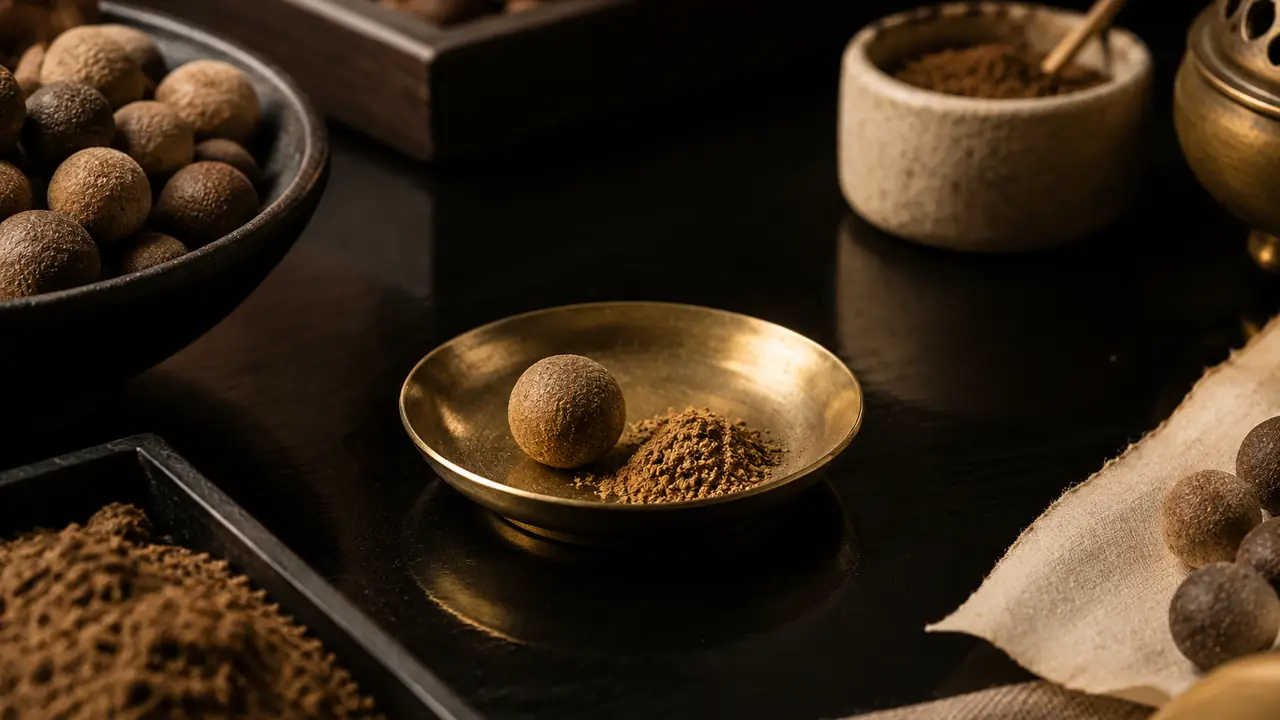
A working definition
Incense beads belong to the Chinese tradition of hexiang, blended incense, in which several aromatic materials are prepared, ground and combined according to a formula. For centuries the blend was burned or carried in sachets; the bead is the wearable form. Powder is kneaded into a dough with a natural binder, rolled by hand into spheres, pierced, dried slowly in the shade and then aged so the separate ingredients settle into one scent. Because nothing is burned, the scent comes from contact: body heat and the friction of wear warm the surface and release the aromatics a little at a time.
The result sits between jewelry and fragrance. A bracelet of incense beads looks like a strand of matte wooden beads, weighs about the same, and carries a scent that stays close to the skin rather than filling a room. That is also why the category has grown with fragrance and lifestyle brands: it is a scent you can wear without alcohol or spray.
What goes into a bead
A formula sheet for a standard bead lists three kinds of ingredient.
| Part | Typical materials | What it does |
|---|---|---|
| Aromatic base | Sandalwood powder, agarwood powder, herb and spice powders | Carries the scent and the character of the line |
| Binder | Nanmu bark powder, often about a quarter of the powder weight | Holds the bead together without glue |
| Plasticizer and accents | Honey, pear juice, flower water, gold leaf on the surface | Makes the dough workable, rounds the scent, decorates |
The binder deserves a sentence of its own. Nanmu powder, ground from the bark of Phoebe trees, turns sticky with water and dries hard, so a bead can be rolled and pierced without any adhesive. Beads made this way have no synthetic fragrance oils and no industrial glue in the standard specification, which is the single most important line on a buyer's sheet. The nanmu binder guide goes deeper.
How the scent is released
A burned incense releases everything at once through heat. A bead releases slowly through three mechanisms: the warmth of the wrist, which raises the surface temperature by a few degrees; friction against skin and sleeves, which exposes fresh material; and humidity, which carries scent molecules off the matte surface. The scent is therefore strongest when the beads are worn and nearly absent when they sit in a closed drawer. Many users describe the scent changing over months as the lighter notes fade and the resinous base comes forward; this is normal aging, not a defect, and it is why ateliers age beads in sealed jars before they ship. How long incense beads last covers care and revival.
Incense beads are not scented wood beads
Buyers sometimes confuse incense beads with wooden beads that have been soaked in fragrance oil. The two look similar from a distance and behave very differently.
- Material. An incense bead is aromatic through its whole volume; a cut bead smells the same inside as outside. A scented wood bead carries oil on and just under the surface.
- Scent life. Oil-scented beads fade in weeks or months. Incense beads keep their scent for years with proper storage because the aromatic material is the bead.
- Declaration. Incense beads can be declared as natural botanical ingredients; oil-scented beads carry fragrance compounds that may need allergen labeling in some markets.
- Weight and feel. Incense beads are matte, slightly grainy and a little lighter than hardwood; wood beads are glossy and denser.
The comparison is drawn out in incense beads vs scented wood beads.
Formats you can buy
The same dough becomes several products, which is useful when a brand wants one scent across a range.
| Format | Typical spec | Typical channel |
|---|---|---|
| Bracelet | 8 mm, 18-22 beads, elastic or silk cord | Fragrance boutiques, gift, e-commerce |
| 108-bead strand | 6 or 8 mm, guru bead, tassel | Yoga and meditation studios, retreat shops |
| Tablet pendant | 30-50 mm pressed tablet with relief | Jewelry brands, gift |
| Car and bag charm | 3-5 beads, knot and tassel | Lifestyle stores, e-commerce |
| Loose beads | By kilogram, sorted by size | Jewelry makers, DIY kits |
All of them appear in the product catalogue with their formula sheets.
Where the tradition comes from
Blended incense has a written record in China that runs from Tang dynasty notes through the Song dynasty Chen Shi Xiang Pu to the Ming compendium Xiang Sheng, and court workshops made scented pellets and beads, the so-called medicine beads, bound with honey and sticky rice. Today the craft lives in small ateliers in and around the Fujian incense clusters, where Yongchun's incense industry and Xianyou's bead trade sit close together, with agarwood supplied by growers in Guangdong and Hainan. The steps after milling are still manual, which is why minimums are counted in dozens and hundreds rather than thousands. The history is told in ancient incense formulas and the modern supply in industry clusters.
Three things buyers often get wrong
"Stronger is better." A bead that smells strongly in the box has usually been dosed with oil. A real incense bead is quiet in the box and comes alive on the wrist.
"Darker means more agarwood." Color comes from the mix of powders, the pear or herb content and the aging; it is not a grade. Ask for the formula sheet and, for agarwood, the CITES documents that travel with the lot.
"Any humidity is fine." Beads are dried to a stable weight and sealed with a desiccant for a reason; a damp carton in a sea container can grow mold on the surface. Packaging is part of the specification, not an afterthought.
What to state when ordering
- The line and the scent direction: sandalwood, agarwood, a formula such as goose pear, or a herbal blend.
- Bead size and count, or the pendant or charm format.
- Findings and cord, engraving or logo on a tablet, packaging.
- Quantity per design and the target delivery date.
- Documents needed: ingredient declaration, CITES for agarwood, metal test reports for findings.
With that information a workshop can propose a formula sheet and a typical reference MOQ rather than a generic price list. Send it through the quote form; reference ranges are on MOQ and lead time.