
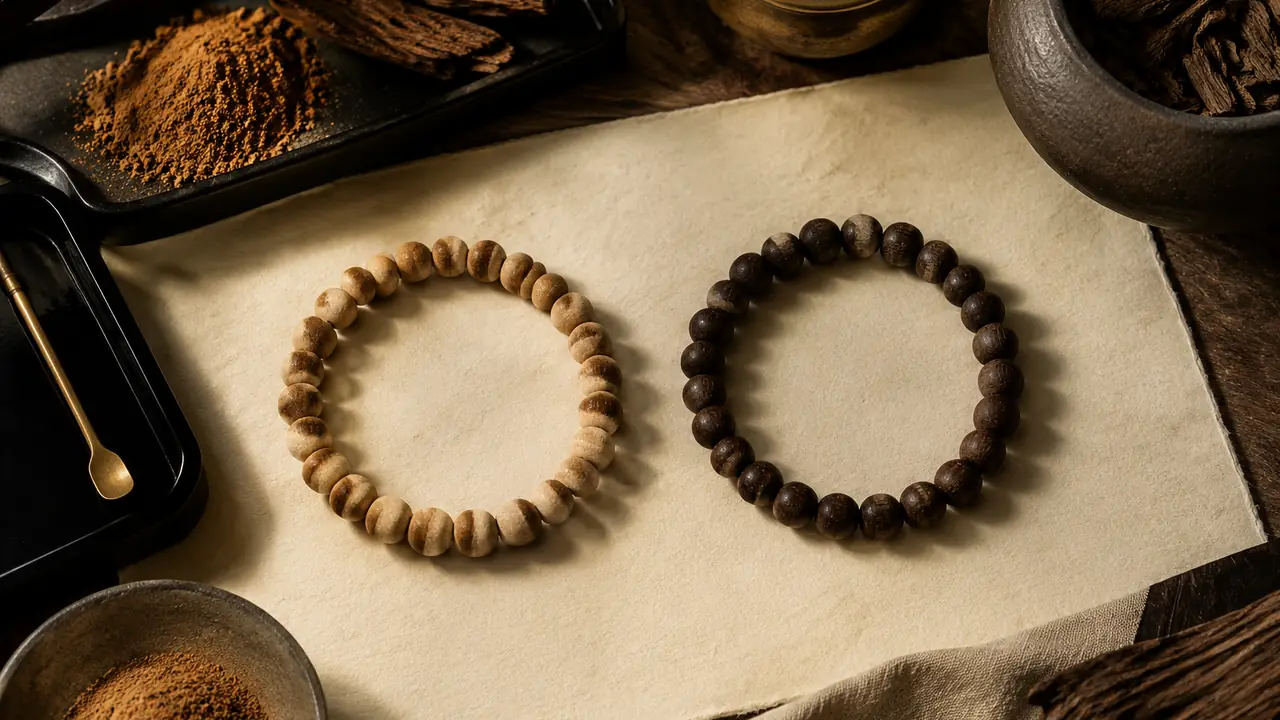
How each bead is made
A solid wood bead is cut from timber, drilled and turned round on a lathe, then sanded and polished. The wood keeps its own grain, color and natural scent, and the process suits machines, so volume is easy to scale. An incense bead is rolled by hand from ground aromatic powder, nanmu bark binder and a little honey, pierced with a steel pin, shade-dried and aged. It has no grain, because it is a compacted powder, and its scent is the substance rather than a property of a piece of timber. The sequence is set out in the making process.
These different routes explain almost every row of the comparison below.
Side-by-side comparison
| Criterion | Incense bead | Solid wood bead |
|---|---|---|
| Scent character | Designed and blended; can be layered or built to a formula | Natural scent of the timber only, often faint |
| Scent life | Years with proper storage; scent runs through the whole bead | Depends on the species; many woods carry little scent after sanding |
| Weight and feel | Slightly lighter, dry matte surface, fine grain-free texture | Often denser, smooth, glossy when polished, visible grain |
| Documents needed | Ingredient declaration; CITES per lot for agarwood; origin for sandalwood | Species and origin; CITES or timber rules if the species is listed |
| Typical channel | Fragrance brands, gift, meditation, specialist retail | Fashion jewelry, general craft, mala makers, promotional items |
| Relative cost factors | Material grade, hand rolling, drying time, aging | Timber species, machine time, finishing and polish |
What really differs for a buyer
The scent is a feature in one and an accident in the other. A wood bead may smell pleasant when new, but sanding and polishing remove much of the aromatic surface and the scent fades quickly unless the species is naturally rich in oils. An incense bead is designed to smell, and the scent is controlled by the formula. If scent is the reason a customer buys, incense beads deliver what the label says; if scent is a bonus, a wood bead is enough.
Appearance is different. A polished wood bead has visible grain and a sheen that suits fashion jewelry. An incense bead is matte and uniform, and its character comes from color and surface softness rather than grain. Neither is superior; they appeal to different tastes, and some designers use both in one bracelet, with wood spacers between incense beads.
Durability differs. A hard wood bead resists knocks and wear better than a compacted powder bead, which is somewhat softer and benefits from care. Incense beads should be kept away from water and from sharp impacts, and wood beads tolerate rough handling more easily.
Production scale differs. Lathe-turned beads can be produced in very large quantities and at consistent size. Incense beads are rolled by hand and dried slowly, so minimums are counted in dozens and hundreds and lead times include drying and aging. The reasons are explained in why incense beads resist full machine production.
Cost without numbers
The cost structures are different, so a simple price comparison is misleading. For a wood bead, the main drivers are the species of timber, how much is lost in turning and the amount of finishing. For an incense bead, the drivers are the grade and origin of the aromatic powder, the labor of rolling and piercing and the drying and aging window. A common timber such as a plain hardwood is usually the cheaper bead. An incense bead built on sandalwood or agarwood is usually the more expensive one, and the gap widens with higher material grades. Regard them as different products with different value propositions, and compare each against the customer promise rather than against each other.
Packaging and care differences
Packaging is where the two products part ways most visibly. Solid wood beads are stable and can sit in an open display or a simple pouch for months without changing. Incense beads need to stay sealed until sold, usually in a foil or tin inner pack with a desiccant sachet, because the surface scent leaks away in open air and a damp carton can encourage mold. Freight cartons for incense beads are lined and kept dry; wood bead cartons rarely need this care. These requirements add a small amount to packaging cost and to handling time, and they should be in the specification from the start.
Care instructions differ too. A wood bracelet can be wiped with a damp cloth and left to dry, though prolonged soaking still harms it. An incense bracelet should be kept away from water, sweat should be wiped off and it should be stored sealed when not worn. A short care card in the pack lowers returns for both products, and for incense beads it also explains why the scent seems to grow and fade with wear.
Finally, think about how staff will describe the difference at the point of sale. A single sentence is usually enough: wood beads are chosen for their look, incense beads for their scent. If your team can say that without hesitation, customers rarely feel misled, and the two products can share a shelf comfortably without competing for the same shopper.
How to decide
- If the product promise is scent, choose incense beads and ask for the formula sheet.
- If the product promise is appearance or mala structure with no scent expectation, a solid wood bead is a reasonable choice.
- If you want both, combine them: incense beads as the main strand and wood or metal as spacers.
- If you sell in a channel where customers expect robust, hard-wearing jewelry, favor wood or use incense beads with a protective care card.
- If your volume is very high and the budget fixed, wood scales more easily; if your volume is small and scent matters, incense beads fit.
Next steps
Ask for samples of both and compare them on the wrist over a day, then again after a week. For incense beads, the product pages for sandalwood bracelets and all incense bead bracelets list formula sheets and options. Typical reference minimums for stock designs are on MOQ and lead time, confirmed in writing for each program, and you can send your specification through the quote form.