
The short answer
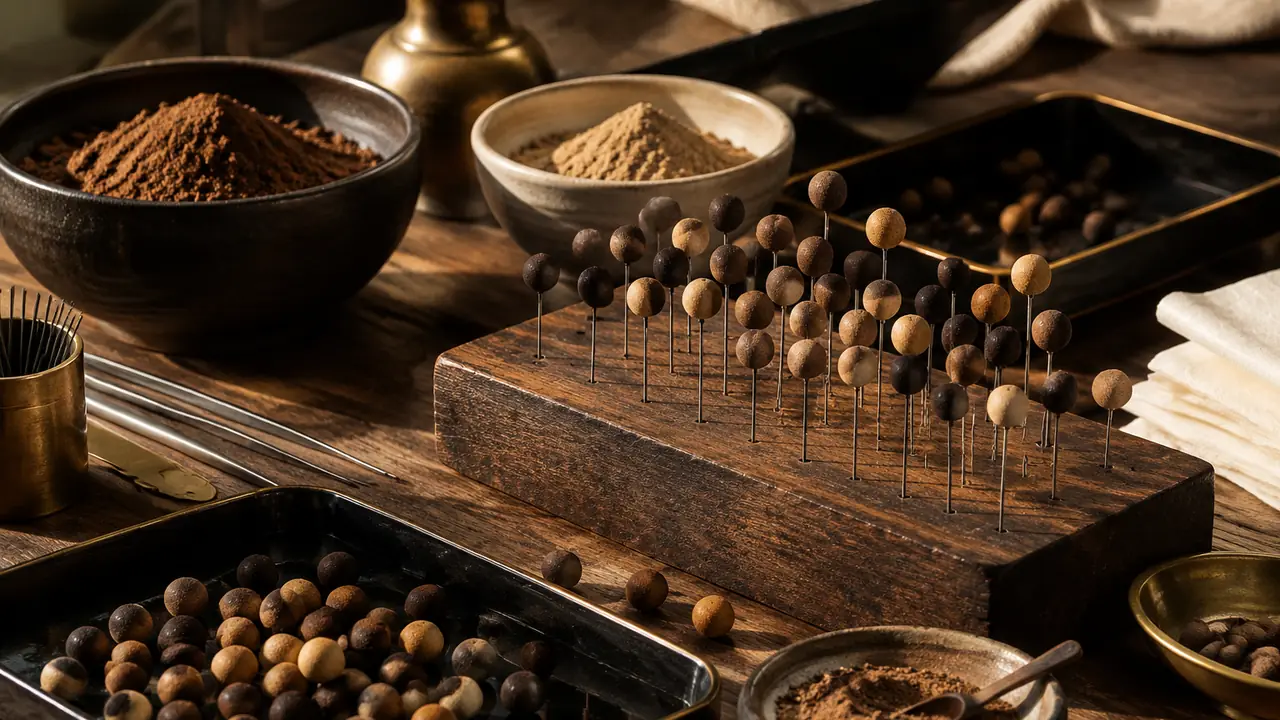
Traditional incense beads are made from plant powders, a natural binder and a little honey, and they are shaped while soft, dried slowly and then aged. Of the seven steps in how incense beads are made, only powder milling is routinely mechanical. The others, from kneading and rolling to drying and polishing, are manual in partner workshops, and for good reasons. Understanding them explains the minimums, the lead times and the small natural variations that come with the category.
The material is not machine friendly
An industrial forming line wants a material with predictable flow, such as plastic pellets or metal powder with a fixed binder. Incense dough behaves differently. It is a wet mass of ground fiber with a plant binder that is sticky when damp and brittle when dry, and its behavior changes with the weather, the water content and the age of the dough. Anyone who has seen a food processor choke on dough has seen a milder version of the problem.
- Stickiness. Dough clings to metal surfaces, tears when forced through narrow openings and leaves residue that changes the next batch.
- Variability. Each batch of powder differs in moisture and particle size, which changes how much liquid the dough takes.
- Fibers. Wood and bark fibers do not flow like a liquid; they catch, align and leave seams.
- Delicate aromatics. Heat and pressure that a machine uses to form material can drive off volatile notes.
The method depends on judgment
A skilled roller adjusts pressure by feel, noticing when a portion is a little dry or a little soft, and compensates by pressing longer or lighter. A machine has to be set to one value. The same applies at the other steps. A person judges when dough has rested enough, when beads are turning from soft to firm on the racks, and when a bead is dry enough to polish. These are the checks described in resting the dough and shade drying.
| Step | Machine suitability | Reason |
|---|---|---|
| Milling and sieving | High | Uniform fineness beyond hand work |
| Mixing the dough | Partial | Mixers help, but water level is adjusted by feel |
| Resting | Not applicable | Time-based, needs only sealed containers |
| Rolling and piercing | Low | Sticky, variable dough; centered holes |
| Shade drying | Low | Slow by design; conditions monitored |
| Polishing | Partial | Drums can help; defects are sorted by eye |
Speed is the enemy of the process
Even where a machine could form a bead, the schedule does not change. The dough needs about 24 hours of rest, the beads need roughly 5 to 10 days of shade drying at conditions near 25 C and 60% humidity, and polishing and aging follow. Faster forming does not shorten the stages that are limited by time. A factory that tries to shorten them with heat meets cracks, fading scent and mold. This is why the practical bottleneck in custom incense is the days on the rack, not the minutes at the table.
Mass-produced scented beads exist, but they follow a different path: a pressed or injected core, often soaked or coated in fragrance oil. That is a different product from a botanical incense bead, and the distinction is drawn in incense beads vs scented wood beads. A low-cost bead that arrives in huge quantity at a very short lead time is likely to be one of these, and the specification should say so.
What it means for MOQ and lead time
Hand production explains the shape of reference ranges: minimums counted in dozens and hundreds, and lead times counted in weeks. Typical reference ranges used by the sourcing desk are 50 to 200 bracelets per design for catalogue items, about 300 to 1,000 pieces per design for private label, and about 500 pieces or more for a custom formula with sample rounds. Samples take roughly 5 to 10 working days from stock and 15 to 25 days for a custom formula; bulk takes 15 to 25 working days from stock, 25 to 40 days for standard batches and 40 to 60 days for custom classical formulas. These are reference ranges and confirmed in writing for each program; see MOQ and lead time.
What the buyer gets in return
The hand-made character has real benefits. Because the shaping is not forced, the material keeps its aromatic content, and the scent is closer to the formula. Small production runs make small, specific orders possible: a studio can order a few dozen 108-bead strands in a single scent, a brand can test a new blend with a limited sample round, and changes of color, size or botanical accent do not need new tooling. The category also offers a story that buyers can truthfully tell: hand-rolled, shade-dried, aged in jars.
The trade-off is that variation exists. Beads in a strand differ slightly in size and color, and lots differ by season. Tolerances are therefore agreed on weight and diameter, and the retained sample sets the reference. The inspection list is on testing and inspection.
Planning a program around hand production
- Order samples early, since they carry the same drying and aging time as bulk.
- Agree the tolerance on bead size, weight and hole in the specification.
- Place bulk in time to fit the quoted lead time, with a buffer for humid weeks.
- For larger quantities, plan staged deliveries instead of a single lot.
- Keep one approved sample as the standard for every lot.
A realistic plan sees the workshop as a craft partner rather than a line. Capacity grows by adding trained hands, racks and drying rooms, which takes planning time, so a repeat program that is announced early is easier to serve than a surprise reorder. Buyers who forecast two or three seasons ahead usually get steadier lead times and more consistent lots, because the workshop can keep the same people on the same formula. If you have a program in mind, send quantity, formula and delivery date through the quote form and the desk will propose staged production against the reference ranges.