
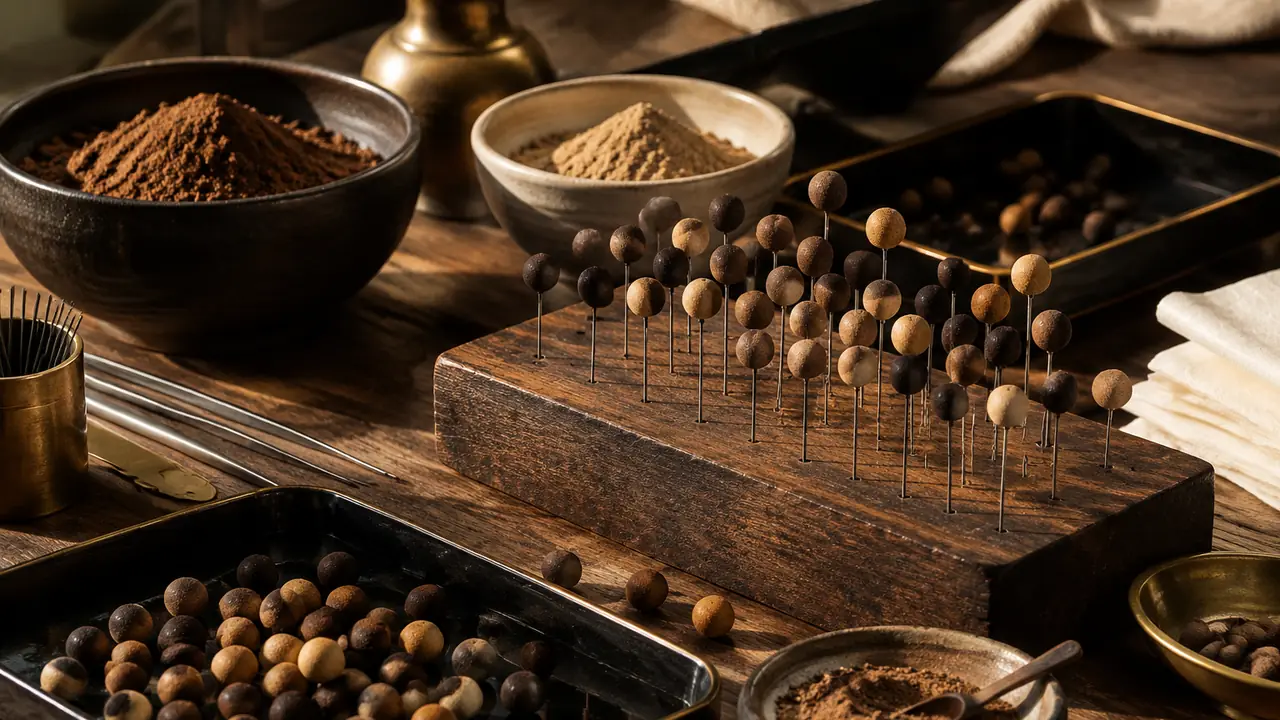
Why drying is slow on purpose
A freshly rolled bead is mostly damp dough. It has to lose that water gradually, from the inside out, without hardening its skin first. If the surface dries faster than the core, it shrinks around a wet center and splits. For this reason partner workshops dry beads in a shaded, ventilated room instead of in the sun or an oven, and give the process about 5 to 10 days depending on bead size, formula and weather. It is the sixth of the seven steps in how incense beads are made, and the one most responsible for the lead times quoted for custom formulas.
Shade also protects the scent. Direct sunlight and strong heat drive off the volatile top notes of sandalwood and agarwood and can fade the color of botanical accents. A slow, cool dry keeps more of what the formula was designed to carry.
Typical drying conditions
| Factor | Workshop practice | Why it matters |
|---|---|---|
| Temperature | Often held near 25 C | Avoids a fast skin and protects volatile notes |
| Relative humidity | Often held near 60% | Too low dries the skin, too high invites mold |
| Airflow | Gentle, no direct draft | Even moisture loss on all sides |
| Light | Shade, no direct sun | Protects scent and color |
| Handling | Beads turned on racks | Prevents flat sides and uneven drying |
| Duration | About 5-10 days | Larger beads and wetter formulas take longer |
These figures are workshop practice and typical reference values. Climate matters, and a workshop in a humid season may slow the process or use gentle dehumidifying; the actual settings for a program are recorded and confirmed in writing.
Where cracks come from
Cracks are the visible failure of drying, and they have a short list of causes.
- Dough that was not rested. Uneven moisture inside the bead drives uneven shrinkage; see resting the incense dough.
- Drying too fast. Sun, heaters, fans pointed at the beads, or a very dry room.
- Uneven bead size. Larger beads dry slower than small ones, and a mixed tray dries unevenly.
- Coarse powder. Large particles create weak points; see milling and sieving.
- Binder shortfall. Too little nanmu leaves the bead without enough strength to resist shrinkage.
Cracks may be hairline at first and widen over weeks in jars, which is why beads that look sound on day seven are checked again after aging.
Mold, the opposite risk
Drying slowly means keeping beads damp for longer, which leaves room for mold if the air is stagnant. Workshops control this with airflow, regular turning and attention to the humidity of the room. White or green spots on the surface, or a musty smell, are reasons to remove beads from the lot. A bead is only safe to seal when it is truly dry throughout, so packing too early is a frequent cause of spots found by importers months later. Storage and shipping consequences are covered in logistics and shipping.
How to know a bead is dry
Workshops rely on touch and on weight. A dry bead feels firm throughout, with no cool, soft sensation at the core, and does not bend a pin pushed against it. Weight is the more reliable check: beads are weighed at intervals, and when the weight stops falling across two or three checks, the bead has reached its stable weight. This weight stability is the practical definition of dry. A buyer can ask for a short record of weights for a sample batch from the first to the last day, which also shows whether the workshop actually watches the process.
- Beads are placed on racks in a single layer, not touching.
- They are turned at intervals so every side meets the air.
- Weight is checked on a few marker beads each day or two.
- When the weight is stable, beads move to polishing.
- Cracked, flat or spotted beads are set aside before polishing.
Seasons and climate
The same formula dries differently in different weeks. In a damp season the air carries moisture back into the beads and the schedule stretches; in a dry, windy season the skin is at risk and trays may be covered or the airflow reduced. Experienced workshops adjust the room instead of the calendar, using shutters, cloth covers, small dehumidifiers or humidifiers to hold the target range. Workshops without that control tend to schedule difficult formulas for stable weather and fill the rest of the year with simpler lines.
For buyers planning programs around seasonal events, this has a simple consequence. A holiday gift program ordered late in a rainy period may need more drying time than the quotation first showed, and a conversation about the calendar early on is far less expensive than a rushed correction later.
Bead size and formula effects
Size has a strong effect on drying time, since moisture has to travel farther from the center of a large bead. A 6 mm bead may be ready near the lower end of the range, while a 12 mm or larger bead is more likely to need the upper end or beyond. Formula matters as well. Formulas with a high share of resin or fruit juice, such as goose pear, hold more moisture or oil and are dried more carefully. Beads with gold or silver leaf are usually finished after drying, not before; see gold leaf and silver leaf on incense beads.
What this means for schedules and sourcing
Drying cannot be shortened without a price in quality, so it sets a floor under the lead time. Reference ranges for samples and bulk lots, which include drying and aging, are on MOQ and lead time and are confirmed in writing for each program. Programs that run during a humid season may need extra days, and it is better to learn this at quotation than at shipment.
When comparing workshops, ask three simple questions: what conditions the drying room is held at, how drying is judged complete, and what happens to beads that crack. Honest answers are usually specific, such as a number of days, a humidity target and a sorting step. Vague answers suggest the stage is being managed by habit. The wider list of checks is on quality control, and the step that follows is in polishing and aging incense beads. For a program brief, use the quote form.