
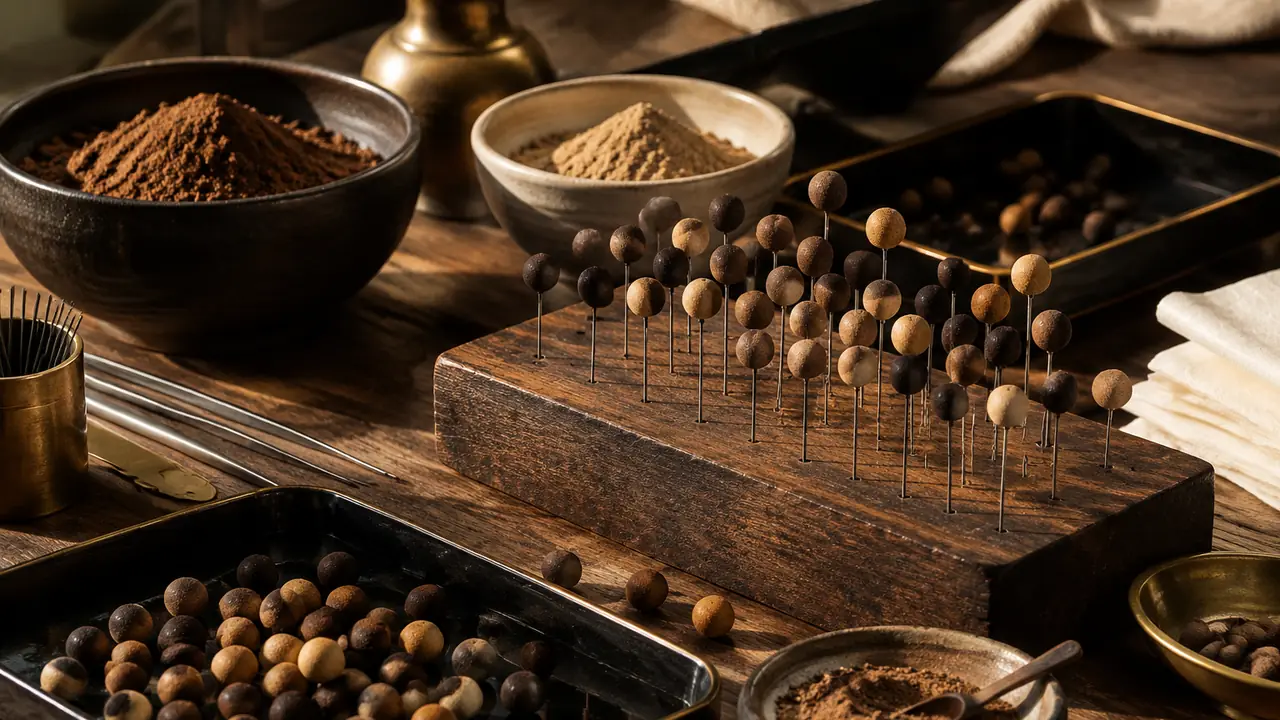
What leaf finishing is
Metal leaf is a very thin sheet of beaten metal, gold or silver, that is laid on the surface of a bead as decoration. On incense beads it is used in two ways: as a full wrap that covers the bead, giving a metallic sphere with an aromatic core, or as a partial accent, with flecks or bands of leaf over the natural matte surface. It has a long history in Chinese lacquer and Buddhist craft, and in bead making it is a finishing step done after the bead is dry and polished, not a part of the dough. The stages before it are described in how incense beads are made.
The leaf is decoration only. It does not change the formula, the binder share or the way the scent is released, although a full wrap does reduce how much bare surface the skin touches, so scent can feel quieter at the start.
How leaf is applied
Application is delicate work. The polished bead is prepared so the surface is dust-free, a very light layer of sizing is applied for adhesion, and the leaf is laid on with a soft brush or bamboo tool and pressed gently. Extra leaf is brushed away, and the bead is dried and sometimes sealed with a thin protective layer. Because leaf tears at a breath, workshops apply it in still air and work on small batches. For flecks the leaf is broken up and scattered over the bead with the same care.
Standard bead specifications state that no synthetic fragrance oil and no industrial glue are used, and this should be carried through to decorated lines. Anything used to hold or seal the leaf is a finishing material, and it should be named in the specification and confirmed in writing for each program, so that an ingredient declaration remains accurate.
Gold, silver and alternatives
| Option | Look | Points to confirm |
|---|---|---|
| Gold leaf | Warm, bright metallic; luxury and festive feel | Material grade stated in the specification; supplier declaration |
| Silver leaf | Cooler, quieter; modern and minimal | May tarnish over time; sealing or not |
| Imitation leaf (copper alloy) | Gold-like color at lower cost | Must be described as imitation, not as gold |
| Flecks or bands | Accent over a natural surface | Placement, density, and what holds it |
| Full wrap | Solid metallic bead | Wear at the pin hole and at contact points |
A buyer who wants real gold or silver should say so, and a buyer who wants an affordable look should ask for imitation leaf and require it to be named as such on packaging and in listings. Mislabeled leaf is a compliance and trust problem, and it is simpler to avoid at specification time. Materials used in findings follow separate declarations; see compliance and certifications.
How leaf wears
Leaf is thin by nature, and on a bead that is worn and rubbed it wears. The highest points, the area around the hole and the sides that rub against neighbors, thin first. Many wearers like the aged look that results, with warm matte aromatic wood showing through the metal, and some brands position the finish as a patina instead of a flaw. Others want a finish that stays intact, and in that case a partial accent or a sealed finish is the safer choice. Some points to expect:
- Full-wrap beads show wear sooner at the pin hole and at the contact points between beads.
- Silver leaf can tarnish with sweat and humidity unless sealed.
- Sealing helps protect the leaf but slightly changes the look and how the surface breathes.
- Water and cleaning products should be kept away; see can incense beads get wet.
Where leaf finishes sell
Leaf tends to be chosen for specific occasions and channels. Gift and corporate programs use a single gold accent bead or a leaf-finished tablet to make a standard bracelet feel special without changing the base line. Festive ranges, such as new year and lunar celebrations, lean on gold. Jewelry brands pair silver-leaf beads with 925 silver spacers for a cool, coordinated look, and in that case the finishing choices should be agreed together with the findings, as covered in the silver set line.
Studios and temple shops usually prefer plain beads, where the natural surface is the point, and may find leaf out of place. The advice for a first order is to test a small leaf-finished run beside the plain version and look at which sells, instead of committing a whole range at once. A short sample round with both variants costs far less than a large decorated lot that does not suit the channel, and the plain version remains the core line in any case.
Cost, lead time and minimums
Leaf finishing is handwork on top of handwork, and it adds time after polishing. It also adds a second inspection: coverage, edges, and the state of the leaf near the hole. Programs with leaf usually carry higher minimums than plain beads, and lead time grows by the days needed for application and drying. Reference ranges for plain and custom programs are on MOQ and lead time, and any leaf finish is quoted and confirmed in writing for each program. No price is quoted here: the cost depends on the type of leaf, the coverage, bead count and quantity.
What to specify in a brief
- The leaf type: gold, silver or imitation, with the wording to appear on packaging.
- Coverage: full wrap, partial accent or flecks, with a reference photo or a sample.
- Whether the leaf is to be sealed, and what the seal is.
- The share of decorated beads in a strand, for example a single accent bead on a bracelet.
- Wear and care wording for the insert card.
A common and practical compromise is a plain aromatic bracelet with one or two leaf-wrapped accent beads or a leaf-finished tablet. That keeps scent exposure high, limits cost and still gives the shelf a metallic highlight. Pendant formats are covered in pressing incense tablets. Send the brief, with bead size, quantity and reference images, through the quote form.