
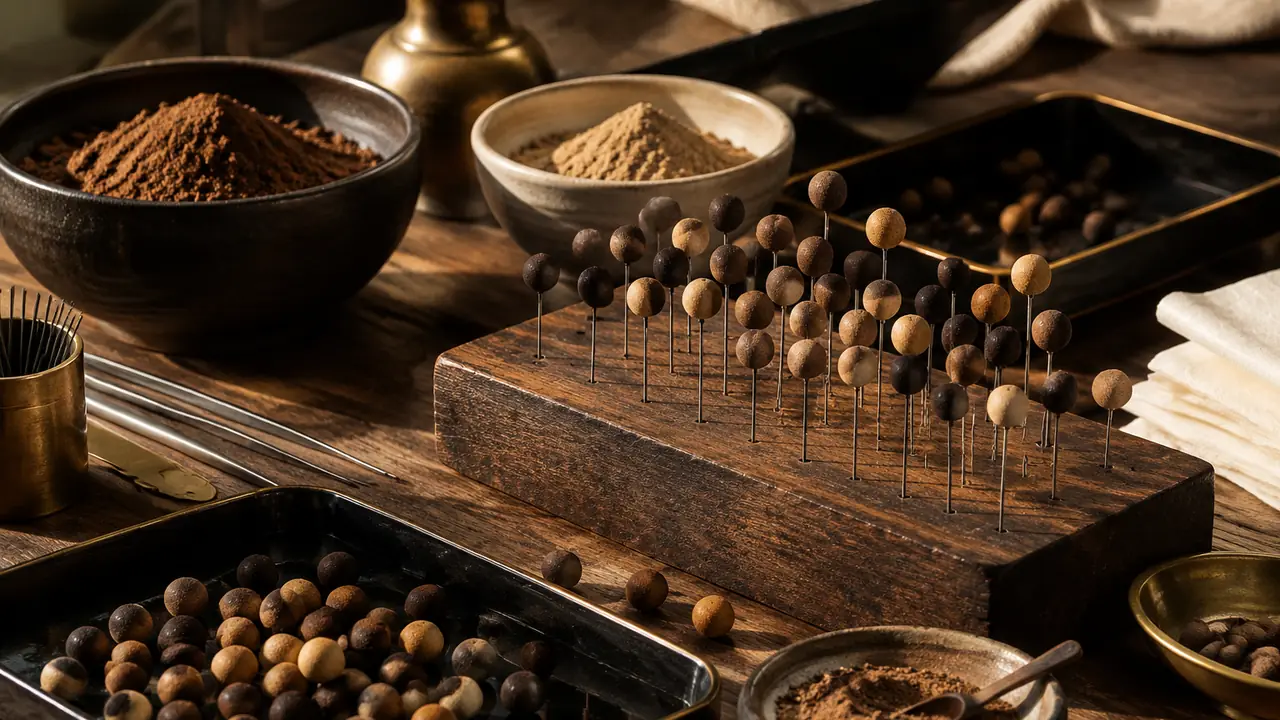
Two steps, one purpose
Polishing and aging make up the seventh and last step of the process described in how incense beads are made. Polishing is about the surface, aging is about the scent, and both are about consistency. A bead that leaves the drying racks is complete in form but still a little rough, and its scent is often sharp, with the separate powders still individually noticeable. After polishing and aging, the surface is close and soft and the notes have moved toward one blended scent.
Polishing: what is done and how
Dry beads are polished by hand or in a slowly turning drum with a soft medium such as fine cloth or wood dust. The aim is to remove tiny burrs, level small imperfections and bring up a close, satin sheen. Hard abrasives and strong pressure are avoided, because a bead is made of compressed powder, not solid wood, and over-polishing wears away shape and scent. Many workshops finish by rubbing beads with a clean dry cloth, which also lifts loose dust.
Two points deserve attention. First, a polished incense bead is not glossy. Its natural finish is satin to matte; a high shine on a bead sold as pure botanical is a signal to ask what was applied to it. Standard specifications use no varnish, wax coating or industrial glue, confirmed in writing for each program. Second, polishing exposes any hidden defects, such as pits from coarse powder or hairline cracks, which are removed in the sorting that follows. Those causes are covered in milling and sieving and shade drying.
Aging: why the beads are sealed away
After polishing, beads are placed in sealed jars or lined bags and left for a period that depends on the program. Workshops often describe this as letting the scent harmonize or settle. In practice several things happen at once. Volatile top notes calm down. The honey and binder settle into the structure and the bead finishes any remaining moisture exchange. The different powders, which smelled distinct when they were weighed, begin to read as one blend. For fruit formulas and resinous ones, the change from the first to the last week is noticeable.
Aging is also a quiet inspection window. Beads that were not completely dry show it in the jar: a faint musty smell, a surface bloom or a spot. Beads that were weak on drying may show a late crack. Catching them here, before packing, is much better than discovering them in an importer's warehouse.
What aging does and does not do
| Aging does | Aging does not |
|---|---|
| Soften sharp top notes and blend the powders | Add scent that the formula does not contain |
| Reveal late cracks or moisture problems | Repair a poor bead |
| Let beads reach a stable weight in sealed storage | Replace proper shade drying |
| Give a consistent scent across a lot | Keep beads fresh indefinitely once they are out of the jar |
Aging is not a fixed number of days in a standard, and it is a point where programs differ. Short aging suits simple sandalwood lines, while custom formulas with several botanicals or a fruit element benefit from longer. The program record states the period, and it forms part of the lead time on MOQ and lead time.
How different lines are finished
Not every line is polished and aged the same way, and the differences are worth knowing when a range is planned.
- Sandalwood and agarwood beads. Light polishing to keep the matte surface, followed by aging to soften sharp resinous notes. These are the reference lines for most programs.
- Goose pear and fruit-based formulas. Handled more gently because the fruit element leaves the bead slightly softer. Aging is more important here, since the sweetness and the wood need time to join.
- Beads with leaf finishes. Polished first, then decorated; the leaf is applied to the finished surface. See gold leaf and silver leaf on incense beads.
- Tablets and pendants. Pressed pieces are sanded at the edges instead of rolled and polished like beads. See pressing incense tablets.
Handling after the jar
Finished beads stay good when they are treated gently. The simplest rules are to keep them sealed until needed, avoid damp hands and avoid leaving them in heat or direct sun. Workshops pack with a desiccant and a short handling note for the importer, and buyers who sell to consumers often pass a shorter version of that note on in the box. Storage detail is in how to store incense beads. Because the surface of a polished bead is soft, strands are packed so that the beads do not rub against hard cord ends or each other during shipping.
Sorting and packing after finishing
Once aged, beads are sorted by size and appearance, and strands are assembled. The sorted beads are checked against the retained sample: diameter consistency, hole centering, surface, and scent. Sealed packing follows, typically in foil-lined bags or sealed jars with a desiccant, because a bead that has been carefully dried and aged can still take up moisture in a damp carton. Packaging for export is part of the specification; see packaging and gift boxes. Scent is described as lasting for years with proper storage, not a fixed number of years.
- Beads are polished and wiped clean.
- Defective pieces are set aside.
- Beads are sealed in jars or bags to age for the period set in the program.
- After aging, beads are re-inspected and compared with the retained sample.
- Approved beads are strung or packed with desiccant.
What a buyer can ask
Ask how long the beads are aged, in what container, and who checks them afterward. Ask what is used for polishing and whether anything is applied to the surface. For a custom formula, request a note on how the scent changed between the first sample and the final aged bead, since this tells you whether the sample stage was long enough for the real scent to emerge. Wider quality steps are on quality control, and a program brief can go through the quote form.