
One sequence, many variations
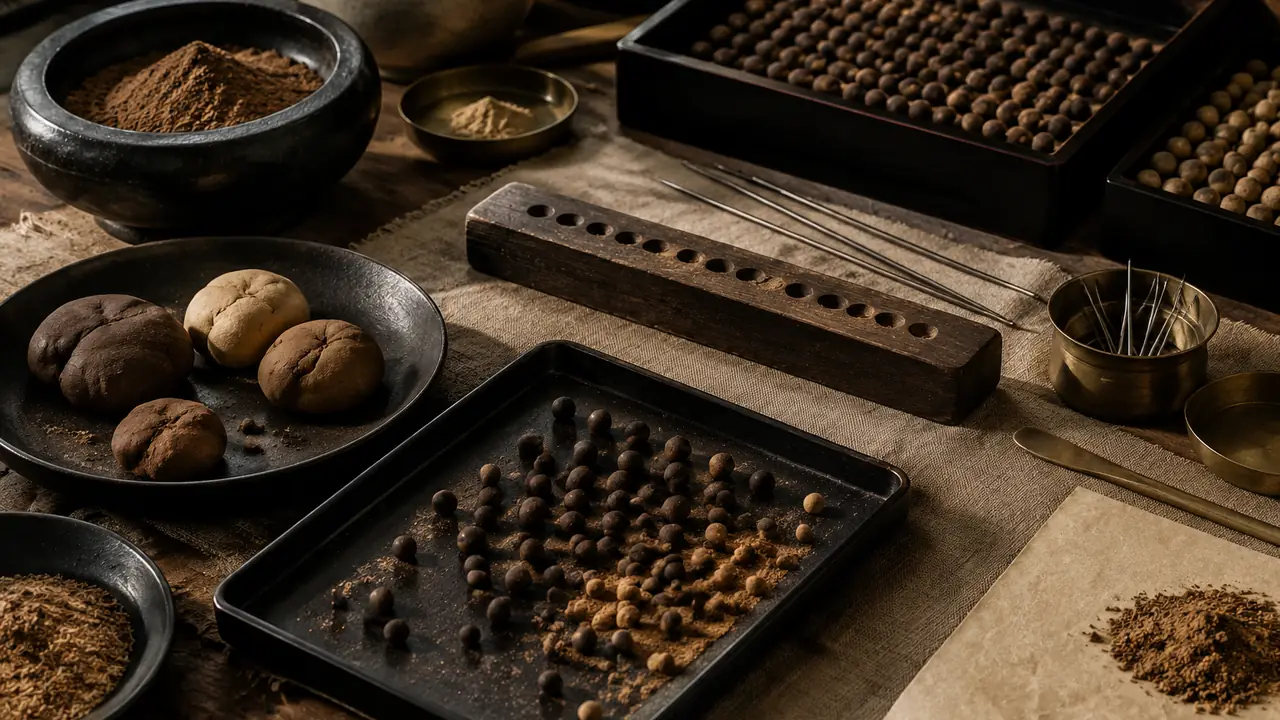
Whatever the line, incense beads made in partner workshops follow the same seven steps. Formulas, bead sizes and finishing change from line to line, but the order does not, and the points where a lot can fail are the same. Outside powder milling, the work is done by hand, which is why the process cannot be sped up by adding machines and why minimums are counted in dozens and hundreds. The desk follows each lot through these steps and links them to the checks in quality control.
The seven steps
- Material preparation. Sandalwood, agarwood or other woods and botanicals are selected, cleaned and, where the formula calls for it, prepared by steaming, soaking or juicing. Origin and documents are matched to the lot.
- Shade drying and milling. The prepared material is dried in shade and ground to powder, then sieved to a set grade. Milling is the only step that routinely uses a machine.
- Blending the dough. Powder is mixed with nanmu bark powder, which is the natural binder at about 25% of the powder, and with warm water, plant decoction or honey. Honey acts as a plasticizer so the dough rolls smoothly.
- Resting the dough. The dough is sealed and left for about 24 hours, sometimes with beating, so the binder hydrates and the dough becomes even and workable.
- Rolling and piercing. The dough is cut by weight, rolled round by hand and pierced with a steel pin. Hole centering and a steady diameter are the skill of the roller.
- Shade drying the beads. Beads dry in a shaded, ventilated room for five to ten days, turned regularly. Workshop practice is typically about 25 C and 60% relative humidity; strong sun or heat causes cracks.
- Polishing and aging. Dry beads are polished for a soft sheen, then sealed in jars so the powders, binder and honey settle into one scent before packing.
What is controlled and how long it takes
| Step | What is controlled | Typical time |
|---|---|---|
| 1. Material preparation | Origin, documents, cleanliness of material | 1-3 days |
| 2. Drying and milling | Dryness of wood, sieve grade, separation of woods | 2-5 days |
| 3. Blending | Recipe by weight, binder share, honey and water | Same day |
| 4. Resting | Sealed container, even moisture | About 24 hours |
| 5. Rolling and piercing | Bead weight, diameter, hole centering | Hand work, 1-3 days per lot |
| 6. Shade drying | Temperature, humidity, turning, mold watch | 5-10 days |
| 7. Polishing and aging | Surface, scent blend, sealed storage | Several days to weeks |
Times are typical reference figures from partner workshop practice, shown as ranges and not as commitments. They depend on bead size, season and humidity, and each program receives its own timetable confirmed in writing. A custom formula is slowest, commonly 40-60 days, because rolling and drying are the bottleneck.
Pressing tablets and rolling sticks
Not every product is a round bead. The same dough, with the same binder and rest, can be shaped in other ways.
- Pressed tablets. For the incense tablet pendant, the dough is pressed into a mold to a thickness of about 3-6 mm, dried flat between boards to avoid warping, and can be engraved. Drying is slower than for beads because the surface is wide.
- Rolled sticks and pills. For the incense gift box, dough is rolled into strands that are cut and dried, or rolled into small pills that can be aged longer. Bamboo-core sticks follow the Yongchun method.
Where lots fail, and what the desk does
Three failures are most common: cracks from fast or hot drying, mold from damp or slow drying, and uneven size from careless cutting. The desk asks for a drying log, takes weight and diameter samples after rolling, and looks at the surface under daylight before aging begins. A lot that shows mold is held until the cause is found. Photos of each stage are requested for the first lot of a new program, so a buyer can follow the work without visiting. Because aging happens in sealed jars, the final scent check against the retained sample is made after step seven, not before.
For how workshops are chosen for this work, see the workshop audit; for ordering and timing, read MOQ and lead time and send your specification through the quote form.