
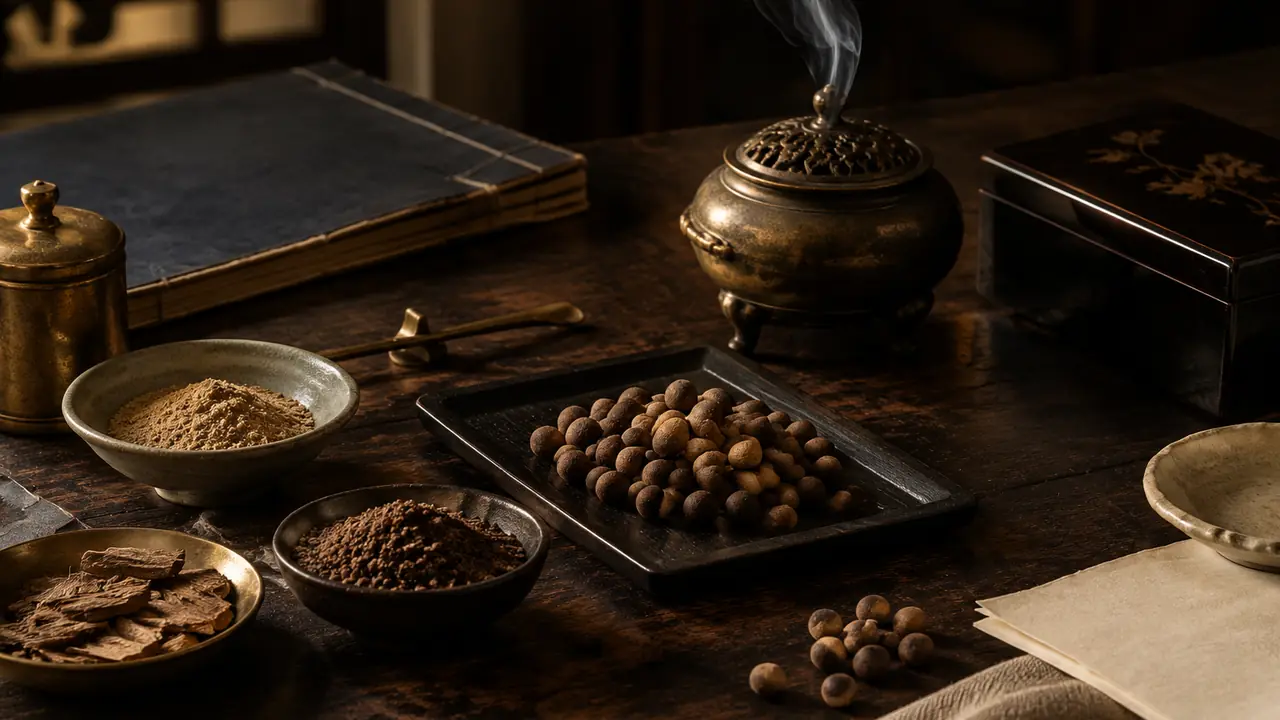
What kind of book it is
Chen Shi Xiang Pu belongs to a genre of Song dynasty writing called xiang pu, incense manuals. Such books gathered formulas, notes on materials and sometimes the lore around them. The Song period was a high point for incense in daily life, with scholars, officials and monks all handling compounded blends, and the manuals reflect that range. Chen Shi Xiang Pu is traditionally associated with Chen Jing and is one of several surviving Song manuals; Hong Chu's Xiang Pu, another Song work, is often read beside it because it organizes materials and describes the practice of incense with a literary eye.
For a buyer, the practical point is that these books are formularies. They record what to combine, in what weights and with what preparation. They are not product catalogues and do not describe shape, size or wear. Everything about a bead as an object belongs to the modern workshop.
How a recipe is written
A typical entry gives a name, a list of ingredients with weights in the units of the time, a short note on preparation and sometimes a use. Weights are given in liang and qian, units that cannot be converted into grams with one agreed figure, because the size of the unit varied by period and region. A modern workshop picks a working conversion and states it. The preparation note is brief: steam, roast, grind finely, mix, moisten with honey or juice, store in a sealed vessel to let the scent settle.
| Feature of a classical entry | What it leaves open | What the workshop decides |
|---|---|---|
| Ingredient list with weights | Grade and origin of each material | Source, grade, documentation per lot |
| Short process note | Fineness, duration, temperature | Milling, steaming rounds, drying |
| Liquid or honey for moistening | Quantity | Enough to form a workable dough |
| Storage in a sealed vessel | Time | Aging in sealed jars before packing |
| No binder for beads | Shape and size | Nanmu bark powder, rolling, piercing |
The kinds of formulas it holds
The recipes in a Song incense manual fall into familiar groups, and recognizing them helps a buyer read a supplier's claims.
- Wood-based blends. Sandalwood and agarwood as chief materials, with supporting spices. These are the most relevant to wearable products.
- Fruit and flower blends. Pear, citrus peel, osmanthus and other plant elements steamed or soaked into the powder. The goose pear formula belongs here.
- Study and tent incenses. Blends named for the place they were burned, such as the scholar's study or the curtained bed.
- Pills and pastilles. Powders bound with honey and shaped into small pellets, the ancestor of today's incense pills and, by extension, beads.
- Materials with limited modern availability. Some ingredients named in old recipes are rare, restricted or no longer identifiable with certainty.
Musk and ambergris appear in many classical recipes but are not used in Ouvare lines. The reasons are covered in the four famous materials.
Turning a recipe into a bead
Pills are the closest relative of the bead. A Song pill is a small sphere of powder and honey, left to dry and age, then burned. A bead is a larger sphere of powder, nanmu binder and a little honey, pierced for stringing and meant to be worn. The step from one to the other involves choices that the old book does not make.
- Select a recipe and agree the working weight conversion with the workshop.
- Replace any rare or restricted ingredient with a legally sourced equivalent, or omit it, and write the change on the formula sheet.
- Add the binder: nanmu bark powder, commonly about a quarter of the powder weight, plus honey.
- Run a sample round, rest the dough for about 24 hours, roll, pierce and shade-dry for 5 to 10 days.
- Age the beads in sealed jars, then compare the scent with the target, adjusting the next round if needed.
The full sequence is in how incense beads are made, and custom work is arranged through custom blended incense.
Citing the book honestly
Marketing often reaches for the word ancient. A more useful approach is to say exactly how a product relates to the source. There are three honest levels. A product can follow the recipe closely, with the same materials and the same main process, as in the goose pear beads that steam agarwood and sandalwood with pears three times. It can be inspired by a recipe, keeping the character but changing materials. Or it can use the manual only as a general reference for the method. Each is legitimate, and each should be labeled differently. Passing off an inspired blend as the classical recipe invites the kind of challenge from informed customers that damages a premium line.
It also helps to keep the claims about effect modest. The Song manuals sometimes mention uses that are household, devotional or bodily in their own terms. A modern seller should not repeat these as claims, because a statement that made sense in a Song household is not evidence for a product sold today. The safe and accurate position is that a blend is traditionally associated with a certain use, and that many users describe its scent in their own words. Keeping to that line also makes translation and customs paperwork simpler, since the product is described as an incense article and nothing more.
What to ask a workshop
- Which recipe, from which book, and which edition or reading was used.
- Which ingredients were changed from the classical list and why.
- What weight conversion was applied for liang and qian.
- Which lots carry CITES documents, for agarwood, and where the sandalwood comes from.
- Whether a reference bead from the approved sample will be retained.
Used this way, the formulary becomes a quality tool as well as a story: a recipe that can be named and checked is easier to reproduce lot after lot. The story of one such recipe is told in goose pear tent incense, and the later Ming compendium is covered in Xiang Sheng. To open a sample program for a classical formula, send a brief through the quote form; reference timelines and minimums are on MOQ and lead time, confirmed in writing for each program.