
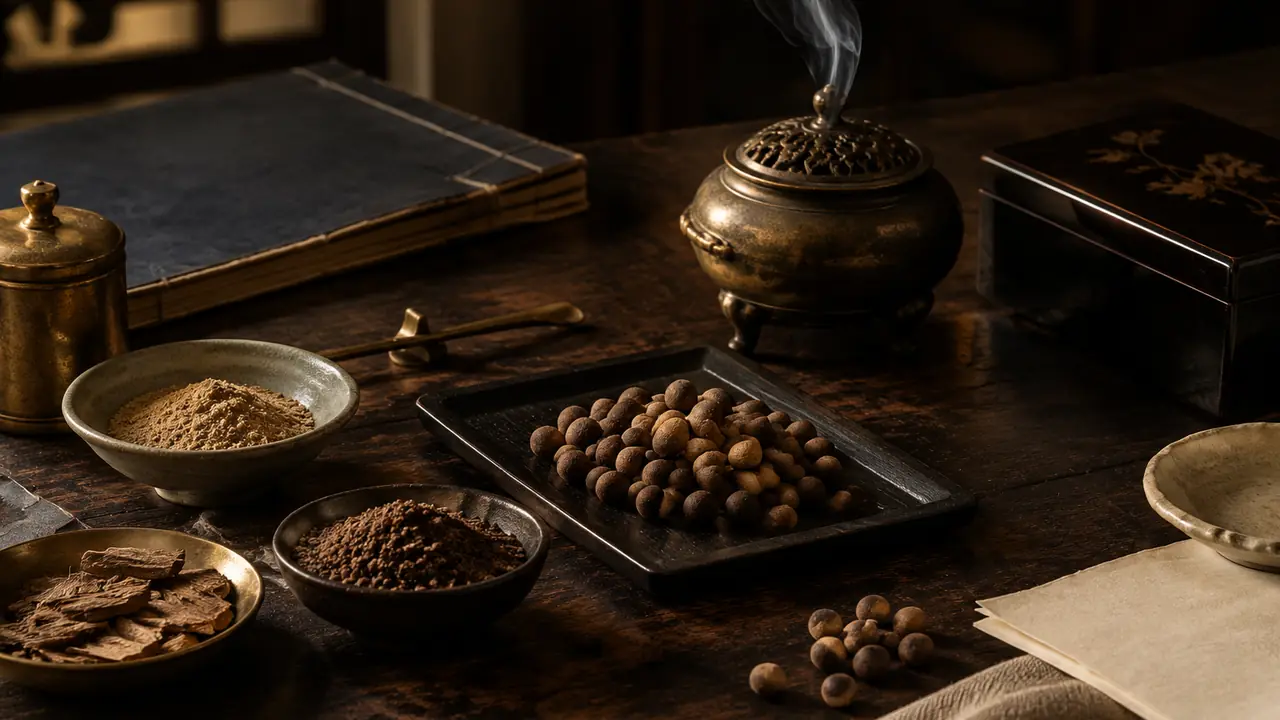
Why revival is happening now
Several things came together. The craft has public recognition: Fujian incense-making, specifically Yongchun incense, was added to the national intangible cultural heritage list in 2021, and Yongchun bamboo strip incense has held geographical indication protection since 2006. Classical texts such as Chen Shi Xiang Pu, Hong Chu's Xiang Pu and Xiang Sheng are available in reprints and annotated editions. Consumers, especially those who value natural ingredients and traceable stories, look for products with a defined origin. And wearable incense has given classical blends a new, accessible form. Each of these makes a classical formula a credible basis for a product, as long as it is handled honestly.
Three levels of revival
| Level | What it means | Example wording |
|---|---|---|
| Close reconstruction | Same main ingredients, same main process, scaled and converted | Rebuilt from the Chen Shi Xiang Pu goose pear entry |
| Inspired by | Keeps the character and logic; materials or ratios changed | Inspired by classical tent incense |
| Method only | Uses the classical method of compounding with a new formula | Made by the traditional hexiang method |
All three are legitimate. The risk lies in using the wording of the first for the product of the third. A buyer who states the level plainly gives customers something to trust, and gives retailers an answer when a knowledgeable customer asks.
What has to be adapted
- Weights and units. The liang and the qian have no single agreed gram value, so a working conversion is chosen and written down. The goose pear formula, with agarwood at one liang and sandalwood at one qian, keeps its ratio of about ten to one in the powder base even when the absolute weights change.
- Binder. A bead needs a binder that the old recipe for burning pastilles did not state. Nanmu bark powder, commonly about a quarter of the powder weight, with honey as plasticizer, is the standard solution.
- Restricted or unavailable materials. Musk and ambergris appear in many old formulas and are not used in Ouvare lines; the formula sheet records any such substitution. See the four famous materials.
- Legal sourcing. Agarwood requires CITES documents per lot, and sandalwood needs stated origin. The old texts say nothing about this; the modern buyer must.
- Format. The shape, size and hole of a bead are design decisions the old books never faced.
The workflow of a responsible revival
- Select the recipe and trace it to its earliest source, noting later copies.
- Read each ingredient with the workshop and fix its modern name, form and source.
- Agree the weight conversion, adaptations and substitutions in writing.
- Run a first sample round: mill, mix, steam or blend, rest the dough for about 24 hours, roll, pierce, shade-dry for 5 to 10 days, age.
- Judge the aged bead against the brief; retain a reference bead; adjust the formula.
- Run a second round if needed, then approve the formula sheet.
- Write the description at the right level of faithfulness, with sources named.
The slow steps, hand rolling and drying, are why custom classical programs take longer than stock lines. Reference ranges are on MOQ and lead time: custom formulas typically begin around 500 pieces with a sample round, and are confirmed in writing for each program.
A worked example
The goose pear formula is the clearest example. The classical entry in Chen Shi Xiang Pu, as commonly read, gives agarwood powder at one liang, sandalwood powder at one qian and ten goose pears, steamed three times. A modern bead keeps those three ingredients and the repeated steaming, adds nanmu binder and honey, converts the weights to a batch, and states that the proportions of the finished bead include the binder. Tradition links the formula to Li Yu of Southern Tang, and the product card can say so as tradition. Read the full account in goose pear tent incense or see the product at goose pear incense beads.
What customers actually respond to
Revival products succeed when the story is specific and the object is good. A card that names the book, the formula and the main ingredients does more than a vague appeal to antiquity. Customers who read the card usually go on to handle the bead, and what they notice is the scent after warming, the weight and the matte finish. A classical formula does not make up for a weak sample; it raises the standard, because informed buyers compare the product with what the text promises. For that reason it is worth spending the extra sample round on the scent after aging and on consistency between lots, rather than on additional story. Pack the product with a short care card, keep the wording factual and let the formula sheet back up every statement on the page.
It also helps to plan the range with some modesty. One or two classical formulas, each in a few sizes and formats, give a brand a clear identity and keep development cost under control. A long list of antique-sounding names invites questions that are hard to answer. Add further formulas once the first has proved itself with customers, and keep the documentation for each in a single folder so that every new lot can be compared with the approved reference.
Pitfalls to avoid
- Calling a bead identical to a historical object.
- Quoting a story as proof of a formula.
- Claiming effects. Classical texts speak about uses in their own terms; modern copy says only that a blend is traditionally associated with a use.
- Hiding substitutions behind a historical label.
- Skipping documents for agarwood or origin statements for sandalwood.
The role of the sourcing desk
Ouvare does not own a workshop. For a classical program the desk shortlists partner workshops in the Fujian and Guangdong incense clusters, passes on the brief, coordinates sample rounds, inspects the aged beads against the retained reference and confirms the specification in writing. The brand keeps ownership of the formula sheet and the story; the workshop keeps the knowledge of preparation. This division is what makes a classical product repeatable from one lot to the next, and repeatability is the difference between a revival and a one-off.
To open a program, send the recipe or the source you want to follow, the bead size and the intended market through the quote form. For the custom process, see custom blended incense.