
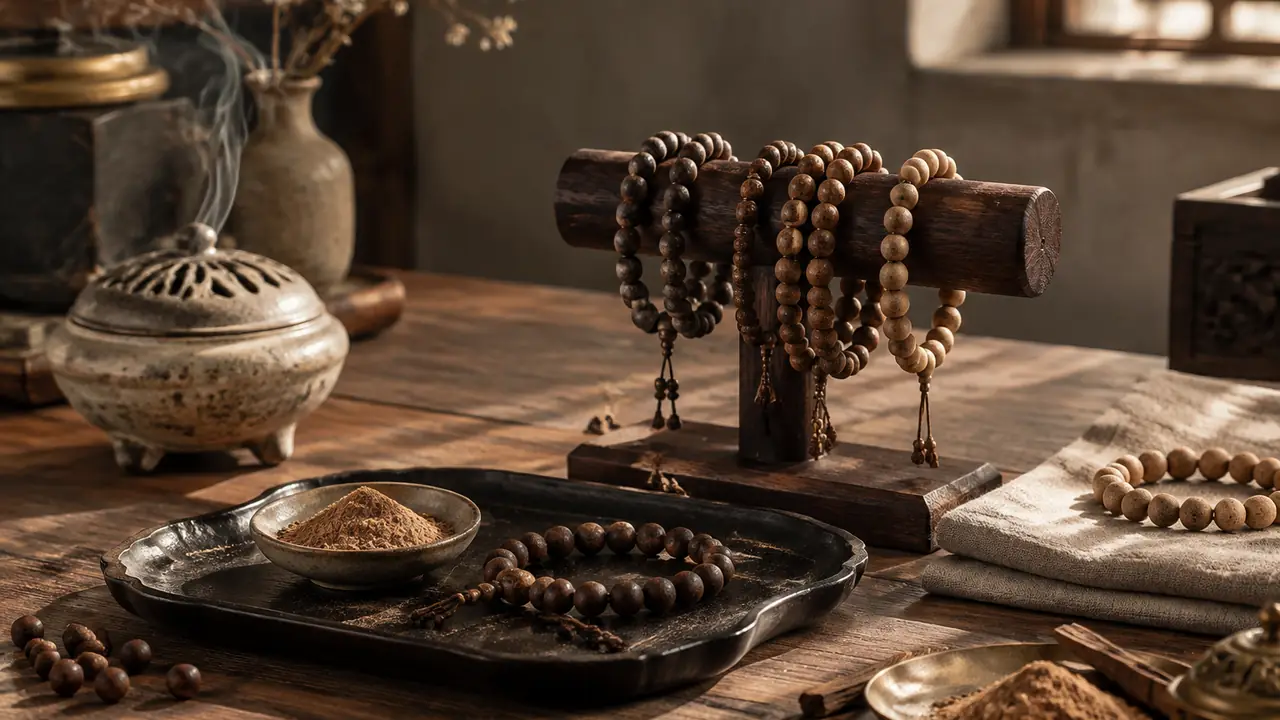
Where beads sit in a fragrance range
Most fragrance brands organize their line by moment: personal scent, home scent, gifting and travel. Incense beads add a fifth category that is closer to jewelry than to perfume. They sit on the wrist or in a bag, work through contact rather than projection, and have a longer, slower life than a sprayed scent. For a brand with a woody, resinous or incense-led perfume, a bracelet in the same family is a natural companion. For a brand built around citrus and florals, a fruit-and-wood bead or a lighter botanical blend can bridge the gap.
The point is extension, not replacement. A customer who owns the eau de parfum may buy the bracelet for travel, a second customer may buy the bracelet first and come to the perfume later, and a gift buyer may choose a set. The comparison with spray perfume is set out in incense beads vs perfume.
What the brand owns
A custom blended bead can be a proprietary formula in a way few accessories can. The brand specifies proportions of the main aromatic powders, any botanical accents, bead size, finish and packaging. The partner workshop supplies preparation and rolling skill, and the desk coordinates sample rounds. Over several rounds the brand arrives at a formula sheet that is documented and repeatable. That sheet is an asset: another brand cannot copy the scent by looking at a bead, and the brand can move the formula between workshops if it needs to.
| Decision | Brand controls | Workshop contributes |
|---|---|---|
| Scent direction | Brief, reference notes, named inspirations | Ingredient suggestions, trial blends |
| Formula sheet | Approval and ownership of proportions | Powder preparation, binder balance |
| Bead size and finish | Size, polish, leaf or none | Rolling, piercing, drying schedule |
| Packaging | Design, copy, materials | Fit, sealing, desiccant advice |
The process for a bespoke blend is on the custom blended incense page. Typical reference terms are about 500 pieces and up for a custom formula, with sample rounds included, confirmed in writing for each program.
Choosing a starting line
- Stock sandalwood. The lowest-risk start. It uses an established formula, a quicker sample and a lower minimum, typically 50 to 200 per design for ready lines.
- Branded stock. A stock formula in private-label packaging, typically about 300 to 1,000 pieces per design.
- Custom blend. A formula developed for the brand. It takes longer and costs more upfront, and it gives the most distinct product.
- Classical formula. A reconstruction of a historical recipe, such as the goose pear formula, which brings a ready story. See goose pear incense beads.
Many brands start with branded stock to learn how customers respond and move to a custom blend once the format has proved itself.
Claims and declarations
A fragrance brand has more to lose from a loose claim than most, because its customers read ingredient lists. For beads in the standard specification the declaration is short: aromatic wood and herb powders, nanmu bark powder as binder, honey, with no synthetic fragrance oil and no industrial glue, confirmed in writing per order. Because there is no fragrance compound, the allergen labeling that applies to sprays and candles may apply differently, but target-market rules should be checked, and the position is covered in compliance and certifications. Agarwood lines require CITES documentation per lot. Copy should describe the scent and materials; it should not promise relaxation, sleep or any bodily effect.
Presentation that fits a fragrance brand
Fragrance customers expect packaging as considered as the product. Beads are sensitive to humidity, so the pack needs three layers: an inner foil pouch or tin that seals in scent, a desiccant sachet, and an outer box that carries the brand. A card should name the scent family, the materials and the care: keep dry, store sealed, expect the scent to deepen over time. For online photography, shoot on neutral stone, linen or paper, and show the matte surface honestly; polished, glossy looks mislead and bring returns.
Brand teams should also prepare a short scent description for staff and customer service. Avoid inventing a technical vocabulary; plain words such as creamy, resinous, warm and sweet, tied to the formula sheet, are enough.
Pairing beads with the rest of the range
The strongest launches connect the bead to something the customer already knows. A candle or room scent with a sandalwood base can share its name and story with a bracelet of the same family, so the two reinforce each other on the shelf and online. A discovery set could include a bracelet, a small sachet of the same powder and a card, giving customers a way to try the scent in three forms. Seasonal editions are straightforward because the dough, cord and box can change while the core formula stays fixed. Keep the number of scents small at first; two well-explained formulas outsell six unexplained ones, and every extra formula adds a sample round, a retained reference and a stock line to manage.
Retail partners will ask for the same things a brand does: a clear ingredient line, a care card and a tester policy. Preparing a one-page trade sheet with the scent description, bead size, count, packaging dimensions and storage advice speeds up wholesale conversations and keeps every channel telling the same story.
A six-step sourcing path
- Write the brief: scent direction, reference products, bead size, format, packaging and target quantity.
- The desk shortlists partner workshops and proposes a formula sheet with a sample plan.
- Receive samples: stock samples typically 5 to 10 working days, new formulas 15 to 25 days with drying and aging.
- Evaluate on the wrist for a week, not on first opening; request adjustments and a retained reference bead.
- Approve packaging proofs together with the bead sample.
- Place the order. Regular batches run about 25 to 40 days and custom classical formulas 40 to 60 days, plus freight.
Reference ranges are collected on MOQ and lead time and are confirmed in writing for each program. Send your brief through the quote form to begin.
Common pitfalls
Four mistakes recur. The first is treating beads as a pure fragrance product and demanding strong projection; they are quiet by nature and should be sold as such. The second is changing the formula after the first lot without a new sample round, which makes the scent drift. The third is approving artwork late, which delays boxes and the whole shipment. The fourth is neglecting retained references: without a sealed bead from the approved sample, a brand cannot show a workshop what a good lot should smell like. A short discipline of documenting each approval prevents all four.