
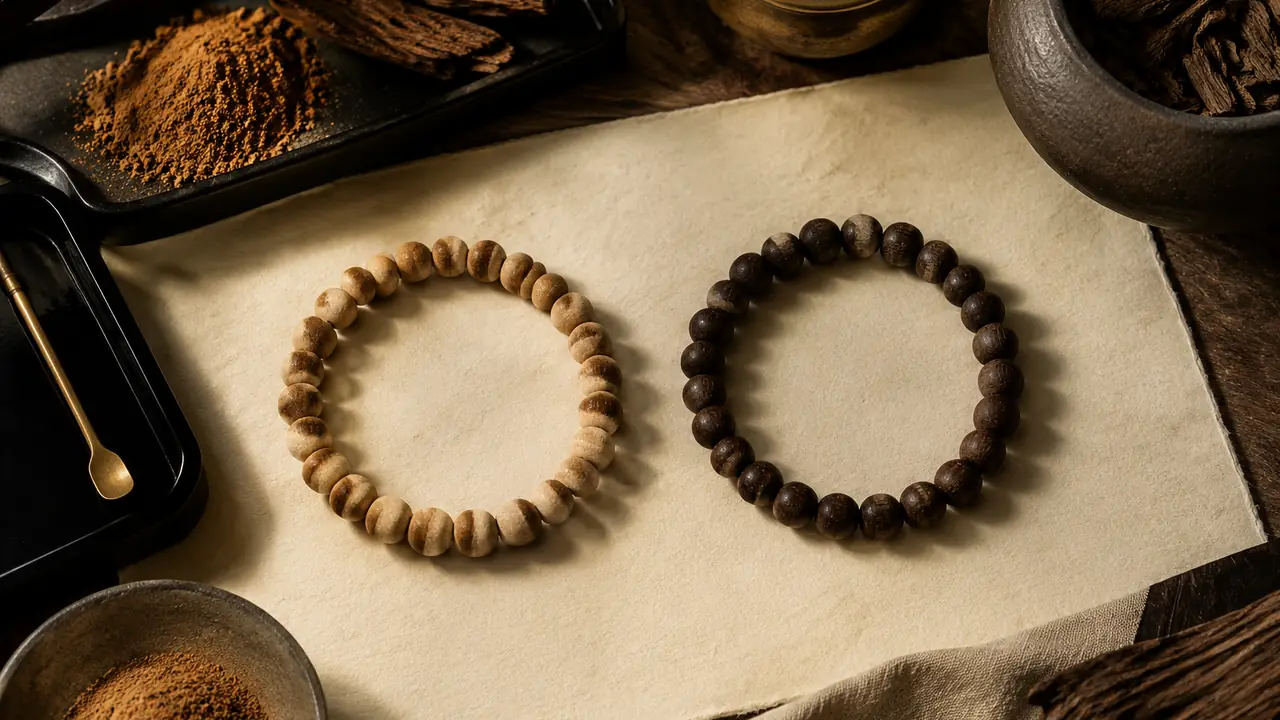
Two lines, one format
Both lines use the same construction: ground aromatic powder, nanmu bark binder and a little honey, rolled by hand, pierced, shade-dried and aged. Bead sizes, cord options and packaging are shared. What changes is the aromatic base. Sandalwood powder, from Santalum album with the origin stated per lot, gives a creamy, milky wood scent. Agarwood powder, from Aquilaria species, gives a resinous, deeper scent. Everything else in this comparison follows from that single difference. The scent chemistry itself is covered in the longer note on agarwood vs sandalwood beads; this page is about the stocking decision.
Side-by-side comparison
| Criterion | Sandalwood bracelet | Agarwood bracelet |
|---|---|---|
| Scent character | Creamy, milky wood, warm and soft | Resinous, deeper, sweet-woody with a darker base |
| Scent life | Years with proper storage; softens gently | Years with proper storage; the base note tends to stay longer |
| Weight and feel | Light, fine matte grain, pale to warm brown | Similar weight at the same size; darker tone |
| Documents needed | Origin stated per lot (plantation or legally sourced wood) | CITES export documents per lot, since Aquilaria is listed in Appendix II |
| Typical channel | Gift, general fragrance retail, e-commerce, yoga shops | Premium boutiques, incense specialists, repeat collectors |
| Relative cost factors | Moderate; driven by origin and powder grade | Higher; driven by resin content, source and paperwork time |
Where the real differences sit
Paperwork is the largest practical gap. Sandalwood needs an honest origin statement. Agarwood needs CITES permits that travel with the lot, and permit timing can set the shipping date. A first-time importer should be ready for that step before choosing agarwood. The background is in the agarwood guide and the sandalwood guide.
Customer expectation differs. Sandalwood is a familiar scent that most customers like on first smell. Agarwood is an acquired taste for some, and the customers who love it tend to know what they are buying. That makes sandalwood easier to explain at a counter and agarwood easier to sell to a repeat buyer who wants something more distinctive.
Cost shapes shelf position. Agarwood costs more for the same bead size, and the gap widens with resin content. Sandalwood spreads across a wider range depending on powder grade and origin. Neither line should be priced from a headline raw-material comparison, because handwork, drying and aging are a large share of the cost in both.
Risk profile of each first order
- Sandalwood first. Lower paperwork load, a scent that rarely gets rejected, easier to add a second size or a gift version. The risk is blending into a crowded shelf; a clear origin statement and a clean ingredient declaration are how it stands out.
- Agarwood first. A stronger story and a more distinct position. The risks are document timing, a smaller addressable audience at the start and a higher outlay per design. It suits buyers with an existing customer base that already buys incense.
How to decide
- If your customers are new to wearable incense, start with sandalwood in 8 mm. It is the lowest-friction entry.
- If your customers already buy incense or oud-style fragrance, start with agarwood or run both in a small sample pack.
- If your timeline is tight, choose sandalwood; agarwood adds a document step that should be planned early.
- If you can only afford one design in the first lot, choose the line whose documents you can explain to your customers.
- If you want a path to a premium tier, launch sandalwood first and add agarwood as the second SKU once the first sells.
A blended middle option
Agarwood lines often use sandalwood powder as a supporting material, so a bracelet can sit between the two. Such a blend softens the resin note and can lower the document burden only if the agarwood share is genuinely small; any agarwood content still brings the CITES question, so ask the workshop to state the share and the paperwork in writing. A blend is a good sample candidate when you cannot decide, since it lets customers react to both notes in one piece.
Presentation and positioning
The two lines also ask for different packaging language. A sandalwood bracelet can be presented with simple wording: a soft, creamy wood scent, hand-rolled, shade-dried and aged. That is easy to read on a card and does not need much explanation. An agarwood bracelet benefits from a slightly longer card that names the material, explains that the resin note develops with wear and states that export documents are held per lot. Buyers who sell through a boutique often find that the card does a good share of the selling for agarwood, while sandalwood sells from the first smell.
Color is a visual cue worth planning for. Sandalwood beads tend to be lighter and warmer, agarwood beads darker. If your shelf already carries dark wooden jewelry, sandalwood adds contrast; if it carries pale stone or pearl pieces, agarwood adds depth. Photograph both on the same background so customers see a clear step between the tiers rather than two near-identical strands.
What to ask the workshop for either line
- A formula sheet listing the aromatic powder, nanmu binder and honey by percentage.
- A written statement that no synthetic fragrance oil and no industrial glue are used in the standard specification.
- For sandalwood, the stated origin of the wood for the lot.
- For agarwood, the CITES documentation that applies to the lot and its expected timing.
- A retained reference strand from the approved sample, for comparing later production.
These five requests cost nothing to make and quickly separate prepared workshops from careless ones. They also give you the material for your own product page, which is more persuasive than generic copy.
Ordering notes
Whichever you choose, state the bead size, count, cord and packaging, plus the documents you need. Stock designs usually start at the typical reference range of 50 to 200 pieces per design, confirmed in writing for each program. Ranges and sample timing are on MOQ and lead time. When you are ready, send the brief through the quote form and the desk will shortlist partner workshops and return a formula sheet for each line.