
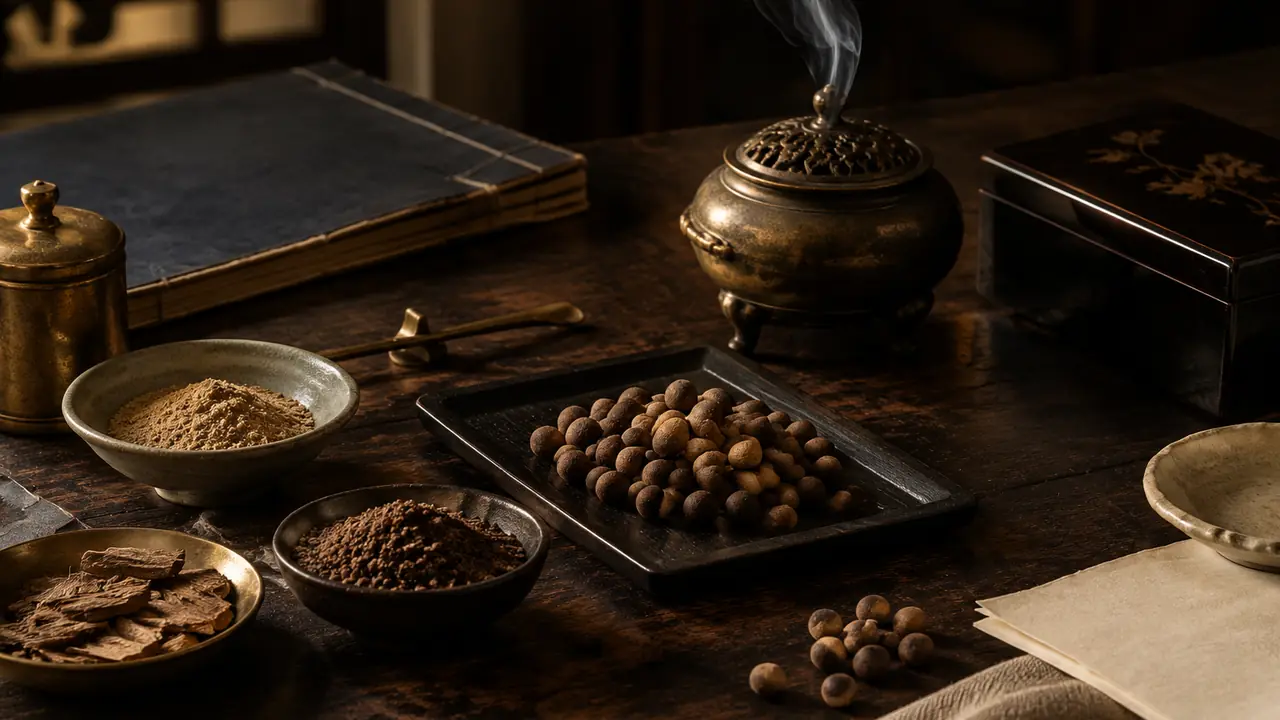
From ritual to household
Aromatic materials reached China early through ritual use and through trade, and by the Tang dynasty the market for fragrant woods and resins was well established, with imported goods arriving along both land and sea routes. What changed in the Tang and grew in the Song was the setting. Incense moved from altar and palace into the homes of officials and scholars, and from there into a wider urban public. The early literature reflects this, including anecdote collections such as Nanbu Yanhua Ji, which preserves stories about incense in courts and households and which the Ming compendium Xiang Sheng later quoted.
The Song period then produced a body of dedicated writing. Chen Shi Xiang Pu and Hong Chu's Xiang Pu are the best-known manuals: they gather formulas, describe materials and show incense as something to be studied as well as enjoyed. Their existence is itself evidence that incense had become a refined domestic art.
Where incense was used
| Setting | How incense appeared | Modern echo |
|---|---|---|
| The scholar's study | Burned during reading, writing and conversation; blends chosen for a clear, quiet scent | Study-style sets, incense tools and boxes |
| The bedchamber | Tent incense, burned inside curtained beds; the goose pear formula is the famous example | Pear and wood blends |
| Gatherings and tea | Part of a refined setting alongside tea, flowers and paintings | Tea-house and lifestyle retail |
| Gifts | Prepared blends and pastilles exchanged between friends and officials | Gift boxes and sachet sets |
| Carried scent | Sachets and small scented objects worn or carried | Incense beads, pendants, charms |
The Song household
The Song period is often described as the age in which incense joined tea, flower arranging and hanging pictures as a set of refined domestic arts. That description is a convenient summary used by later writers, and it is a fair reflection of the way the manuals present incense: as part of the setting of educated life. A household might keep a burner on the desk, a box of prepared pastilles, small tools to handle ash and charcoal, and a few blends for different occasions. Blends were named, often for the occasion or the place, and exchanged. Some were made at home from recipes in the manuals and some were bought.
The same period developed measured burning. The practice of marking time by burning a trail of incense in a patterned seal is recorded from this age, which shows how closely incense was woven into the rhythm of the day. It is a reminder that the culture was practical as well as aesthetic.
What was burned, and what was carried
Most of the evidence concerns burning: powders and pastilles on ash and charcoal, sticks and cones in later periods. Carried scent existed alongside it. Cloth sachets of dry aromatics were worn at the waist or kept in sleeves and chests, and small compounded pieces were carried. The wearable incense bead is a modern descendant of this carried tradition rather than an exact copy of any object, and it is more accurate to say so than to claim a Tang or Song bead. What carries over is the logic of the blend: a main wood, supporting aromatics, a softening element and time to settle. The craft side is covered in how incense beads are made.
Tools and vessels
Daily incense needed equipment, and the equipment shaped the culture. Burners of bronze, ceramic and stone, ash beds for even heat, small tools for shaping and lifting, and boxes for storing pastilles all belong to the period's vocabulary. Their descendants are the incense tools and boxes sold today, such as holders, tongs, spoons and lidded boxes, which sit in the incense goods and tools range. The link matters for retail: a customer who buys a bracelet for its history is often receptive to a simple set of tools that belongs to the same story, and a gift box that pairs the two reads as a coherent object. Keep the pairing modest, with plain materials and quiet finishes, to match the restrained taste the period is remembered for.
Materials in the daily life of the period
The materials of the Tang and Song household are the ones the manuals name. Agarwood and sandalwood served as the main woods, with resins, spices, flowers and fruit as supporting elements, and the animal materials musk and ambergris appear in many formulas as fixatives, a point covered in the four famous materials. Cost mattered then as now, and grades of the same wood were distinguished by scent and appearance. A modern buyer reads that history as context for grading, origin and documents; the practical guidance is in the agarwood guide and sandalwood guide.
Using the history in product copy
- Do name the sources: Chen Shi Xiang Pu, Hong Chu's Xiang Pu, Nanbu Yanhua Ji and Xiang Sheng.
- Do describe incense as part of the refined domestic setting of the period, in measured language.
- Do not claim that a product is an exact copy of a Tang or Song object.
- Do not attach health or mood outcomes to the historical use. Say traditionally associated with, and stop there.
- Do not invent anecdotes. If a story cannot be traced to a source, leave it out.
A short note of this kind on a card or insert gives a bracelet context without overreaching. It works well for tea houses, temple and retreat shops, and gift programs, where customers read the card. See solutions by audience for fit.
From history to a sourcing brief
- Choose the period or setting you want to reference: study, tent, tea or gift.
- Pick a matching blend direction: clear wood, sweet pear and wood, or herbal and spiced.
- Agree on the format that fits the story, such as a bracelet, a sachet set or an incense gift box.
- Write the card text with the sources named and the adaptations stated.
- Send the brief to the desk through the quote form and ask for a sample plan.
Reference minimums and timelines for formats like these are on MOQ and lead time, always confirmed in writing for each program. For the goose pear example of a tent blend, read goose pear tent incense.